
ICOM: Why Maximizing "Reach" is Killing Your Social Media Campaign
Competitive opinion maximization in social networks
The paper introduces ICOM (Iterative Competitive Opinion Maximization), a novel framework designed to maximize total user opinions in social networks under competitive settings. By utilizing a Competitive Linear Threshold (CLT) diffusion model, ICOM effectively balances user sentiment—allowing for negative opinions—and opponent strategies to outperform traditional influence maximization methods.
In the world of viral marketing, we've long been obsessed with Influence Maximization (IM). The logic was simple: find the most "connected" people, give them free samples, and watch the word-of-mouth spread. But what if your most connected user actually hates your product? Or what if your competitor gets to them first?
The paper Competitive Opinion Maximization in Social Networks (presented at ASONAM '19) argues that mainstream IM is fundamentally broken for the real world. Under the weight of competition and diverse user sentiments, traditional strategies can actually lead to negative brand equity.
The TL;DR: From "How Many" to "How Much Love"
The authors shift the goalpost from Influence (how many people see it) to Opinion (the sum of user ratings). Crucially, they address the "First-Mover Disadvantage" by introducing ICOM (Iterative Competitive Opinion Maximization), an algorithm that treats social influence like a chess game rather than a solo race.
The "Blind Spot" of Modern Marketing
Most SOTA (State-of-the-Art) influence models suffer from two fatal assumptions:
- Uniform Value: They treat every activated user as a "+1". In reality, a "1/5 star" review is a "-1" that hurts your brand.
- Solitary Propagation: They assume you are the only one in the network. In the real world, if Disney and Netflix release a horror movie on the same weekend, they are fighting for the same finite space in a user's schedule.
Methodology: The ICOM Strategy
The core of the paper is the Competitive Linear Threshold (CLT) model. In this model, once a user "buys into" a competitor’s product, they are locked out—they won't adopt a similar product from you.
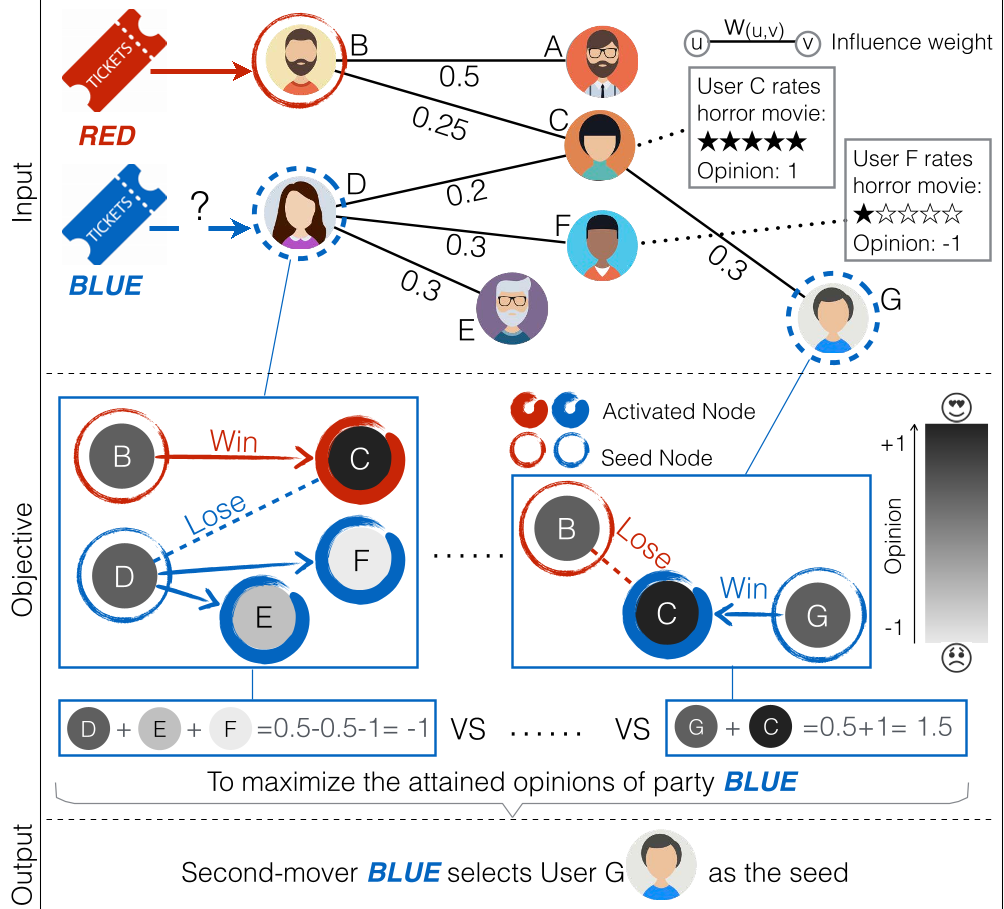
How ICOM Works:
- Opinion Awareness: It uses matrix factorization (collaborative filtering) to predict how every user in the network would rate a product before they even see it.
- Iterative Inference: Instead of guessing what the competitor will do, ICOM uses a "strategic response" loop. It simulates a competitor's move, calculates the optimal counter-move, and repeats this (usually for ~5 rounds) until the seed set stabilizes.
- Handling Negative Utility: Unlike greedy IM, ICOM will actively avoid high-degree nodes if those nodes are predicted to have negative opinions of the product category.
Experimental Battleground
The researchers tested ICOM against 5 baselines on datasets like Flixster and CiaoDVD.
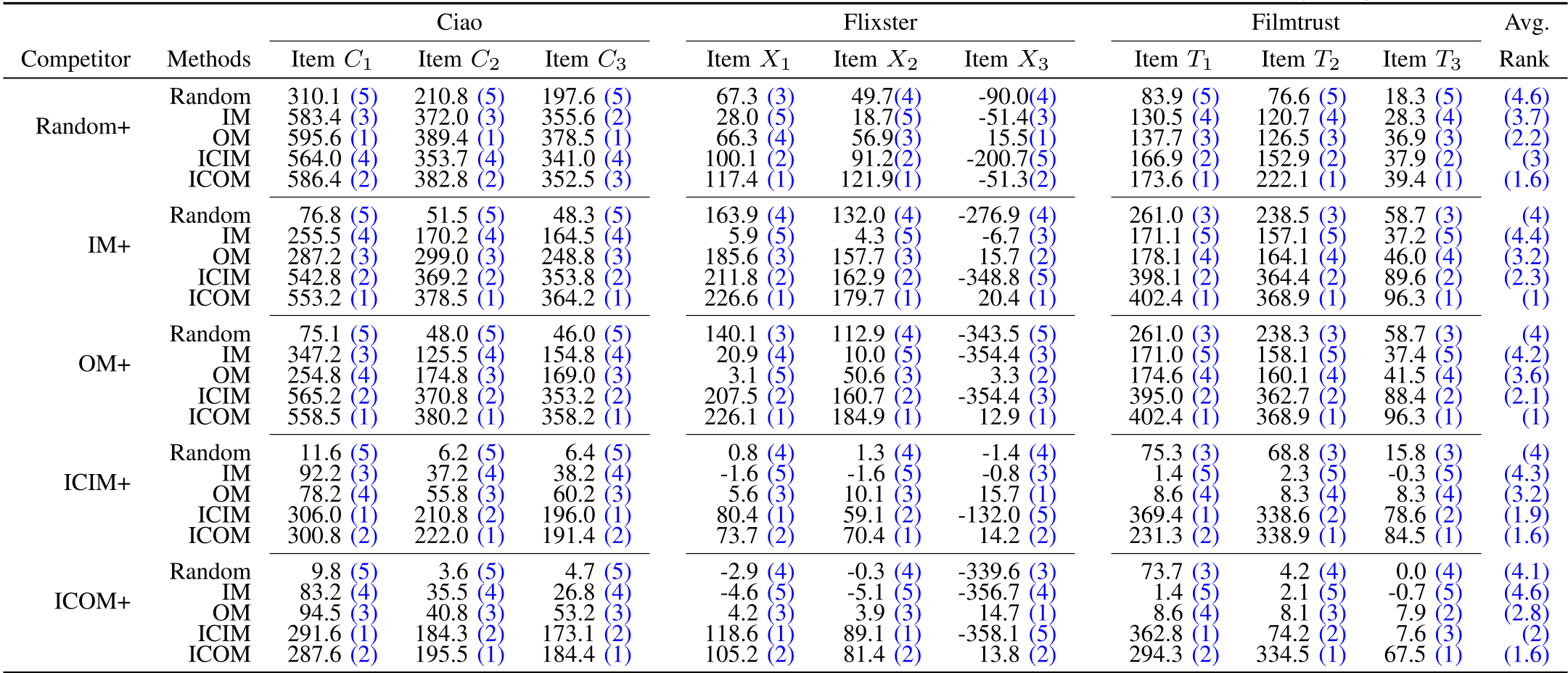
Key Findings:
- IM Fails in Competitive Settings: Standard IM often ranked near the bottom because it chased "big" nodes that were either already taken by competitors or held negative views.
- Efficiency: Even though the problem is #P-hard (computationally "nightmarish"), ICOM converges in just a few iterations, making it viable for networks with thousands of nodes.
- The Sentiment Advantage: By targeting "niche fans" who influence other fans, ICOM secured higher total ratings even with a smaller total "reach."
Critical Insight: The Future of Competitive Influence
The brilliance of this work lies in its acknowledgment that rational competitors exist. If you act as if you are alone, you will lose the most valuable nodes to the "Second-Mover" who can see your seeds and block your path.
However, the model does have limitations. It assumes the competitor’s strategy is somewhat predictable (e.g., they also use a greedy-based model). In an adversarial setting where a competitor uses non-rational or "chaos" strategies, the iterative inference might need more robustness.
Conclusion
ICOM teaches us that in a crowded market, your best influencers aren't just the popular ones—they are the ones who actually like you and haven't talked to your competitor yet. For data scientists and marketers, this is a clarion call to integrate Sentiment Analysis and Game Theory directly into the heart of influence algorithms.