
The Physics of Virality: Measuring Complaint Influence in the Social Epoch
Research on the measure method of complaint theme influence on online social network
The paper introduces a comprehensive model to measure the influence of consumer complaint themes on Online Social Networks (OSNs). By integrating "Entropy Weight Theory" with a three-dimensional evaluation system—Text Quality, Transmission Timeliness, and User Interaction—the authors provide an empirical framework to quantify how individual grievances scale into influential group events.
TL;DR
In the digital age, a single complaint is no longer a private whisper; it is a potential wildfire. This research introduces a mathematical framework using Entropy Weight Models to quantify the influence of complaint themes on social networks. By analyzing data from Sina Weibo, the study reveals that the quality of the author and the speed of interaction are the true "force multipliers" of online outrage.
Context: Beyond the Follower Count
For years, brand managers looked at follower counts to judge risk. However, this paper argues that the theme itself carries a trajectory. The authors position this work as a transition from User-centric influence (who is talking) to Theme-centric influence (what is spreading and how fast). It bridge the gap between informatics (Shannon Entropy) and consumer psychology to provide a real-time decision-making tool.
The "Why": Why Some Complaints Explode
The authors identify a core gap: prior work (like PageRank or HITS adaptations) focuses on the "static nodes" of a network. But online complaints are dynamic—they aggregate, mutate, and resonate. The research insight is that influence is a composite of three vectors:
- Quality: Is the complaint substantive and from a credible source?
- Timeliness: Is it spreading faster than average?
- Interaction: Is it drawing in "high-rank" users who act as secondary detonators?
Methodology: The Entropy-Weight Framework
The core of the paper is a three-dimensional index system. Unlike subjective scoring, the authors use an Entropy Model to calculate weights. This ensures that the most "disordered" or distinguishing variables are given higher priority.
1. Model Architecture
The model splits indicators into Static (the initial post properties) and Dynamic (how the network reacts over time).

2. The Dynamic Influence Formula
The influence of a theme at time is calculated not just as a snapshot, but as a cumulative function of interaction growth. The formula considers the quality of new texts added to the theme plus the "continued ripples" of previous texts.
Empirical Evidence: The Micro-blog Case Study
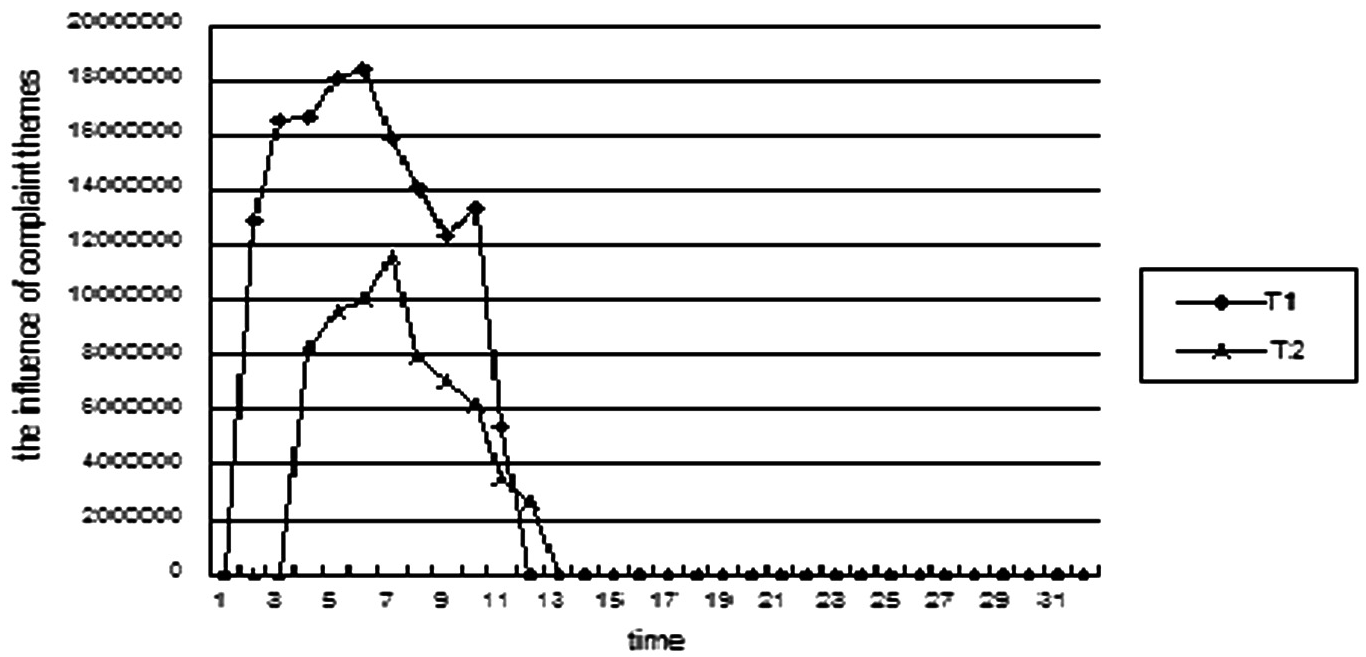
The researchers analyzed two massive events on Sina Weibo: the "Plasticizer" scandal and the "Lei Zhengfu" scandal.
Key Findings from Data:
- Opinion Leaders Matter: The "Complainer’s Rank" (weighting ~0.64 in the quality index) is the single biggest predictor of whether a post will gain initial traction.
- The Interaction Loop: Hits and effective replies contribute 50% of the total influence weight, suggesting that the "audience" is just as responsible for influence as the "author."
- Rapid Decay: The influence curves (Fig. 1) show an aggressive spike followed by a tail, providing a "Golden Window" for corporate response.
Critical Insight & Tactical Takeaways
The study concludes that long-tail participation (the masses) is necessary for a theme to gain "discourse power," but opinion leaders are the catalysts.
For Practitioners:
- Don't just count mentions: Use Entropy-weighting to identify which complaints are actually gaining "Influence Velocity."
- Prioritize the High-Rankers: A complaint interacted with by a Level 10+ user on Weibo is mathematically more dangerous than 100 complaints from Level 1 users.
- Listen First: The "Peak Influence" arrives quickly (often within days). If your listening mechanism has a 48-hour lag, the crisis is already over your head.
Limitations & Future Horizon
While the entropy model is robust, it treats all "keywords" of a theme with similar emotional weight. Future research could integrate Sentiment Analysis (NLP) to differentiate between "constructive criticism" and "malicious smear," and expand the model to cross-platform environments where a complaint might jump from Weibo to WeChat or TikTok.