
CTIR: Refining Travel Recommendations via Behavioral Social Pruning
Complementing Travel Itinerary Recommendation Using Location-Based Social Networks
2019-08-01
Summary
Problem
Method
Results
Takeaways
Abstract
This paper introduces a Travel Itinerary Recommendation (CTIR) framework that leverages Location-Based Social Networks (LBSN) to predict a traveler's preferred destination. By combining X-means clustering on temporal check-in patterns with heterogeneous graph embedding (LINE-based), the system achieves superior destination prediction accuracy by filtering out irrelevant social ties.
## TL;DR
Researchers from the Communication University of China have developed a new framework (CTIR) that predicts your "dream destination" even if you're just browsing. By analyzing your check-in habits on social media and matching you with friends who share similar temporal routines, the system filters out noisy social data to provide highly accurate geographic recommendations.
## The Problem: The "Noisy Friend" Dilemma
Most modern recommendation systems leverage your social graph: if your friend likes a ski resort, you might too. However, this ignores a fundamental truth—some friends have entirely different lifestyles. A "night owl" who visits bars won't necessarily enjoy the early-morning hiking trails recommended by a "morning person" friend.
Prior work like **Collective Geographical Embedding (CGE)** suffers from this noise. They treat all social ties as equal indicators of interest, leading to diluted features and sub-optimal predictions.
## Methodology: Filtering Social Ties with Temporal Intelligence
The authors' core "Insight" is that **temporal check-in patterns** (when you travel, not just where) are proxies for user preference.
### 1. High-Dimensional Temporal Modeling
The system models users using a 36-dimensional feature vector:
* **24 Dimensions**: Hourly check-in frequency.
* **12 Dimensions**: Monthly check-in frequency.
To make this manageable, they use **t-SNE** (t-Distributed Stochastic Neighbor Embedding) to compress these patterns into a 2D space, followed by **X-means** clustering to find natural groupings of similar types of travelers.
### 2. The Pruned Heterogeneous Graph
The system builds a complex graph consisting of three sub-graphs:
* **User-User (Social)**
* **User-Location (Check-in history)**
* **Location-Location (Physical proximity)**
**The Innovation**: Instead of embedding the whole graph, they **prune** it. If User A and User B are friends but belong to different temporal clusters, their connection is deleted. This ensures the graph embedding algorithm (LINE) only learns from social connections that actually matter.
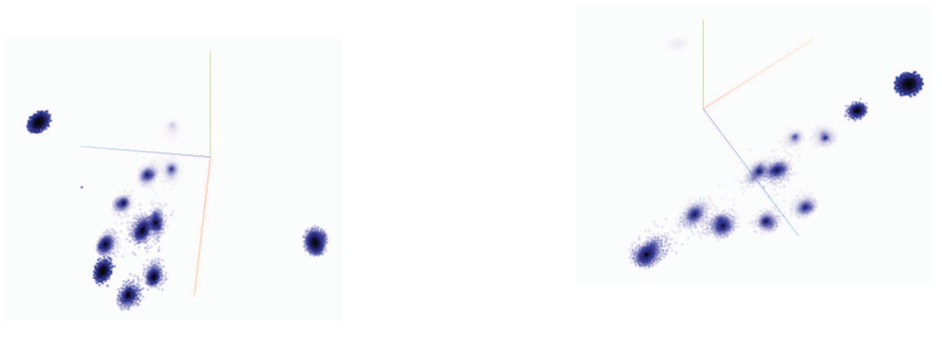
*Fig 1: Visualization of user clustering based on temporal features, showing distinct behavioral identities.*
## Experimental Results: Precision Over Distance
Using the **BrightKite dataset** (over 58k users and 4.4M location connections), the authors tested their framework against the CGE baseline.
* **Mean Distance Error**: CTIR reduced the average error by **32km** compared to the baseline.
* **Accuracy @ 140km**: CTIR achieved a **69.47%** accuracy, demonstrating that the behavioral pruning effectively removed the "local noise" of irrelevant social suggestions.
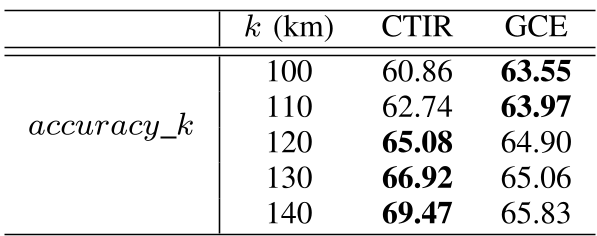
*Table 1: Accuracy comparison between CTIR and CGE across different distance thresholds.*
## Critical Analysis & Conclusion
The brilliance of this work lies in its **Inductive Bias**: travel preference is as much about *rhythm* as it is about *location*. By using t-SNE and X-means as a pre-processing filter for the graph embedding, the authors significantly reduce computational overhead (by pruning edges) while simultaneously increasing recommendation quality.
**Limitations**: The study uses the BrightKite dataset which doesn't explicitly distinguish "home" from "vacation." This means daily commutes might still bias the results. The authors suggest that "inferring" a user's home location to prune short-distance daily routines is the next logical step to focus specifically on long-distance holiday planning.
**Future Outlook**: This methodology of "clustering-before-embedding" could be applied to broader domains like E-commerce or Music streaming, where temporal usage patterns (e.g., listening to Lo-Fi while working vs. EDM while partying) are just as important as the social graph.