
Beyond the Grid: Understanding Ubicomp as a Complex Adaptive Socio-Technical System
Complex Adaptive Socio-Technical Systems Theory View of Ubiquitous Computing Systems Research
This paper proposes a theoretical framework viewing Ubiquitous Computing (Ubicomp) systems as Complex Adaptive Socio-Technical Systems (CASTS). It introduces the "SmartBody" concept as a building block for Global Ubiquitous Computing Environments (GUCE) and demonstrates through comparative analysis that Agent-Based Modeling (ABM) is the most effective methodology for capturing the emergent and evolutionary behaviors of such systems.
TL;DR
As we transition from isolated smart devices to a Global Ubiquitous Computing Environment (GUCE), traditional modeling fails. This paper argues that we must treat Ubicomp systems as Complex Adaptive Socio-Technical Systems (CASTS). By comparing various modeling paradigms, the authors conclude that Agent-Based Modeling (ABM) and the "agentification" of objects into SmartBodies are the only ways to capture the emergent complexity of the future smart world.
The Complexity Crisis in Ubicomp
Ubiquitous Computing (Ubicomp) has evolved beyond Mark Weiser’s original vision. We are now entering an era of "hyper-ubiquitous" environments where the physical, digital, and social worlds are inextricably linked. However, the field faces a significant bottleneck: Complexity.
Most current research focuses on the "what" (sensing, connectivity) rather than the "how" (high-level system behavior). The authors argue that existing engineering frameworks cannot handle systems that are both Socio-Technical (involving human-actor networks) and Complex Adaptive (evolving through local interactions).
The CASTS Framework: Micro and Macro Perspectives
The authors break down the complexity of Ubicomp into two distinct layers of characteristics:
1. Micro-Level (The Building Blocks)
- Numerousness & Heterogeneity: Thousands of devices from different manufacturers.
- Local Interactions: Objects communicate in their immediate vicinity without a central controller.
- Adaptiveness: A smart air conditioner adjusting its behavior based not just on data, but on its history of interactions with its environment.
2. Macro-Level (The Emergent System)
- Self-Organization: System-level order arises spontaneously from local rules.
- Path-Dependency: Current system states are dictated by their historical trajectory, not just current inputs.
- Co-evolution: Users and technical systems change each other over time.
Battle of the Models: SDM vs. DEM vs. ABM
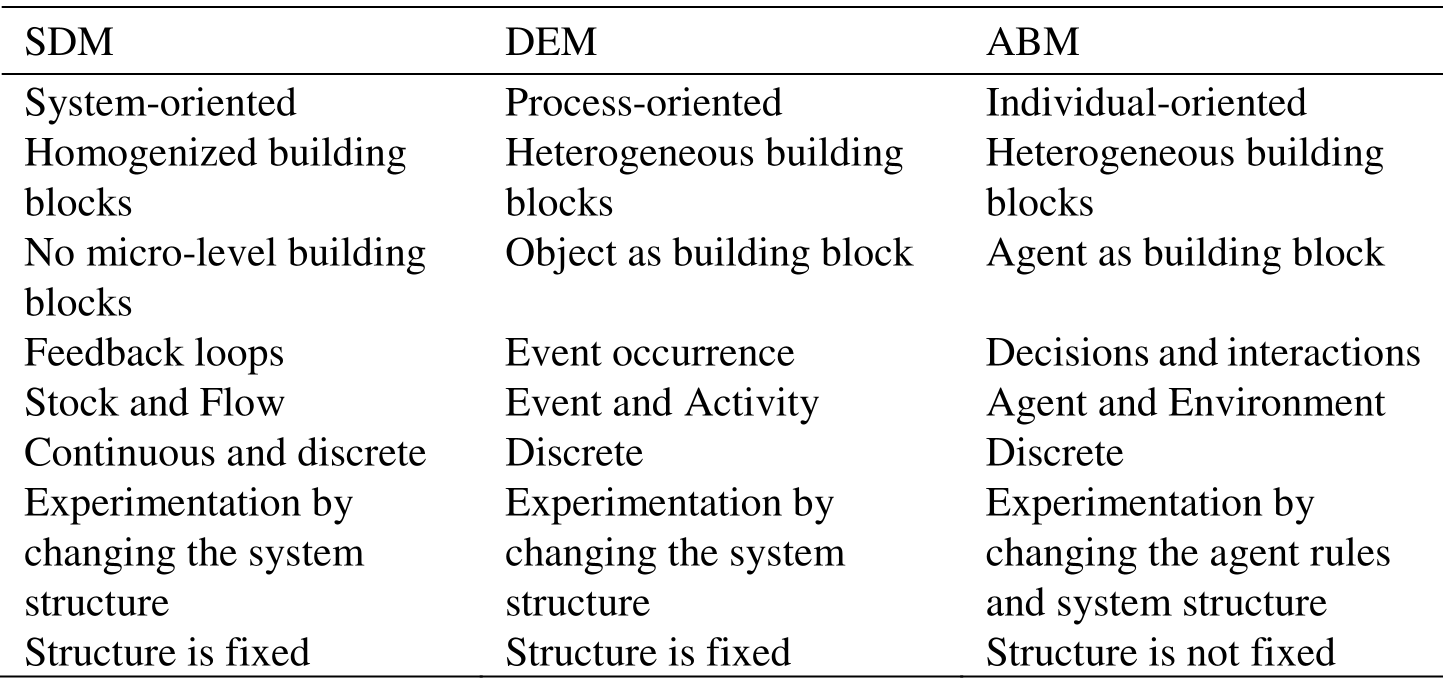
The core of the paper is a rigorous comparison of three modeling methodologies to see which can actually handle a CASTS environment.
Why SDM and DEM Fall Short
- System Dynamics Modeling (SDM): It uses a top-down, "aggregate" view. It treats populations as averages and assumes a fixed structure. It cannot show emergence because the macro-behavior is pre-calculated by the modeler.
- Discrete Event Modeling (DEM): While better at handling individual entities, it views them as "passive" objects triggered by a clock. It struggles to model proactive, intelligent adaptation.
The Winner: Agent-Based Modeling (ABM)
ABM is the only approach that supports bottom-up emergence. By treating every "SmartBody" as an autonomous agent with its own logic and memory, the structure of the system becomes dynamic. The "process" is not fixed; it emerges from the agents' decisions.
The SmartBody: A New Primitive
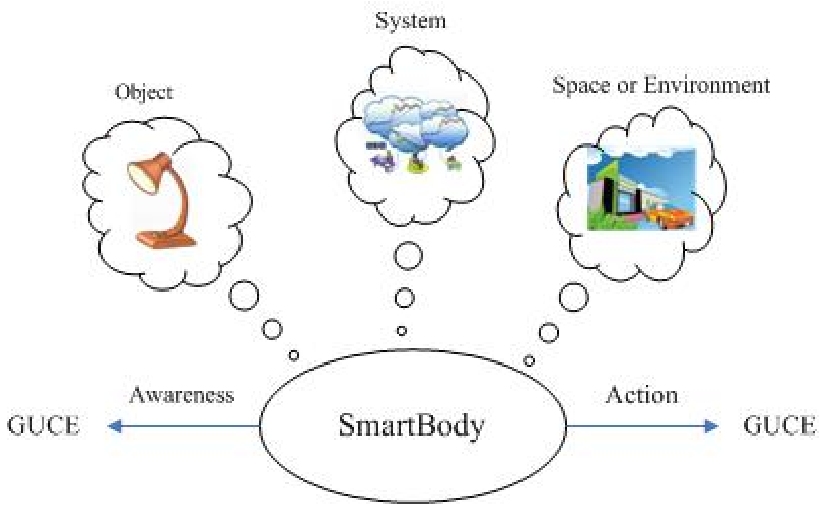
The authors propose the SmartBody as the fundamental building block of the GUCE. A SmartBody is not just a sensor; it is the "agentification" of an everyday object. This facilitates:
- Bottom-up Construction: Build complex systems incrementally by adding agents.
- Integration: Merging the physical world and information world at the "block level."
Critical Insight & Conclusion
This paper shifts the focus from connectivity to ontology. By defining Ubicomp through the lens of Complex Adaptive Systems, the authors provide a roadmap for handling the "chaos" of billion-device networks.
Limitations: While the theory is robust, the paper remains largely conceptual. The transition from a theory of agents to a standardized software protocol for "SmartBodies" remains the next major hurdle for the research community.
Future Work: The authors plan to move from theory to practice, implementing a real-world experimental system based on these agent-based SmartBodies. For researchers in IoT and Distributed Systems, this CASTS perspective is a vital reminder that in a smart world, the "whole" is always significantly different from the sum of its parts.