
Beyond First-Order Connectivity: 2cut and Pcut for Complex Social Network Analysis
Complex Interactions in Social and Event Network Analysis
The paper introduces two novel graph segmentation algorithms, 2cut and Pcut, designed to identify higher-order interactions in social and event networks. These methods extend classical spectral clustering by addressing the limitations of Min Cut and Normalized Cut in complex, sparse datasets like terrorist communication networks.
TL;DR
Analyzing modern adversarial networks (like terrorist cells) requires more than just identifying "who talks to whom." This paper introduces 2cut and Pcut, two graph segmentation algorithms that move beyond first-order effects to capture high-order interactions. By optimizing for sub-graph balance and minimizing secondary redundant cuts, these methods provide military analysts with a much clearer picture of network structures than traditional Min Cut methods.
The Problem: The "Outlier Trap" in Graph Cutting
In the realm of Social Network Analysis (SNA), the most common task is segmentation—breaking a large, messy cloud of interactions into distinct, meaningful groups.
The classic Min Cut approach has a fatal flaw: it is biased toward isolating outlier nodes. If a single node has a weak connection to the rest of the graph, the algorithm will "cut" that node first because it results in the lowest mathematical cost. In a military context, this is useless; an analyst doesn't want to see 100 separate "groups" of single individuals; they want to see the two or three major factions within a larger organization.
Current improvements like Normalized Cut (Ncut) and RatioCut try to fix this by weighting the cut by the size of the sets, but they still face issues with iterative partitioning where secondary effects are ignored, leading to fragmented results.
Methodology: Engineering a Better Cut
1. The 2cut Approach: Preventing Redundant Segments
The authors propose 2cut to solve the "iterative cut" problem. Often, a first cut removes one outlier, and a second cut removes another outlier right next to it.
The Intuition: Instead of looking at one cut in isolation, 2cut optimizes for a cut that makes further internal cutting difficult. It looks for a primary partition ( and ) such that the internal structures of and are robust.
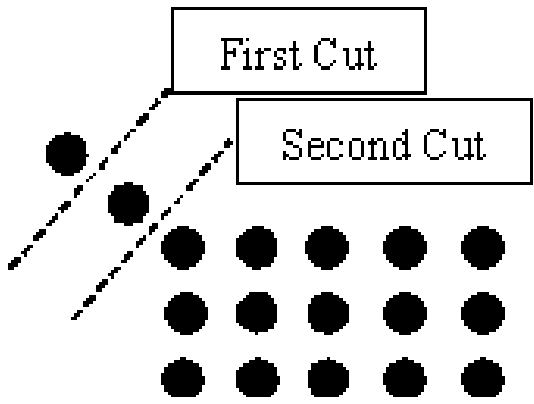 Figure 1: Visualizing why standard iterative cuts fail by isolating neighbors one by one instead of grouping them.
2. The Pcut Approach: Post-Cut Balancing
The second innovation, Pcut, focuses on the quality of the resulting sub-graphs. Most algorithms only care about the cost of the "knife" passing through the edges. Pcut, however, looks at the "density" of the remaining groups.
The mathematical formulation:
By adding the term to the standard Laplacian quadratic form (), the algorithm is forced to find a solution where the number of nodes and their total weights are balanced across the partition.
Experimental Results: Real-World Adversarial Data
The authors tested these algorithms on the World Incident Tracking System (WITS) database, specifically looking at events in Iraq from 2003-2009.
- Effectiveness: While Min Cut produced "uninterpretable" tiny clusters, Pcut successfully bisected networks in a way that identified organizational divides.
- Strategic Value: In terrorist network analysis, Pcut was found to be the most "fruitful" because it identifies the specific cuts that maximize the disruption of communication efficiency.
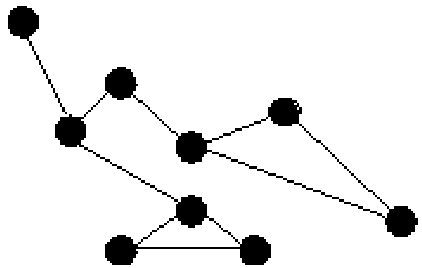 Figure 2: A weighted undirected graph representation used as the foundation for the 2cut and Pcut analysis.
Critical Analysis & Takeaways
The core contribution of this work is the shift from Global Optimization (lowering the cut cost) to Structural Realism (ensuring the resulting pieces are meaningful).
Limitations:
- The paper notes that these problems are often NP-hard, and while spectral relaxations are used, the computational cost on extremely massive graphs (millions of nodes) remains a challenge.
- The specific Iraq dataset is "event-based," meaning the nodes are often location-event combinations. Translating this directly to pure social messaging platforms might require different similarity functions.
Future Outlook: The integration of Tensor Decomposition (from the authors' previous work) with these new graph cuts suggests a future where we can analyze "Network Physics"—how nodes move and interact across time, space, and intent simultaneously.