
The Computational Limits of Privacy: Complexity of Social Network Anonymization
Complexity of social network anonymization
This paper provides a comprehensive complexity analysis of various k-anonymization problems in social network graphs, focusing on edge-labeled and bipartite structures. It introduces the "Table Graph" framework to prove that most structural anonymization techniques (e.g., k-neighborhood, k-symmetry) are NP-complete for k ≥ 3, while identifying specific cases like unlabeled bipartite graphs that remain tractable.
TL;DR
Releasing social network data safely is a double-edged sword: you want to preserve utility while masking identities. This paper provides the mathematical "reality check" for this field, proving that most sophisticated ways to hide identities in labeled graphs are NP-complete (too hard for perfect solutions) for , but surprisingly tractable for specific bipartite structures (like those in consumer or medical databases).
Background: Beyond Naive Anonymization
Simply removing names from a social network dataset isn't enough. Adversaries can use "structural fingerprints"—like the number of friends a person has (degree) or the specific types of relationships (edge labels)—to re-identify individuals. To solve this, researchers use k-anonymity: ensuring every person in the graph is indistinguishable from at least others.
The billion-dollar question: Can we find the minimum number of edges to add to achieve this state? If the problem is NP-hard, we are stuck with "good enough" heuristics. If it's in P, we can reach mathematical perfection efficiently.
Deep Dive into the Problem: The Complexity Landscape
The authors categorize the problem into several dimensions: labels (labeled vs. unlabeled) and structure (general vs. bipartite).
1. The "Table Graph" Framework (The Hardness Proof)
To prove that anonymizing graphs is hard, the authors introduce a clever bridge called a Table Graph. By showing that a standard database table can be perfectly represented as a specific type of edge-labeled graph, they prove that the well-known difficulty of anonymizing tables (NP-hardness) carries over to graphs.
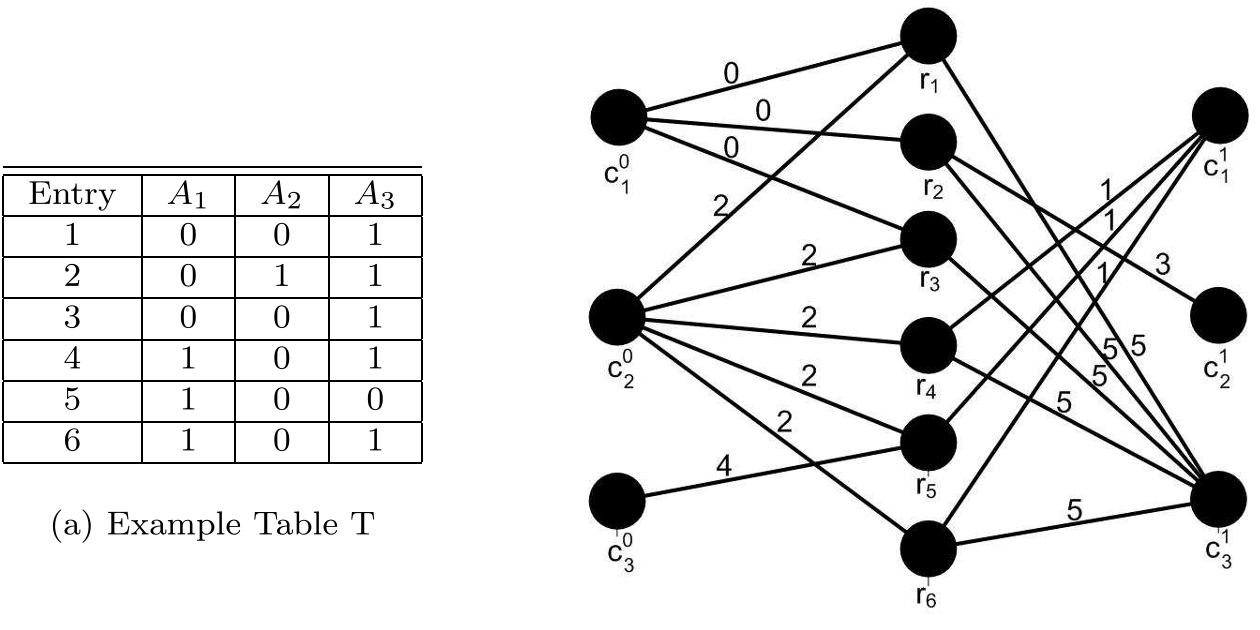 Figure 1: Encoding a binary table into a bipartite graph. This mapping allows the authors to prove that if you can solve the graph problem efficiently, you could solve the NP-hard table problem.
2. Bipartite Graphs: A Ray of Hope
Bipartite graphs (where nodes represent two distinct categories, like Patients and Drugs) are common in real-world privacy scenarios. The paper finds:
- Unlabeled Bipartite Graphs: Always solvable in polynomial time ().
- Labeled Bipartite Graphs: Solvable for using complex hypergraph matching, but becomes NP-complete once you require .
Methodology: How to Solve the "Easy" Cases
For the solvable cases (unlabeled bipartite graphs), the authors use a two-step process:
- Degree Anonymization: Use Dynamic Programming to find the targets. Given a sorted sequence of degrees, the algorithm calculates the cheapest way to group them into clusters of size .
- Graph Construction: Add edges from the "left side" of the bipartition to the "right side" until everyone hits their target degree. Because it's bipartite, adding an edge for one person doesn't accidentally change the degree of another person we are trying to anonymize on the same side.
Attribute Disclosure and t-Closeness
Even if your identity is hidden (you are 1 of 10 people in a group), if all 10 people in that group have "Cancer" as an attribute, your privacy is still leaked. This is Attribute Disclosure.
The authors adapt t-closeness to graphs, requiring that the distribution of sensitive attributes in any anonymous group must be close to the overall population distribution. They prove that achieving t-closeness while maintaining k-anonymity is also NP-complete, reinforcing that "perfect" privacy is a massive computational challenge.
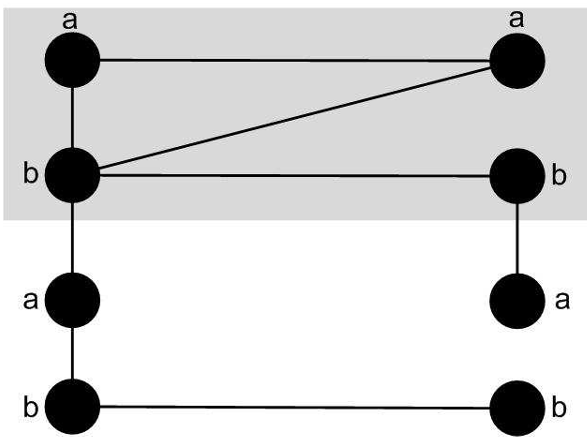 Figure 2: (a) Original graph, (b) Structural anonymity that fails attribute privacy, (c) A t-close graph that protects both.
Critical Insight & Conclusion
This paper is a cornerstone for theoretical privacy because it maps out the "No-Fly Zones" for algorithm designers.
- The Hard Truth: If you are working with general edge-labeled social networks (like Facebook or LinkedIn data), don't waste time looking for an optimal anonymization algorithm for . Use heuristics.
- The Opportunity: If you are working with Bipartite datasets (Netflix ratings, medical prescriptions), you can use the authors' DP approach to achieve provably optimal privacy with minimal data distortion.
Ultimately, the work highlights that as we add more "features" to our data (labels, neighborhood info, symmetry), the computational cost of protecting that data grows exponentially.