
Beyond Node Counts: Why Structural Diversity is the Secret Sauce of Social Diffusion
17337_A Component-Based Diffusion Model With Structural Diversity for Social Networks.
The paper proposes a novel Component-Based Independent Cascade (COMP) model for social network diffusion analysis. By shifting the unit of influence from individual nodes to community-based "components," and incorporating a Dynamic Structural Diversity measure, the model achieves significantly higher accuracy in predicting information cascades on real-world datasets like MemeTracker.
TL;DR
Most social diffusion models (like the classic Independent Cascade) treat every friend's influence as a unique, independent signal. This paper argues that's wrong because friends in the same social circle are redundant. By grouping neighbors into "components" and measuring their Structural Diversity, the authors created a model that is both more accurate and computationally efficient at predicting how information spreads.
The "Redundancy" Problem in Social Networks
Imagine you hear a rumor from three different colleagues who all work in the same small office. Now imagine hearing that same rumor from a colleague, your high school best friend, and your yoga instructor. In which scenario are you more likely to believe the news is "big"?
Standard models like the Independent Cascade (IC) often fail because they treat these two scenarios as identical—three sources are three sources. However, social science tells us that the first scenario contains high redundancy. This paper addresses this "structural hole" theory by proposing that it’s not the number of friends that matters, but the number of non-redundant groups (components) that pressure you to act.
Methodology: Components and Effective Size
The authors transform the diffusion process from a node-to-node interaction into a component-to-node interaction.
1. Component-Based Influence
Instead of calculating the probability of activation based on individual nodes, the model detects communities among a node's parents. A node is influenced by its parent components . Within these components, information is assumed to be shared and thus redundant.
2. Dynamic Structural Diversity
The core innovation is the use of Effective Size. A component is more influential if its activated members are sparsely connected (high structural diversity). The authors move beyond static measures by introducing Dynamic Effective Size, which updates the "novelty" of a component in real-time as different members within that group become active.
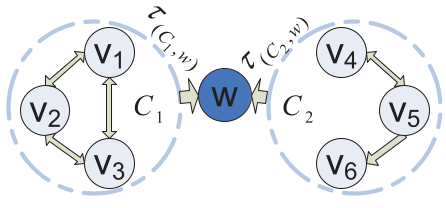 Figure 1: Transformation from individual node parents (a) to grouped parent components (b).
3. The Power of Decay
Information has a "shelf-life." The model incorporates an exponential decay factor , ensuring that "stale" activations within a component have less influence on the target node than fresh ones.
Results: Better Accuracy, Faster Inference
The authors tested their model against the massive MemeTracker dataset (9 months of news and blog data).
- Perplexity Gains: The component-based model with decay (COMP-DK) achieved a perplexity of ~13.3, a stark improvement over the standard ICM benchmark (~18.6).
- Efficiency: While calculating structural diversity adds some preprocessing overhead, the overall Expectation-Maximization (EM) algorithm converges much faster because treating neighbors as components significantly reduces the number of parameters the model needs to learn.
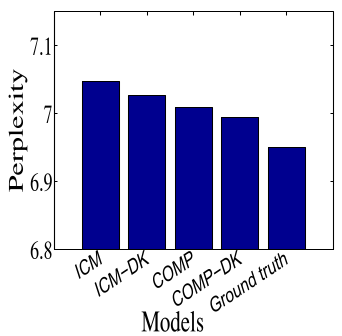 Figure 2: Performance comparison on the MemeTracker dataset. Lower perplexity indicates a better fit.
Critical Insight & Takeaways
The brilliance of this paper lies in its Inductive Bias. By baking the sociological reality of "redundancy" into the mathematical framework of the IC model, the authors created a system that doesn't just "overfit" to the training data but captures the underlying physics of human social behavior.
Key Takeaways for Practitioners:
- Stop counting, start grouping: If you are building recommendation engines or influence trackers, look at the connectivity between nodes to find redundancy.
- Diversity > Volume: A few sources from diverse backgrounds are more predictive of a "trend" than many sources from a single echo chamber.
- Dynamics Matter: Static community detection is a good start, but tracking how a community "unfolds" over time (Dynamic Effective Size) provides much tighter accuracy.
Future Outlook
While the model assumes a static network structure, the real world is fluid. The next frontier for this research will likely involve Temporal Graphs where the "components" themselves shift and merge as the information cascade progresses.