
[Cursor Research] Composer 2: Scaling Specialized Intelligence for Agentic Software Engineering
Composer2
Composer 2 is a frontier-level specialized model for agentic software engineering, built on an MoE architecture (1.04T total / 32B active parameters). It leverages a two-phase training recipe of continued pretraining and large-scale asynchronous Reinforcement Learning (RL) to achieve SOTA performance on benchmarks like SWE-bench Multilingual (73.7%) and CursorBench (61.3%).
Executive Summary
TL;DR: The Cursor research team has unveiled Composer 2, a 1.04-Trillion parameter (32B active) MoE model purpose-built for real-world coding. By shifting away from generic pretraining toward a feedback loop that emulates the actual Cursor IDE environment, they've achieved accuracy levels that rival or exceed GPT-5 and Claude 4.6 on coding tasks, while remaining significantly more cost-effective to serve.
Background Positioning: This is a classic "Vertical Excellence" play. Rather than competing for the general-purpose crown, Composer 2 defines the frontier for Agentic Software Engineering. It demonstrates that high-fidelity environment simulation and asynchronous RL can transform a strong base (Kimi K2.5) into a domain master.
Problem & Motivation: The Failure of Static Benchmarks
The team identifies a critical gap in AI evaluation: Domain Mismatch. Standard benchmarks like SWE-bench focus on isolated bug fixes with highly descriptive prompts. Real-world engineering is messier—it involves:
- Intent Ambiguity: Developers often give terse, underspecified instructions.
- Long Horizons: Edits often span hundreds of lines across multiple files (the median lines changed in their new CursorBench is 181, vs. 7-10 in public sets).
- Harness Drift: Models trained on static data often fail when plugged into a real IDE with complex tools (grep, shell, semantic search).
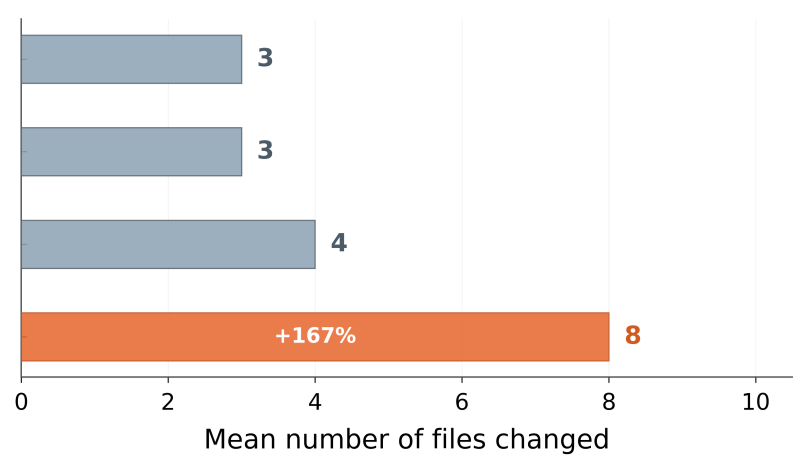 Figure: CursorBench tasks are significantly more complex and underspecified than standard benchmarks.
Methodology: The Architecture of Agentic RL
Composer 2's training follows a rigorous two-phase pipeline: Continued Pretraining and Asynchronous RL.
1. Continued Pretraining & MTP
The model starts with Kimi K2.5 and undergoes continued pretraining to 256k context. A notable technical choice is the use of Multi-Token Prediction (MTP) layers. By training the model to predict several future tokens simultaneously, Cursor improves speculative decoding speeds in production, essential for an interactive coding tool.
2. Infrastructure-Harness RL
To solve the "train-test mismatch," the RL phase uses Anyrun, an internal compute platform that launches Firecracker VMs for every training rollout. This means the model "practices" coding in the exact same environment the user sees.
3. Reward Shaping & Nonlinear Penalties
A standout innovation is the Nonlinear Length Penalty. Standard linear penalties often discourage models from "thinking" about hard problems. Composer 2 uses a concave-down penalty: This forces the model to be snappy on easy tasks while allowing it to allocate "thinking tokens" for complex refactors.
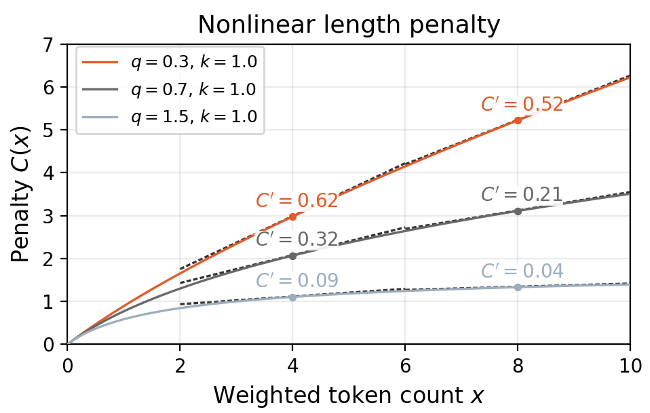 Figure: The nonlinear penalty curve ensures the model doesn't over-think easy requests but remains thorough on hard ones.
Experiments & Results: The Pareto Frontier
The results on CursorBench-3 are definitive. Composer 2 achieves 61.3% accuracy, a massive jump from Composer 1.5 (44.2%).
More interestingly, when plotted on a Cost vs. Accuracy graph, Composer 2 occupies a Pareto-optimal position. It delivers "Frontier" (GPT-5/Opus level) intelligence at the cost of "Medium" or "Low-effort" variants of those models.
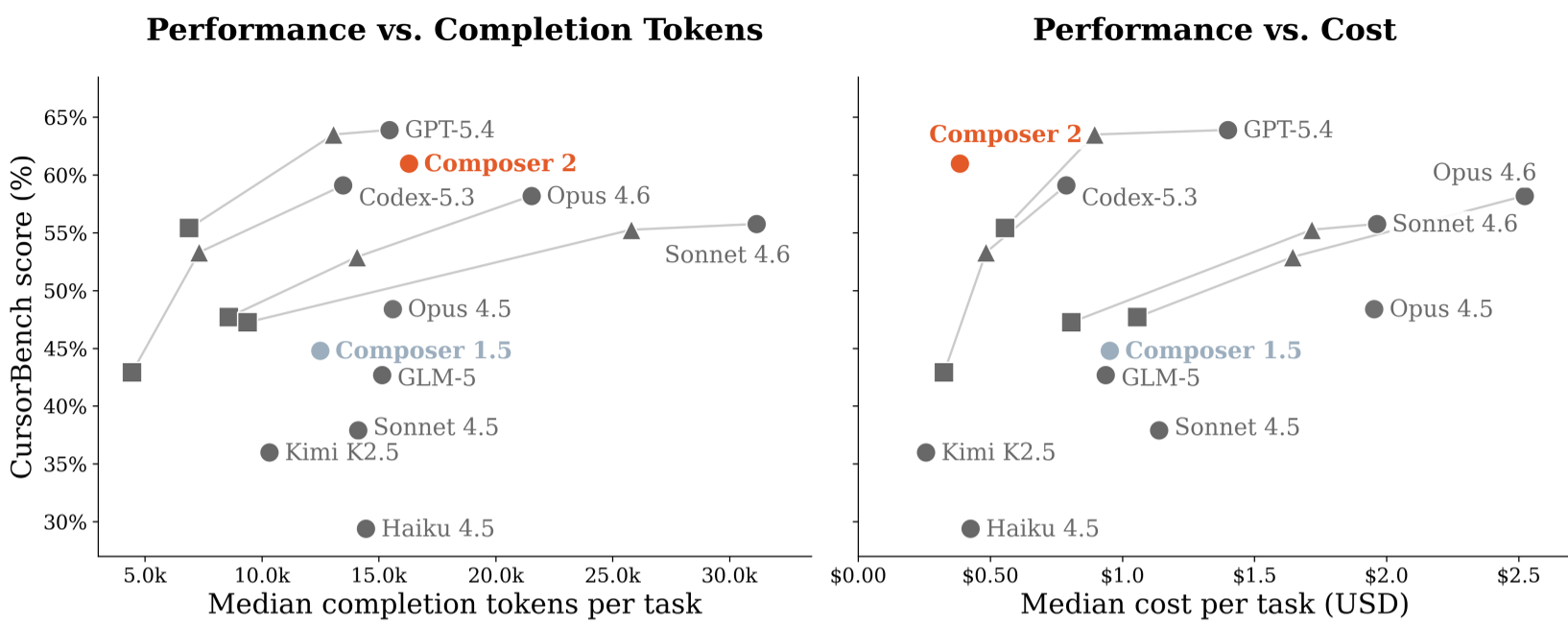 Figure: Composer 2 achieves a superior trade-off between accuracy and inference cost.
Key Stability Insights:
- Router Replay: In MoE models, the trainer and inference engine must agree on expert routing. Composer 2 uses "Router Replay" to ensure the gradients flow correctly through the selected experts.
- KL Estimator: They opted for the standard estimator for KL divergence over the unbiased to avoid the extreme variance blow-ups seen when the policy diverges significantly.
Critical Analysis & Conclusion
Takeaway: Composer 2 is a testament to the power of vertical specialization. By focusing solely on the "Agent-in-the-Loop" software engineering experience, Cursor has built a model that can out-plan generalist giants.
Limitations: Despite the gains, the authors admit that long-horizon coherence still has room for improvement. The current 1.04T parameter size is massive, and while MoE keeps it efficient, the orchestration requirements for world-scale RL (spanning multiple regions) are non-trivial.
Future Outlook: The future of software engineering isn't just "chatting with code" but agents that manage hours-long migrations and data analysis. Composer 2 sets the infrastructure blueprint—snapshotting environments, forking VMs, and high-fidelity reward modeling—for the next era of autonomous engineering.