
Activity Composer: Balancing Leadership and Cohesion in Social Group Formation
Composing activity groups in social networks
2012-10-29
Summary
Problem
Method
Results
Takeaways
Abstract
This paper introduces "Activity Composer," a system designed to automatically form activity groups in social networks by optimizing for both host leadership and member communication. Using a greedy approximation algorithm called GroupComp, it balances user-specified interests (labels) and social cohesion to outperform existing team formation baselines.
## TL;DR
Forming the perfect group for an activity—be it a study session or a group-buying crew—is a complex balancing act. Researchers from National Taiwan University and National Chengchi University have developed **Activity Composer**, an automated system that uses a greedy 2-approximation algorithm to select group members who are not only qualified (matching interest labels) but also socially cohesive. By optimizing for both the "Host Leadership" and "Internal Communication," the system significantly reduces the "social friction" of group activities.
## The Problem: The High Cost of Social Coordination
In the era of Facebook and LinkedIn, we "invite" people to events constantly. However, current platforms face a dual challenge:
1. **Inefficiency**: Manual selection is tedious and subjective.
2. **Cohesion Gap**: Groups often include people who don't know the host well or, worse, don't get along with each other, leading to failed objectives.
Existing research mostly focused on **Team Formation** (finding experts for a task) or **Community Search** (finding dense subgraphs). Neither addressed the specific needs of an *activity*, which requires a central host and a specific group size.
## Methodology: The Activity-Cost Function
The core innovation lies in the definition of the **Activity Cost** $f(S)$. The authors argue that a successful group must minimize two types of "distances":
* **Host Leadership**: The sum of shortest-path distances between the host and each member.
* **Communication Ability**: The sum of pairwise distances between all members in the group.
A hyperparameter $\alpha$ allows the system to adapt to different scenarios. For a **Group Buying** activity, $\alpha$ is high (focusing on trust in the host). For a **Study Group**, $\alpha$ is low (prioritizing member-to-member interaction).
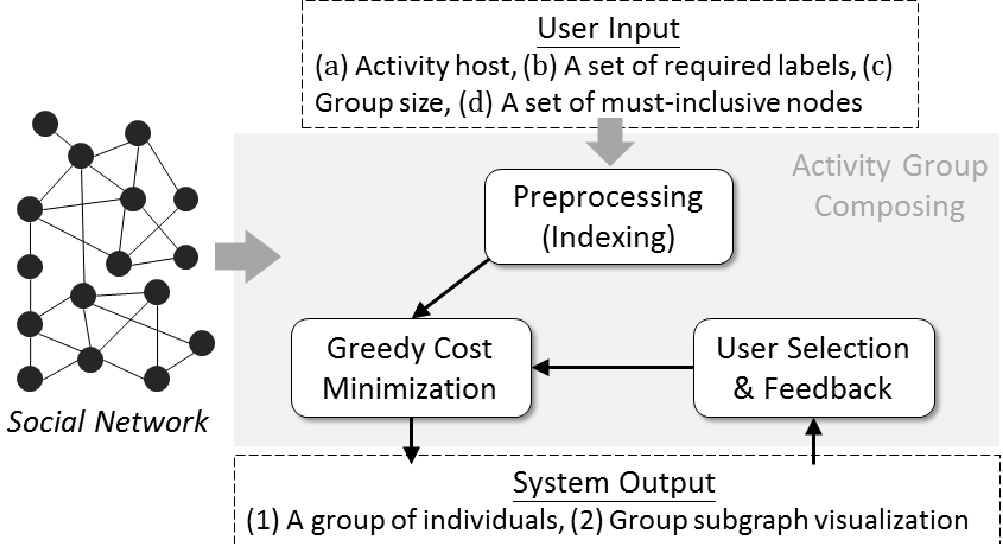
*Figure 1: The Activity Composer system workflow, from indexing to relevance feedback.*
### The GroupComp Algorithm
Since the problem is NP-hard (reducible from 3-SAT), the authors proposed **GroupComp**. It works by:
1. **Preprocessing**: Creating a hash table for all-pair shortest distances and an inverted index for user labels.
2. **Two-Phase Selection**: Using Uniform-Cost Search to anchor the group around the host, then greedily adding members who minimize the marginal increase in communication cost while satisfying label requirements.
## Experimental Validation
The researchers tested their approach using a **DBLP co-authorship network** (22,285 nodes). They treated "co-authorship" as social links and "research topics" as labels.
The results demonstrated that GroupComp significantly outperformed the **Enhanced-Steiner** method, a common baseline for team formation. As the group size increased, the efficiency of the greedy approach became even more apparent.
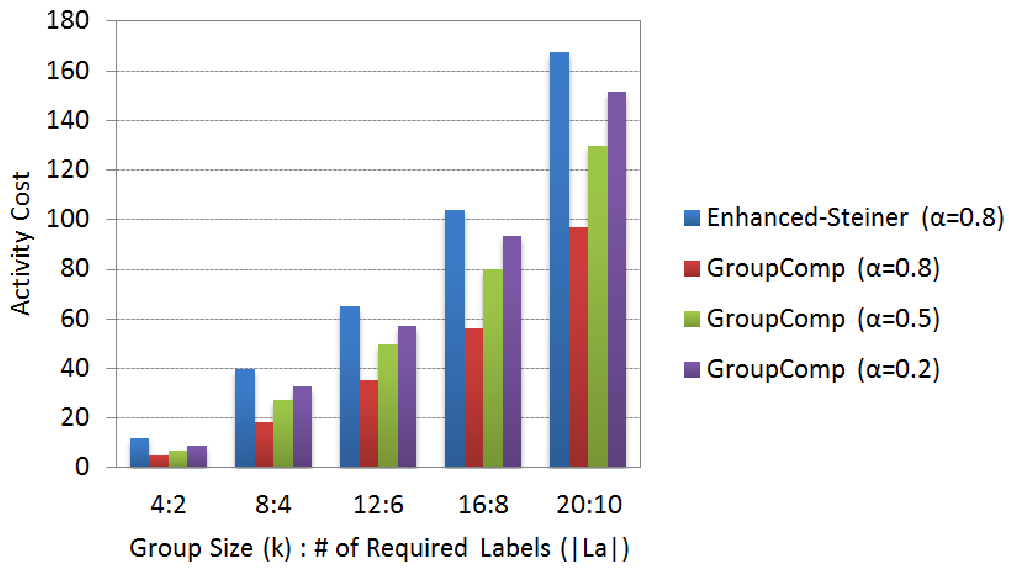
*Figure 2: Performance comparison showing lower activity costs for GroupComp across different group sizes and $\alpha$ settings.*
## Critical Insights
What makes this work stand out is its **Human-in-the-loop** design. The system doesn't just output a static list; it allows for "Must-inclusive" individuals and iterative feedback.
However, looking at it through a modern lens, the reliance on **pre-computed all-pair shortest distances** could be a bottleneck for massive networks (like the full Facebook graph). Future iterations might benefit from **Graph Embeddings** to approximate these distances in latent space rather than physical graph hops.
## Conclusion
"Composing Activity Groups" moves beyond simple expert-finding. It acknowledges that social chemistry—the "interaction cost"—is the silent engine of any successful group endeavor. By mathematically balancing the influence of the host with the harmony of the collective, Activity Composer provides a blueprint for the next generation of "Intelligent Event Planning" features in social media.