
TACO-miner: Bridging the Gap Between Neural Networks and Interpretable Job Shop Scheduling
Composite Dispatching Rule Generation through Data Mining in a Simulated Job Shop
The paper introduces TACO-miner, a novel data mining tool that extracts composite Dispatching Rules (DR) for dynamic job shop scheduling. By utilizing a hybrid approach of Artificial Neural Networks (ANN) and Ant Colony Optimization (ACO), the method generates human-interpretable "If-Then" rules that outperform or match traditional heuristics like FIFO, SPT, and EDD across varied shop configurations.
TL;DR
Scheduling a dynamic job shop is notoriously difficult because the "best" rule changes as the shop floor gets crowded. This paper presents TACO-miner, a system that uses Neural Networks to learn the optimal scheduling patterns and then employs Ant Colony Optimization to translate those patterns into simple, human-readable "If-Then" rules. The result? A system that is as smart as a neural net but as transparent as a manual.
Performance vs. Transparency: The Scheduler's Dilemma
In industrial engineering, Dispatching Rules (DR) like First-In-First-Out (FIFO) or Shortest Processing Time (SPT) are beloved for their simplicity. However, their performance is notoriously finicky. SPT might work great when the shop is empty, but fail miserably when buffers are full.
While modern Artificial Neural Networks (ANN) can predict which rule to use with high accuracy, they suffer from a "black-box" nature. Factory managers are often reluctant to trust a system they cannot understand. The authors of this paper ask: Can we have the predictive power of an ANN with the clarity of a logic-based rule?
Methodology: The TACO-miner Architecture
The researchers developed a sophisticated pipeline to extract "Composite Dispatching Rules." The process follows three distinct phases:
- Simulation & Data Generation: They modeled a 24-workstation job shop and ran full factorial experiments (243 combinations) to see how different rules (FIFO, SPT, EDD) performed under varying arrival rates, buffer sizes, and due-date tightness.
- The Neural Teacher: A Multi-Layer Perceptron (MLP) was trained on this data. It learned the "weights"—the hidden relationships between shop parameters and the optimal rule.
- The Ant Explorer (TACO): Instead of leaving the knowledge buried in weights, they used Touring Ant Colony Optimization. In this step, digital "ants" traverse the neural landscape to find the most significant paths, which are then converted into explicit logic rules.
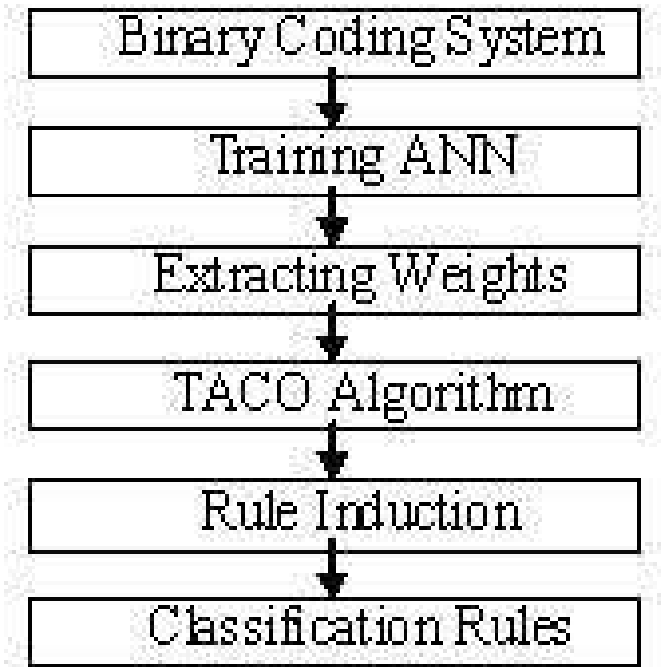 Figure 1: The two-stage process from ANN training to TACO-based rule extraction.
Experiments and Results
The extracted rules (totaling about 19 distinct logic statements) were put to the test against the original heuristics.
Key Findings:
- High Fidelity: The TACO-miner reached a testing accuracy of nearly 97%, meaning the simplified rules almost perfectly mimicked the complex neural network.
- Robustness: As shown in the performance comparison, the "Composite Rule" (red line in the graph below) consistently tracks the lowest error rates across different shop configurations.
- Superiority: In 7 out of 10 random test scenarios, the composite rule outperformed every single traditional heuristic.
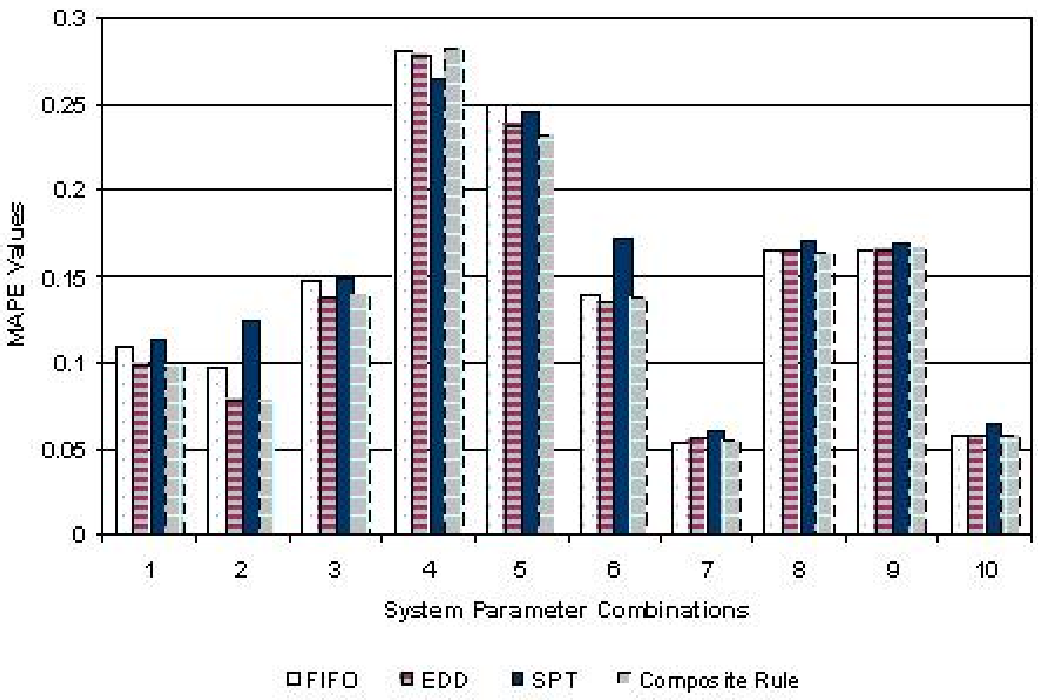 Figure 2: The Composite Rule (Triangle markers) maintains low MAPE across varied input combinations compared to rigid single rules.
Critical Insight: Why This Matters
The real value of this paper isn't just a lower MAPE score. It's the Rule Set (Table 6 in the paper). For example, Rule 1 tells us:
IF Interarrival Time is 45 AND Search Depth is high AND Due Date is tight... THEN use FIFO.
This level of Axiomatic Knowledge allows production managers to understand why the system is making a choice. It uncovers "structural knowledge"—insights that might have been hidden from human experts for decades.
Conclusion & Future Outlook
The TACO-miner proves that we don't have to choose between "smart" and "interpretable." By using meta-heuristics to mine neural networks, we can create adaptive scheduling systems that are robust to the chaos of a real-world factory floor.
Future Directions: While the current model uses a hypothetical job shop, the next logical step is applying TACO-miner to real-time manufacturing execution systems (MES) where machine breakdowns and variable labor shifts add even more noise to the data.
Keywords: Ant Colony Optimization, Neural Networks, Job Shop Scheduling, Rule Extraction, Explainable AI.