
Hierarchical Compositionality: Bridging Bodily Expression and Emotion with RNNPB
A Compositionality Assembled Model for Learning and Recognizing Emotion from Bodily Expression
The paper introduces a hierarchical Recurrent Neural Network with Parametric Bias (RNNPB) that utilizes the linguistic "principle of compositionality" to recognize and generate emotions from bodily expressions. By employing adaptive learning techniques like Adagrad and Adadelta, the model achieves stable, real-time emotion recognition by mapping complex non-linear motion sequences into a low-dimensional parametric space.
TL;DR
Understanding human emotion isn't just about reading a face; it's about the "grammar" of the body. This paper presents a hierarchical RNN framework that treats body parts like words in a sentence—using the Principle of Compositionality to map physical movements to internal emotional states. By adding Parametric Bias (PB) units and adaptive learning rates (Adagrad/Adadelta), the authors created a system that can recognize and predict emotions in real-time with high stability.
Problem & Motivation: The Noise of Human Motion
In Human-Computer Interaction (HCI), interpreting bodily expression is notoriously difficult. Human movement is a non-linear time series, often captured with significant sensor noise (e.g., from a Kinect).
The authors argue that we perceive emotions through two integrated pathways:
- Ventral Pathway: Influenced by emotional stimuli.
- Dorsal Pathway: Processes spatial and motion information.
Existing models often treat motion as a flat sequence. However, this paper suggests a Hierarchical approach is necessary. Just as linguistics combines constituent meanings via rules, bodily expression combines "key features" (like head angle or arm speed) to manifest an internal state.
Methodology: The Power of Parametric Bias
The core of the system is the RNNPB (Recurrent Neural Network with Parametric Bias). Unlike a standard RNN, the RNNPB includes special "PB units" that act as bifurcation parameters.
How it works:
- The Hidden Layer: The hidden state is influenced not just by the input and previous state, but by a slowly updating PB vector.
- The "Internal State": These PB values represent the "essence" of an emotion. By changing the PB value, the same network can generate entirely different motion sequences (e.g., a "sad" walk vs. an "angry" walk).
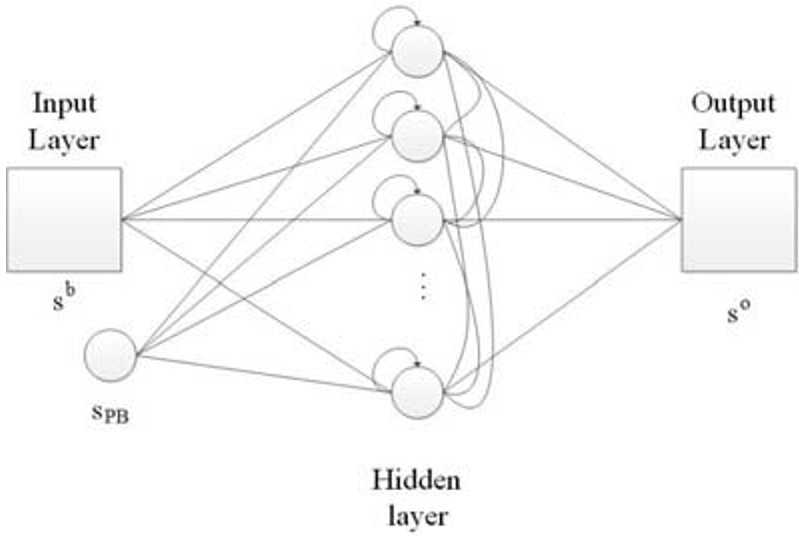 Fig 1: The RNNPB structure showing how Parametric Bias units () influence the hidden layer to modulate dynamics.
Adaptive Learning for Real-Time Performance
The paper makes a significant technical contribution by replacing fixed learning rates with:
- Adagrad (Learning Phase): Helps the model converge rapidly despite the sparsity or instability of certain body movements.
- Adadelta (Recognition Phase): Acts like a sliding window, allowing the PB values to converge to the correct emotional "cluster" without needing a pre-defined stopping threshold.
Experiments & Results: Mapping Emotion Space
The authors tested the model on walking and standing behaviors across five emotions: Joy, Pride, Fear, Anger, and Sadness.
PB Space Clustering
The most compelling result is the visualization of the PB space. Once trained, the PB values are not random; they form distinct clusters representing specific emotions.
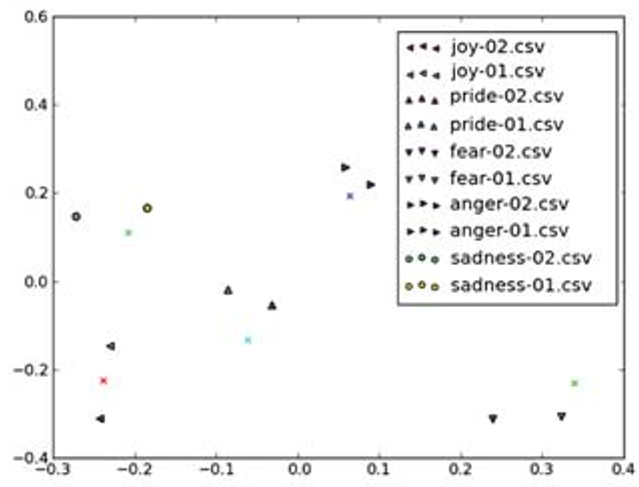 Fig 2: Visualization of the 2D PB space. Similar emotions (marked by the same shapes/colors) cluster together, proving the model successfully "learned" the internal representation of these states.
Generalization
In the recognition phase, the model was fed 30 untrained sequences. Using the Adadelta-driven update rule, the PB values converged to the vicinity of the pre-trained emotional clusters. This demonstrates that the network didn't just memorize sequences; it learned a generalizable manifold of emotional expression.
Critical Analysis & Conclusion
Takeaway
The study successfully validates the compositionality hypothesis. It proves that a small number of higher-level variables (PB values) can effectively mediate complex sensorimotor behaviors. This is a massive win for efficient AI—reducing a high-dimensional joint-angle problem into a 2D or 3D coordinate space.
Limitations
While effective, the model relies on PCA (Principal Component Analysis) for initial dimension reduction. This linear preprocessing might strip away subtle non-linear nuances before the RNN even sees the data. Future work could benefit from using Autoencoders to learn these features end-to-end.
Future Outlook
This hierarchical approach paves the way for robots that don't just "detect" emotion but can "reason" about how their own movements affect human perception. It moves us closer to machines that possess a "physical empathy" through shared latent spaces.