
Beyond Friendship: Decoding Influence via Hybrid Social Networks (CIP)
Comprehensive Influence Propagation Modelling for Hybrid Social Network
The paper introduces the Comprehensive Influence Propagation (CIP) model based on a Hybrid Social Network (HSN) framework. It integrates direct influence (explicit social links) and indirect influence (implicit behavioral correlations like shared preferences) to achieve superior performance in Influence Maximization (IM) tasks.
TL;DR
Why do some marketing campaigns go viral while others with "top-tier influencers" fail? This paper argues that we have been looking at social networks through a keyhole. By introducing the Comprehensive Influence Propagation (CIP) model, the authors prove that influence isn't just about who you follow (direct), but also about the "traces" you leave in the digital environment (indirect), such as ratings and reviews.
Background: The Myopia of Single-Factor Modeling
Most Influence Maximization (IM) research rests on a shaky assumption: Friendship = Influence. In the real world, you might buy a laptop because of an anonymous expert review (indirect influence) rather than a friend's recommendation. Existing models like the Independent Cascade Model (ICM) often fail to capture these "hidden pathways," leading to sub-optimal seed selection in marketing and information diffusion.
The Core Insight: Direct vs. Indirect Influence
The researchers break down influence into two primary components:
- Direct Influence: Immediate interactions through explicit links (e.g., trust, friendship, emails).
- Indirect Influence: Stigmergic communication. Like ants leaving pheromones, users influence others by modifying their shared environment (e.g., leaving a 5-star rating on a product that a stranger later sees).
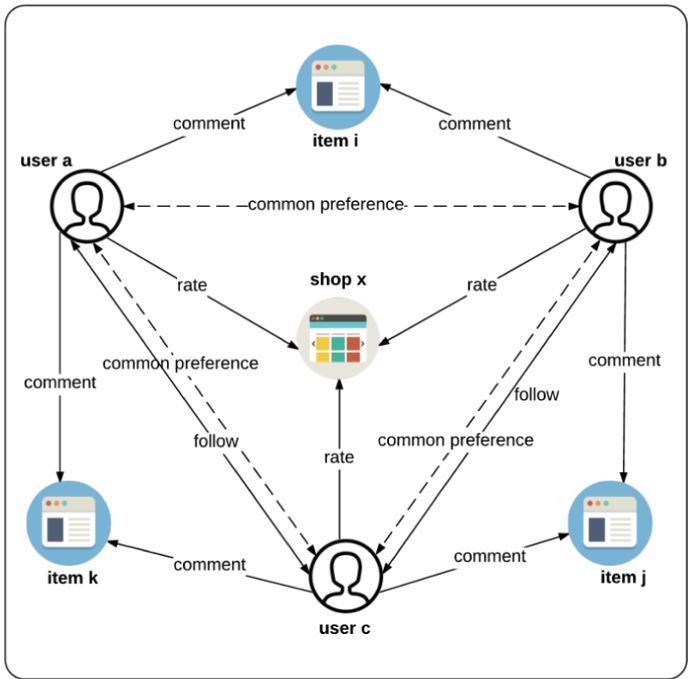
Methodology: The Hybrid Social Network (HSN)
To capture this complexity, the authors propose the Hybrid Social Network (HSN). Instead of one graph, it’s a composite structure:
- Trust Network (TNT): Models explicit social ties.
- Preference Network (PNT): Models implicit ties based on Jaccard similarity of item ratings and interaction frequency.
The CIP Model then calculates a comprehensive weight for any two nodes by aggregating probabilities across all these layers using a multiplicative non-occurrence logic ().
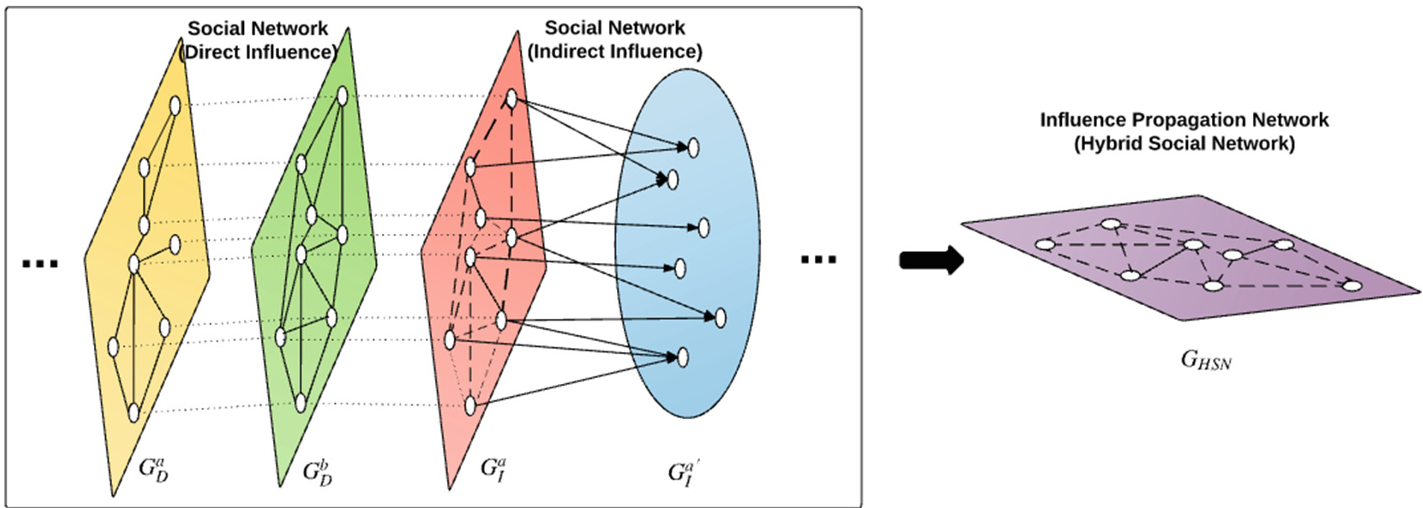
Algorithm: Breadth-First Influence Propagation
The authors extended the ICM with an Influence Propagation Attenuation (IPA) factor. This ensures that as information hops further from the source, its persuasive power decays realistically.
Experimental Validation
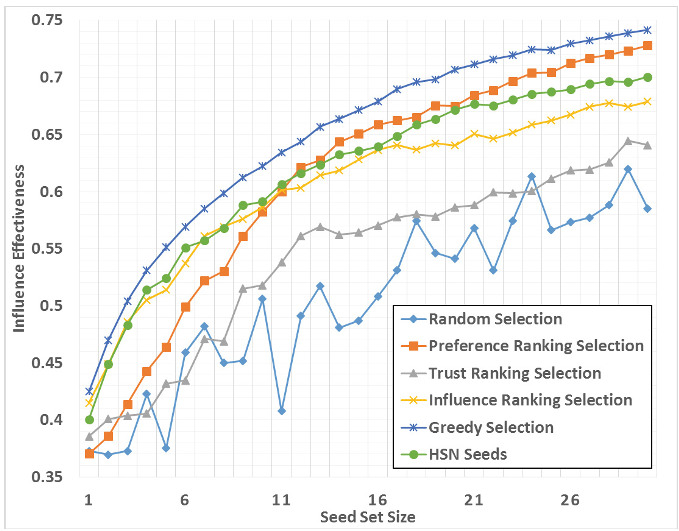
Using the MovieLens dataset (1M+ ratings), the team constructed a 500-node HSN. They compared several seed selection strategies: Greedy, Rank-based, and Random.
Key Findings:
- Cross-Network Robustness: Seeds selected from the Hybrid Social Network (HSN) performed exceptionally well when "tested" in purely trust-based or purely preference-based environments.
- The Fail-Safe Nature of HSN: Traditional rank-based methods (like selecting the most "trusted" person) often failed in the Preference Network. However, the HSN-Greedy approach provided stable, near-optimal performance regardless of the scenario.
Critical Analysis & Future Outlook
Takeaway: The real power of this paper lies in its extensibility. The HSN isn't limited to just "trust" and "preference"; one could theoretically plug in "geo-location," "temporal dynamics," or "professional affiliation" as additional layers.
Limitations:
- The computational cost of the Greedy algorithm remains high for very large HSNs.
- The model assumes we have access to item-level interaction data (PNT), which may be gated behind privacy walls in real-world applications.
Future Work: The authors suggest moving toward a decentralized multi-agent system, where specific agents monitor individual "influence facets" to provide real-time updates to the global hybrid model.