
Bayesian Networks in Healthcare: Trapped in the Chasm Between Research and Practice
A comprehensive scoping review of Bayesian networks in healthcare: Past, present and future
This paper presents a novel scoping review of Bayesian Networks (BNs) in healthcare, analyzing 123 high-quality studies to characterize their use in Clinical Decision Support (CDSS). It identifies a significant chasm between research interest and clinical adoption, highlighting that BNs often reach SOTA accuracy but fail to demonstrate practical utility or generalizability.
TL;DR
Despite a gold rush of research into Bayesian Networks (BNs) for medical decision support, there is a shocking reality: almost none of these models are actually used by doctors. This comprehensive scoping review of 123 papers reveals that while we are great at building accurate "black boxes" on paper, we are failing at the "last mile" of clinical adoption due to a lack of temporal modeling, poor reproducibility, and a neglect of interventional reasoning.
Contextual Positioning
Bayesian Networks are the darlings of causal AI because they handle uncertainty and expert knowledge far better than traditional neural networks. Within the academic coordinate system, this paper serves as a vital critical audit. It doesn't propose a new algorithm; instead, it provides a "state of the union" for BNs in healthcare, exposing the systemic failures that prevent these models from saving lives in real-time.
The Core Problem: Accuracy $
eq$ Usefulness The research intuition here is sharp: a model can have 99% accuracy on a static dataset, but if a clinician doesn't understand why a prediction was made, or if the model cannot handle the dynamic nature of a patient's worsening condition over time, it will never be adopted.
Prior work has been segmented into:
- Method-driven: Technically sound but clinically irrelevant.
- Problem-driven: Clinically relevant but technically shaky and hard to replicate.
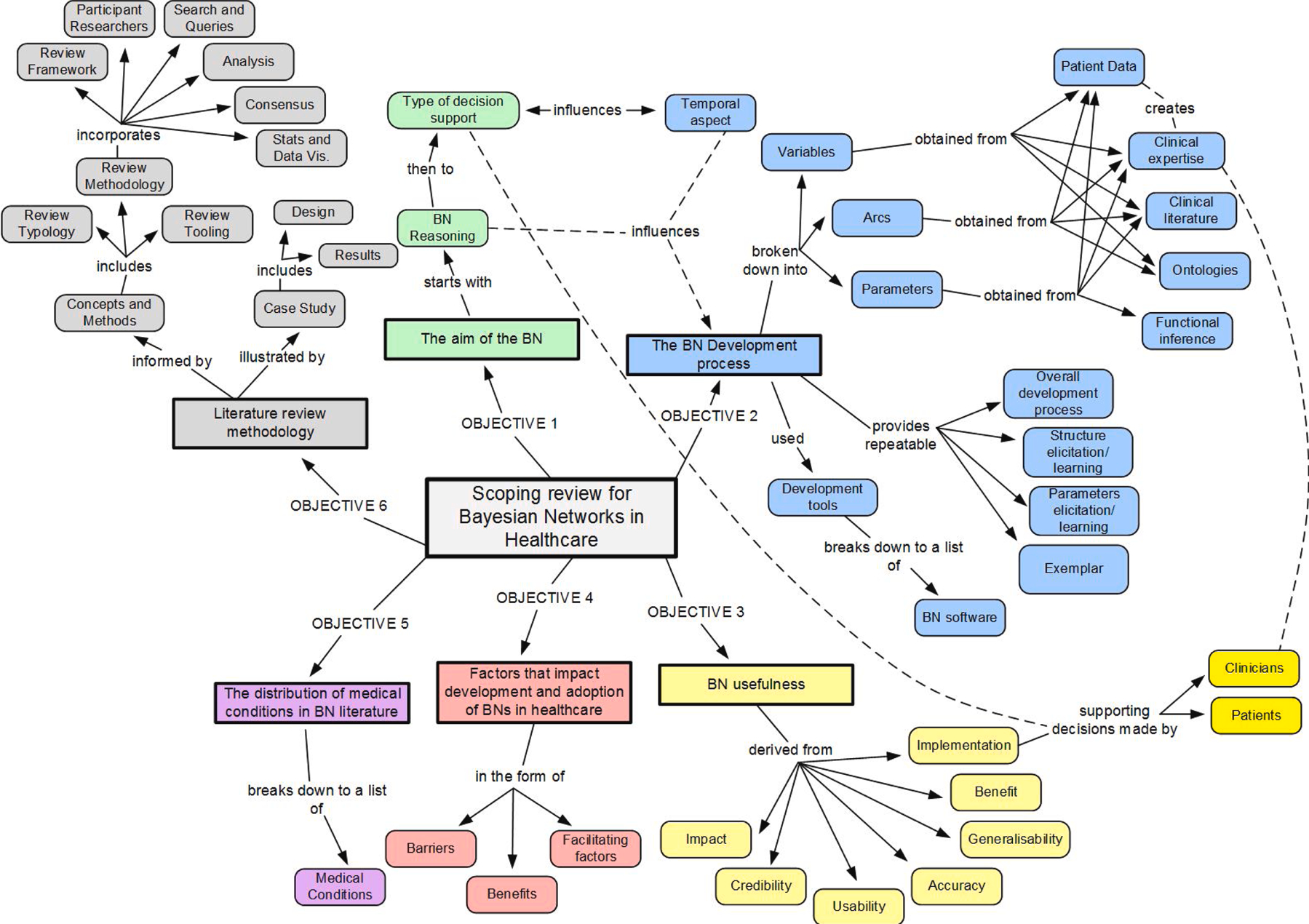 The Authors' Framework: Evaluating BNs through the lens of Decision Support, Modeling, and Usefulness.
Methodology: A Taxonomy of Neglect
The authors' framework highlights three critical areas where BNs are failing to meet their potential:
1. The Reasoning Gap
Most BNs (73%) use Observational Reasoning (simple diagnosis). However, the true power of BNs lies in:
- Interventional Reasoning: "What happens if we give this drug?" (Only 8%)
- Counterfactual Reasoning: "Would the patient have survived if we had operated sooner?" (Only 1 paper!)
2. The Modeling Gap (Data vs. Knowledge)
There is a dangerous prevalence of Data-driven models over Knowledge-driven ones. In healthcare, data is often "noisy" or incomplete. The review found that models built purely from data often lack the causal credibility that doctors need to trust them.
3. The Temporal Gap
Medicine is dynamic. Symptoms evolve. Yet, 57% of models were static, ignoring the time element entirely.
Key Results and Findings
The review reveals a "Success-Failure Paradox":
- Success: 82% of papers identify a clear clinical benefit; 76% achieve high accuracy.
- Failure: 0% evidence of clinical implementation.
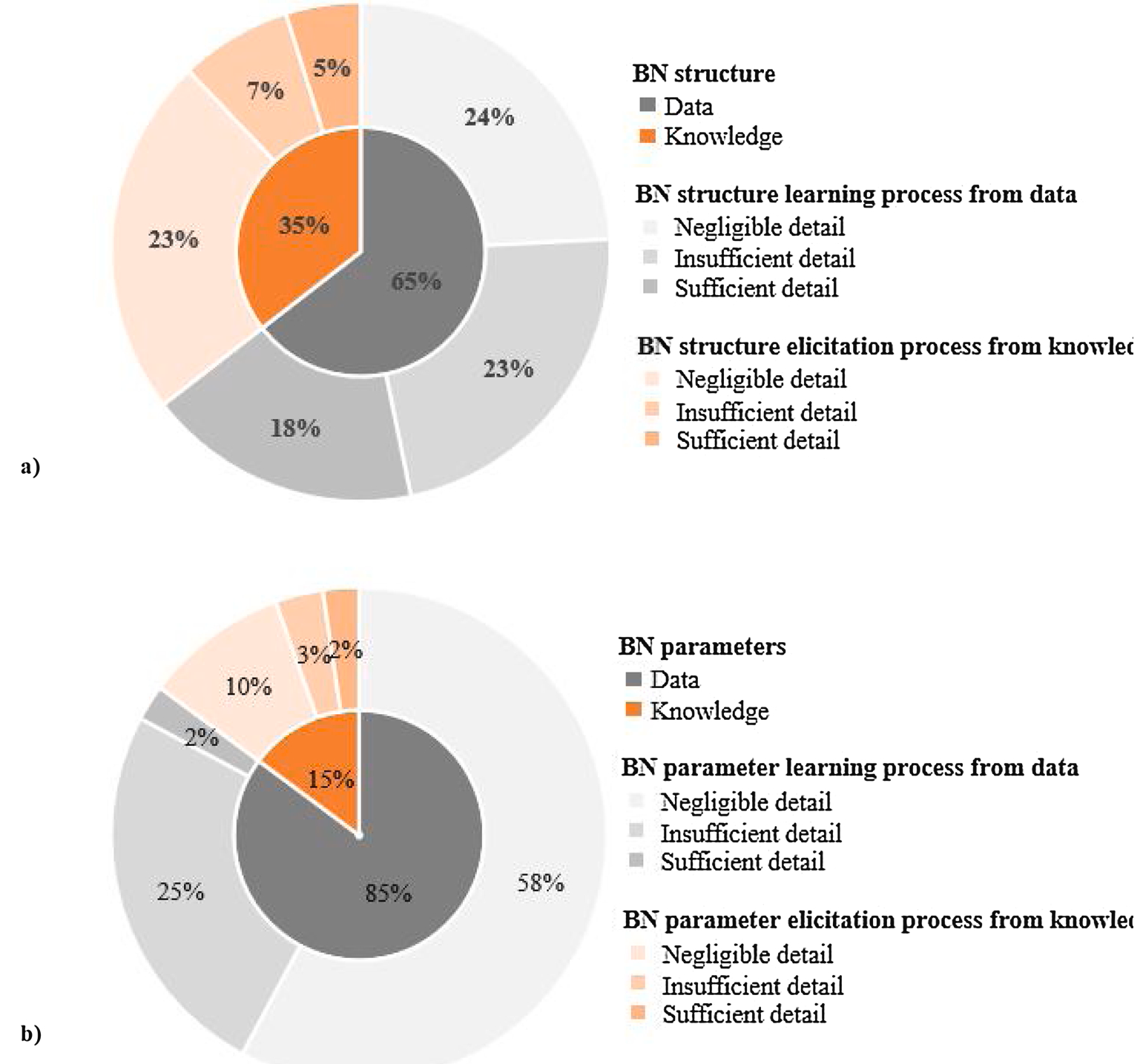 A breakdown of BN development: Most models lack sufficient detail for other researchers to repeat the findings.
The "Adoptability" Crisis
The study defines the properties of a "Useful Model" (Benefit, Credibility, Accuracy, Generalizability, Usability, Impact).
- Generalizability: Only 5% of papers tested their models on external datasets.
- Usability: Only 10% proposed a user interface for clinicians.
Critical Insight: The Path Forward
The authors don't just complain; they provide a roadmap for the next generation of AI researchers:
- Embrace the Hybrid: Combine automated structure learning with expert causal constraints. Don't let the algorithm "hallucinate" relationships that contradict medical physics.
- Disclosure is Mandatory: Provide the Node Probability Tables (NPTs)! Without them, your research is a closed book that no one can validate or build upon.
- Beyond Probability: Move toward Explainable AI (XAI). A clinician needs an "Incremental Explanation" of inference to trust a BN's suggestion.
Conclusion
This scoping review is a wake-up call. The "BN Chasm" exists because we have focused on building better calculators rather than better clinical tools. For BNs to survive the next decade of AI competition, they must move from static, data-mined snapshots to dynamic, causal, and transparent reasoning engines.
Takeaway: Accuracy is a prerequisite; Impact is the goal. If your model doesn't work in a different hospital or provide a UI for a nurse, it isn't "SOTA"—it's a prototype.