
PullRec: Solving the "Undersharing" Crisis in Social Networks
Towards Comprehensive Social Sharing of Recommendations: Augmenting Push with Pull
This paper proposes PullRec, a novel social recommendation framework that complements traditional "push" mechanisms with a "pull" strategy. It enables users to actively query their social circles for recommendations while minimizing sharing effort through automated activity logging and sentient sentiment inference.
TL;DR
Despite the ubiquity of "Like" and "+1" buttons, social networks suffer from a massive "undersharing" problem. Users are often too lazy, forgetful, or privacy-conscious to push recommendations to their friends. PullRec flips this model on its head by allowing users to pull recommendations from friends. By utilizing proactive activity logging and even brainwave sensors, PullRec captures "silent" endorsements and shares them only when a relevant query is made.
The Motivation: Why Your Friends Aren't Recommending Great Stuff
We often assume social media is a place of "oversharing." However, research into the Google Play Store and Twitter reveals the opposite for recommendations.
- The Lazy Gap: For apps with 4.5+ star ratings, often less than 5% of users click the "+1" button.
- The Privacy Barrier: On Twitter, many users "Favorite" a tweet (private/low-profile) instead of "Retweeting" it (public/high-profile) to avoid spamming their followers or managing complex privacy settings.
The authors argue that the "Push" model is fundamentally broken because it puts all the work—deciding relevance, remembering the item, and choosing the audience—on the person giving the recommendation.
PullRec: The Architecture of Passive Recommendation
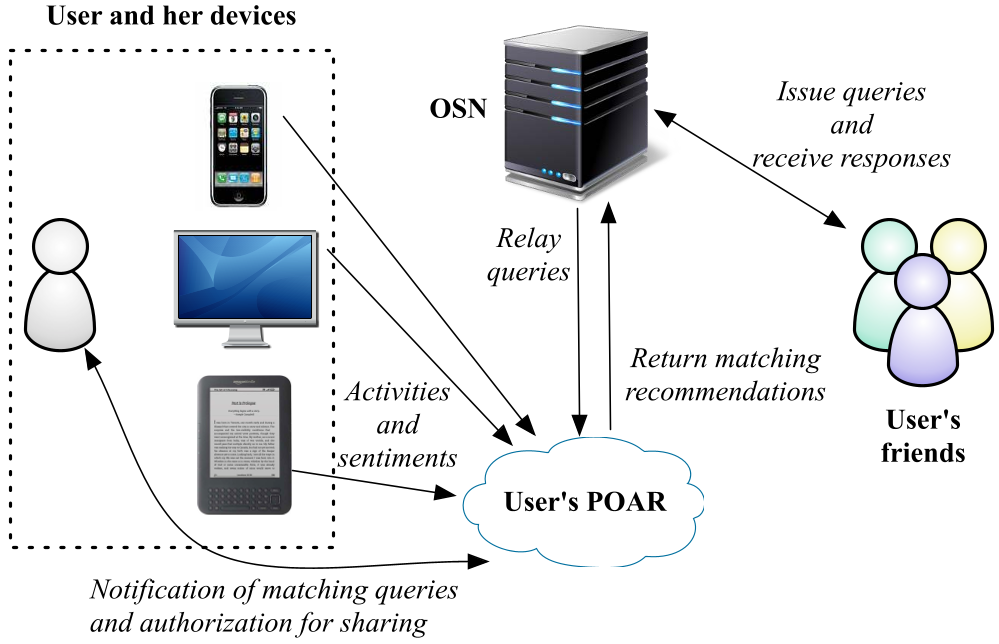
PullRec’s core innovation is the Personal Opinion and Activity Repository (POAR). This is a private, cloud-based vault for every user that tracks:
- Digital Entities: Web pages, songs, and apps consumed across devices.
- Real-world Entities: Restaurants and locations visited via GPS tracking.
- Inferred Opinions: Instead of asking "Do you like this?", PullRec infers it if you listen to a song repeatedly or visit a cafe multiple times.
The "Mind-Reading" Component
One of the most provocative aspects of the methodology is the use of commodity brainwave sensors (like Neurosky). The authors envision a future where wearable tech (like smart glasses) monitors neural responses to content. If your brain shows a positive "spike" while reading an article, PullRec logs a recommendation without you ever lifting a finger.
How the "Pull" Works
When Alice wants a recommendation for a "Thai restaurant in San Francisco," the system doesn't blast a status update to everyone. Instead:
- The query is sent to the POARs of all her friends.
- The POARs locally check for matches (e.g., has Bob visited a Thai place in SF?).
- If a match is found and an opinion was inferred, only then is Bob prompted: "Alice is looking for Thai food; do you want to share your recommendation of 'Siam Palace' with her?"
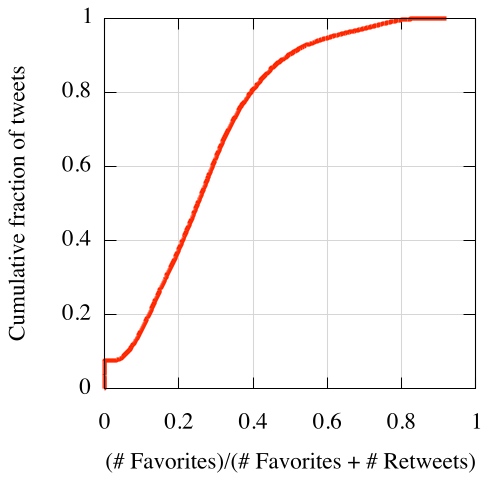 (Note: Figure 1(a) in the paper highlights how current 'retweet' vs 'favorite' ratios prove users prefer low-effort/low-visibility interactions over high-effort sharing.)
Privacy and Serendipity
A common critique of pull systems is the loss of "serendipitous discovery"—finding something you weren't looking for. PullRec addresses this by leveraging "Circles" or "Friend Lists." If Bob agrees to share a recommendation with Alice, the system can optionally surface that recommendation to other friends in that same circle who have similar interests, maintaining a balance between targeted queries and social discovery.
Critical Analysis & Future Outlook
PullRec represents a significant shift in Inductive Bias for social systems: it assumes that utility comes from private data that is selectively revealed, rather than public data broadcasted to all.
Pros:
- Drastically reduces "spam" by filtering queries by relevance before they reach the human user.
- Captures high-intent data that is currently lost to user "laziness."
Challenges:
- Incentives: Why should I pay to host a POAR if it only helps my friends? The authors suggest a "tit-for-tat" model.
- Hardware Adoption: While GPS is everywhere, brainwave sensors are still niche.
- Security: A central repository of every activity is a goldmine for law enforcement or hackers.
Conclusion
PullRec moves us away from the "Performance" of social media—where we only share what makes us look good—towards a "Utility" model where our actual experiences are used to help our social circle. It’s a step toward a more comprehensive, low-friction digital memory.