
The New Frontiers of Graph Anomaly Detection: A Deep Learning Revolution
A Comprehensive Survey on Graph Anomaly Detection With Deep Learning
This paper provides a comprehensive survey of Graph Anomaly Detection (GAD) using deep learning, categorizing methods by the type of anomalous object—nodes, edges, sub-graphs, and graphs. It covers the shift from traditional statistical models to modern deep graph representation learning and Graph Neural Networks (GNNs).
TL;DR
Graph Anomaly Detection (GAD) has evolved from simple statistical outlier hunting to complex deep representation learning. This survey systematically maps the landscape of Deep Learning for Graph Anomaly Detection (GADL), covering nodes, edges, sub-graphs, and whole-graph anomalies. It identifies the critical shift from feature-only detection to relational-aware deep models that can handle the dynamics of non-Euclidean data.
Academic Positioning: This is a seminal "one-stop-shop" survey that provides a unified taxonomy for GADL, filling the gap where prior surveys focused only on tabular data or non-deep graph methods.
Problem & Motivation: Why Graphs Change Everything
Traditional anomaly detection treats data as independent and identically distributed (i.i.d.) points in Euclidean space. However, real-world data is relational. A fraudster on Twitter doesn't just have suspicious profile text; they have suspicious connections.
The authors argue that traditional techniques (like matrix factorization or SVMs) fail because:
- Structural Complexity: They blink at irregular structures and large-scale relational dependencies.
- Linear Constraints: They cannot capture the high-order, non-linear interactions between node attributes and graph topology.
- Expert Bottleneck: Old methods required labor-intensive feature engineering, failing to detect "unknown unknowns."
Methodology: The Taxonomy of Detection
The paper categorizes GADL based on the object of interest. This is a critical distinction because the mathematical objective changes for each:
1. Anomalous Node Detection (Anos ND)
Most research lives here. Models like DOMINANT utilize a GCN-based autoencoder. The intuition is: if a node's structure and attributes cannot be reconstructed well from a latent representation, it is a "Community Anomaly."
 Figure: A general architecture showing how GCNs encode graph structure and attributes, followed by separate decoders for reconstruction-based anomaly scoring.
2. Anomalous Edge and Sub-graph Detection
This moves from individuals to collectives. DeepFD and FraudNE model online review networks as bipartite graphs, using autoencoders to find "dense blocks" in the embedding space—effectively finding groups of bots collaborating to boost product ratings.
3. Dynamic and Adversarial GAD
Modern graphs aren't static. Models like NetWalk and AddGraph introduce temporal components (like GRU or LSTM layers) to find anomalies in evolving patterns, such as a sudden burst of connections in a computer network (Intrusion Detection).
Key Competitive Analysis: GCN vs. GAN vs. RL
- GCN-based (e.g., DOMINANT): Best for static attributed graphs; relies on reconstruction error.
- GAN-based (e.g., OCAN): Powerful when "normal" data is available, as the generator creates "complementary" fake data to train a one-class discriminator.
- RL-based (e.g., GraphUCB): Emerging for interactive detection where expert feedback (human-in-the-loop) is used to refine the detection strategy.
Experiments & Results: The Benchmarking Gap
The survey provides a massive collection of datasets (Cora, Enron, Yelp, etc.) and notes a major hurdle: Ground-truth scarcity. Most papers currently rely on "Synthetic Injection"—manually corrupting a clean graph to test if the model can find the "planted" anomalies.
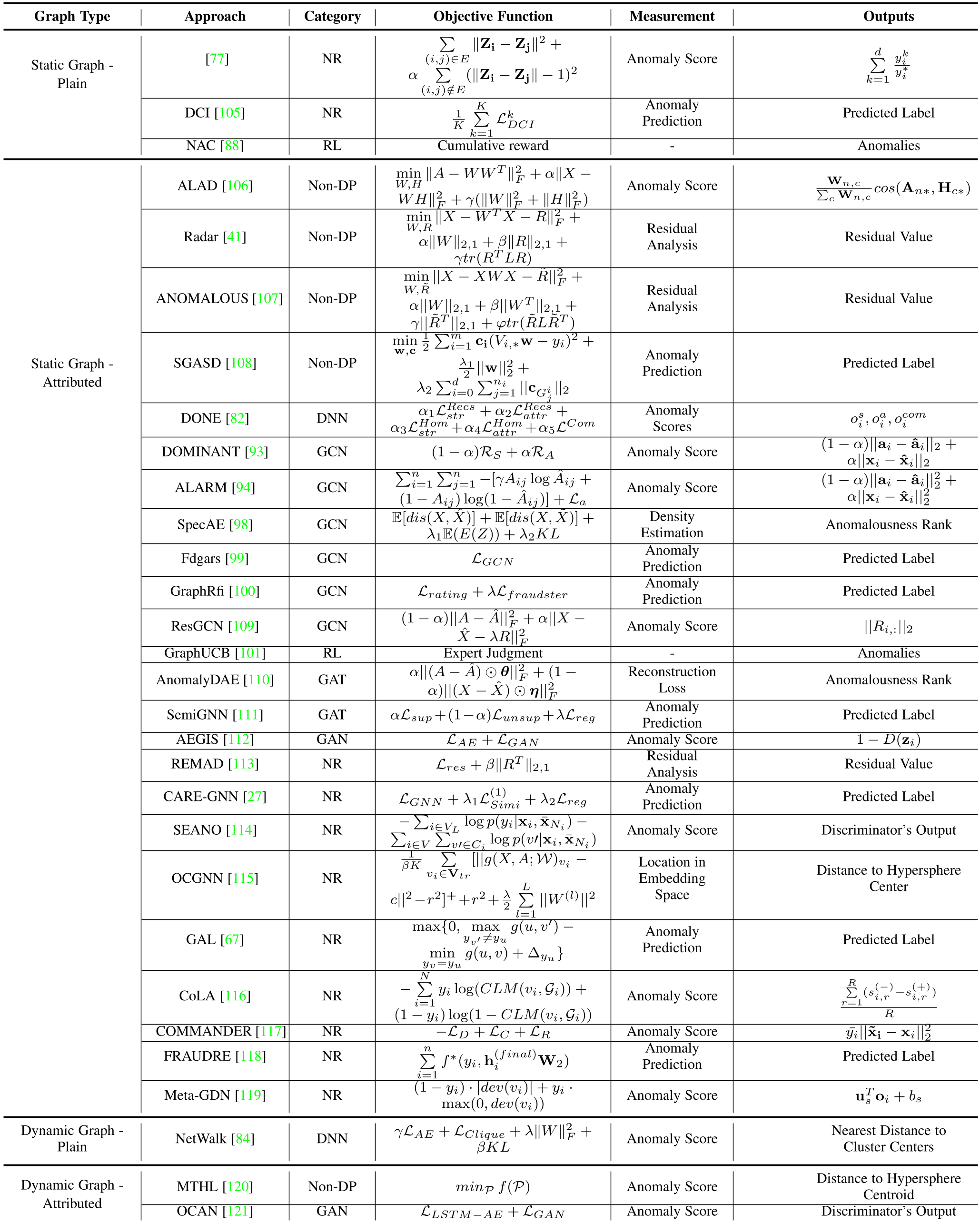 Table: Summary of diverse techniques and their specialized objective functions across static and dynamic graphs.
Critical Insight: The 12 Future Directions
The authors conclude with a roadmap. Three specific areas stand out as the next "SOTA" battlegrounds:
- Camouflaged Anomalies: Fraudsters who mimic benign users' connection patterns (Relation Camouflage).
- Explainability: In financial systems, "The AI said so" isn't a legal reason to block an account. We need GNN-explainer blocks for GAD.
- Large-scale Scalability: Moving from transductive (whole-graph at once) to inductive (GraphSAGE-style) learning for web-scale graphs.
Conclusion
This survey proves that GADL is no longer a niche sub-field. By shifting from "what" the data looks like to "how" the data is connected, deep learning is finally cracking the code on detecting modern, sophisticated fraudsters and system failures.