
ML-Based Big Data Analytics: The Backbone of Next-Gen Smart Healthcare
A comprehensive survey on machine learning-based big data analytics for IoT-enabled smart healthcare system
This paper provides a comprehensive survey on the integration of Machine Learning (ML) and Big Data analytics within IoT-enabled smart healthcare systems. It establishes a multi-layered architecture for Wireless Body Sensor Networks (WBSNs) and highlights how ML techniques optimize disease prediction, data aggregation, and assisted living in the eHealth domain.
Executive Summary
TL;DR: This comprehensive survey explores the synergy between the Internet of Things (IoT), Big Data, and Machine Learning (ML) in reforming modern healthcare. It proposes a transition from hospital-centric to patient-centric care through an intelligent 5-layer architecture, demonstrating how ML can solve the "Data Deluge" while maintaining surgical precision in disease prediction and data security.
Positioning: This work serves as a foundational taxonomy and critical roadmap, bridging the gap between generic Big Data studies and the highly specialized requirements of the eHealth and mHealth sectors.
Motivation: Why Hospitals are No Longer Enough
The COVID-19 pandemic acted as a "stress test" for global health infrastructure, exposing a critical flaw: traditional systems cannot handle large-scale, real-time monitoring. While IoT wearables offer a solution by providing a constant stream of physiological data, they create a new bottleneck—Big Data.
The authors identify that sending raw, redundant sensor data to the cloud is unsustainable due to:
- Resource Scarcity: Wearables have limited battery and processing power.
- Network Congestion: Massive data streams (Velocity and Volume) saturate bandwidth.
- Veracity: Distinguishing clinical "noise" from life-saving "signals" is computationally expensive.
Methodology: The 5-Layer WBSN Architecture
To address these challenges, the paper advocates for a structured Wireless Body Sensor Network (WBSN). The core innovation lies in the Mining and Learning Layer, which acts as the "brain" of the system.
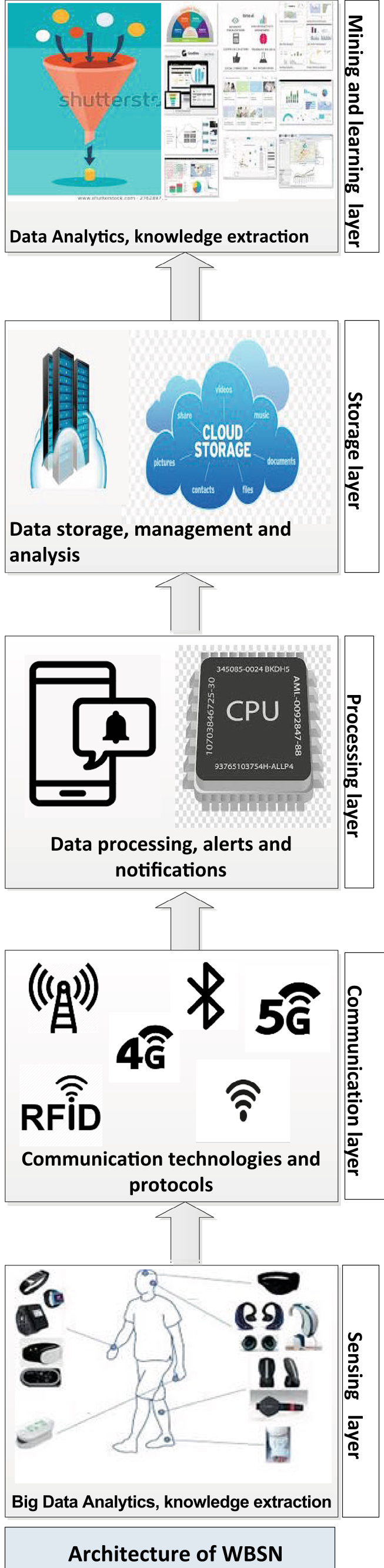
Core Functional Pillars
- ML-Based Recommendation: Using SVM and Elastic Net to suggest customized wearables or diets based on the "Type-2 Fuzzy Ontology," which handles the inherent uncertainty in medical data.
- ML-Based Prediction: Moving beyond simple threshold alarms to intelligent systems (like K-means and Random Forest) that can predict Parkinson's disease or Arrhythmia before they become critical.
- Intelligent Data Aggregation: Using ALVQ (Adaptive Learner Vector Quantization) and Hadoop to eliminate redundant data at the source (Edge), drastically reducing the energy cost of transmission.
Critical Insight: The Shift to the Edge
A key takeaway from the survey is the emergence of Fog Computing. Instead of sending all data to a centralized Google or Amazon cloud, "Smart Gateways" process data locally. This provides:
- Lower Latency: Critical for emergency alerts (e.g., ICU monitoring).
- Privacy: Sensitive genomic and behavioral data stays closer to the user.
Experimental Analysis & Comparisons
The paper compares various SOTA techniques across categories. For instance, in "Secured Analysis," various watermarking and ML-based classification methods are evaluated for their ability to resist DoS and eavesdropping attacks.
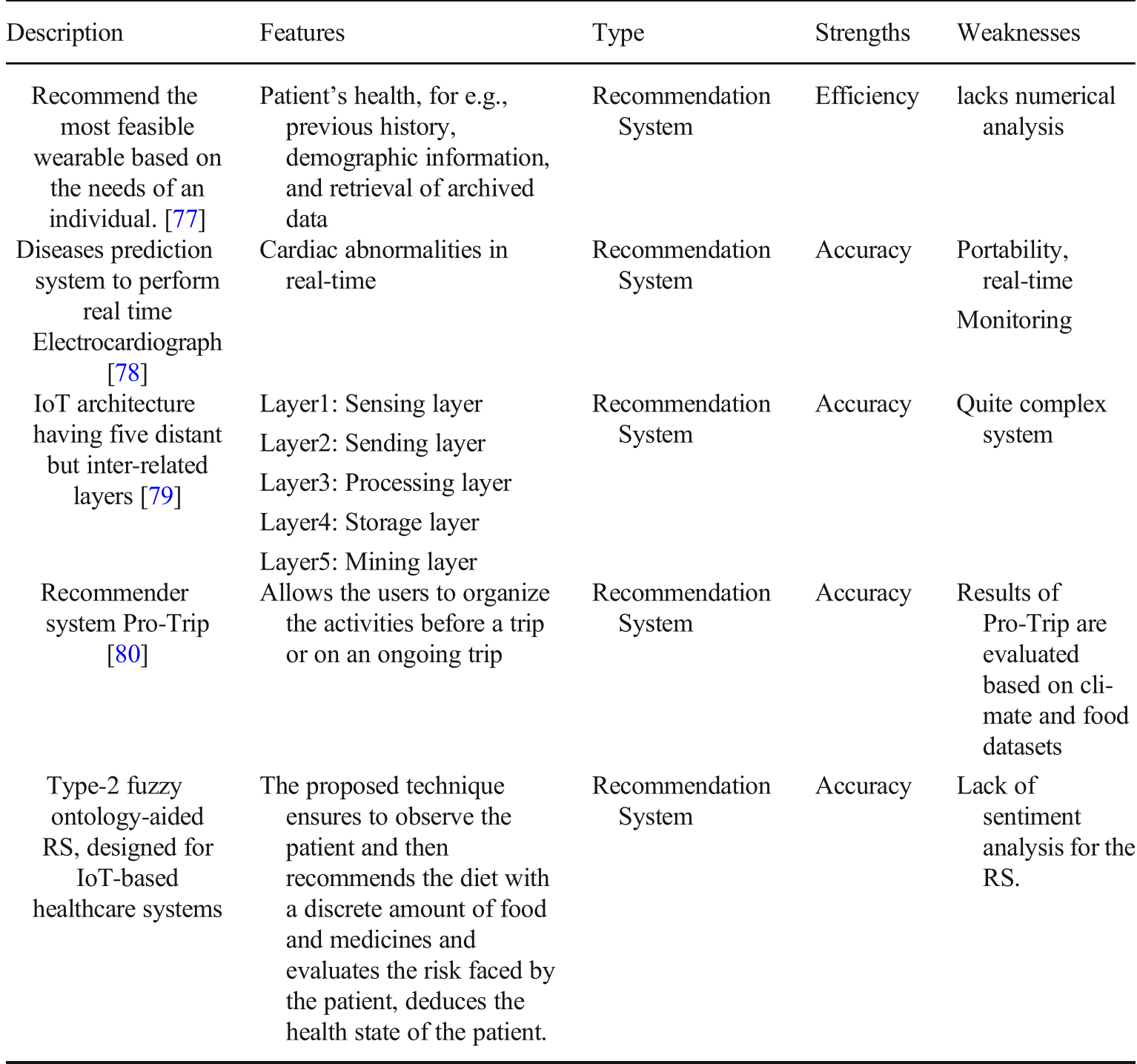
Key Findings:
- Precision: ECG analysis models reached up to 99.4% accuracy, proving that ML can rival human practitioners in specific diagnostic tasks.
- Energy Efficiency: Techniques like "Self-organizing data aggregation" transformed high-dimensional data into low-dimensional space, extending network lifetimes by over 30% in several cited studies.
Future Outlook and Limitations
Despite the progress, the authors highlight several "Gaps in the Armor":
- Interoperability: The lack of global standards for IoT hardware prevents seamless data sharing between different hospital systems.
- Security Paradox: Traditional encryption is too "heavy" for tiny medical sensors, necessitating the development of lightweight cryptography.
- Human Element: Sentiment analysis and "Social IoT" are still under-researched in the context of elderly care and mental health.
Conclusion
This survey serves as a clarion call for the healthcare industry to embrace ML-driven Big Data analytics. The future of healthcare is not just connected—it is predictive, proactive, and personalized.
Takeaway for Practitioners: Focus on "Edge Intelligence." The value of healthcare IoT lies not in the data collected, but in the efficiency of the inference performed at the sensing layer.