
G-IPLWAH: Mastering the Art of Gapped Compression for Sparse Big Social Data
Compression for Very Sparse Big Social Data
The paper introduces G-IPLWAH (Gapped-Line Improved Position List Word-Aligned Hybrid), a novel bitmap compression algorithm specifically designed for high-velocity, very sparse big social network data. It significantly optimizes the storage of "following" relationships to accelerate social network mining tasks.
Executive Summary
As social networks scale to billions of users, the resulting connectivity matrices become astronomically large yet incredibly sparse. A typical Instagram user might have 150 followers out of a billion active users—a sparsity level that renders naive storage impossible. This paper presents G-IPLWAH, the latest evolution in the Word-Aligned Hybrid (WAH) family. Unlike its predecessors, G-IPLWAH identifies and bridges "gaps" between active data points, achieving state-of-the-art compression ratios that directly translate to faster data mining and recommendation speeds.
Problem & Motivation: The Sparsity Paradox
In Big Data science, we are often "drowning in data but starving for storage efficiency." Traditional bitmap compression like WAH works by grouping bits into 31-bit segments. If a segment is all zeros, it's compressed; if it contains a "1", it is stored as a "literal word."
However, social data is irregularly sparse. In many cases, a few "1"-bits (representing followed users) might appear with just one or two empty groups between them.
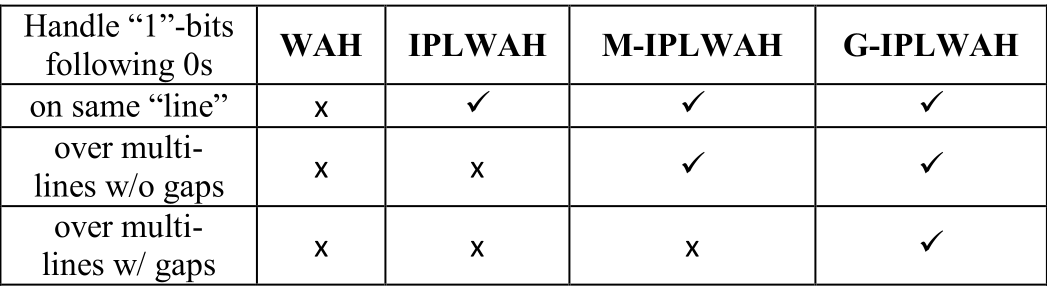
- IPLWAH tried to fix this by packing "1"s from a single succeeding group.
- M-IPLWAH improved it by packing "1"s from consecutive succeeding groups.
- The Gap Problem: If there is a single empty group (a "gap") between two active groups, both previous methods lose efficiency. They treat them as separate entities, wasting valuable bits.
Methodology: Bridging the Gaps
The core innovation of G-IPLWAH(k, g) lies in its flexibility. The parameter defines how many "1"-bits we try to pack, and defines the "span" or "gap" we can jump over.
Architecture Shift
While previous models used "flag bits" to indicate if several "1"s were on the same line, G-IPLWAH abandons flags in favor of extended position lists. By allocating more bits to represent the position, the algorithm can point to "1"s that reside 50, 80, or even 100 bits away from the starting zero-run.
The Encoding Logic
- Prefix (2 bits): Identifies the word type.
- Primary Position (5 bits): Locates the first "1"-bit.
- Extended Positions ( collections of bits): These are the "magic" bits. If , each collection has 7 bits, allowing it to address a much wider window of bit-space, effectively jumping over empty groups (the "gaps").
- Suffix: Stores the count of the preceding zero-runs.
Experiments & Results
The authors conducted an analytical comparison using user ID scenarios and validated performance on Stanford’s SNAP datasets.
The "Kees" Case Study Results:
- Uncompressed: 126,272 bits
- WAH: 384 bits
- IPLWAH(1): 256 bits
- M-IPLWAH(3): 160 bits
- G-IPLWAH(3, 2): 128 bits
By allowing the algorithm to "see" across gaps, the storage requirement for a single user's follow-list dropped significantly. In large-scale deployments involving billions of users, these savings are exponential.
Critical Analysis & Conclusion
Takeaway
G-IPLWAH represents a significant step forward in Structural Sparsity Management. It recognizes that data density in social networks isn't just low; it's "clumpy." By designing a compression model that fits the physical distribution of social relationships, the authors have reduced the memory bottleneck for graph mining.
Limitations & Future Work
While G-IPLWAH is superior for sparse data, it might introduce overhead if the data becomes too dense (though social networks rarely do). The choice of and currently seems to require heuristic tuning. Future research could focus on adaptive gap-line compression, where the parameters and adjust dynamically based on the local sparsity of the bitstream.
For engineers building recommendation systems or large-scale social analytics, G-IPLWAH offers a blueprint for processing "Big but Sparse" data without the traditional computational tax.