
G-IPLWAH: Bridging the Gaps in Sparse Big Social Data Compression
Compression for Very Sparse Big Social Data
This paper introduces G-IPLWAH (Gapped-line Improved Position List Word-Aligned Hybrid), a novel bitmap compression algorithm specifically designed for social network analysis. It extends previous hybrid models to efficiently represent very sparse but massive "following" relationships by allowing the compression of bitwise "1"s across multiple words even when non-consecutive gaps exist.
TL;DR
In the world of social media, everyone is a node, but very few are connected. This paper presents G-IPLWAH, a breakthrough in bitmap compression that tackles the extreme sparsity of social networks. Unlike previous methods that only compressed consecutive data, G-IPLWAH handles "gapped" relationships, reducing storage requirements by up to 3x compared to standard WAH compression and significantly speeding up social network mining.
Problem & Motivation: The Sparsity Paradox
Modern social networks like Instagram boast over 1 billion active users, yet the average user only follows about 150 accounts. When we represent this as a bit vector for data mining (where a '1' implies a connection), we are left with a vector of length 1,000,000,000 containing 99.999% zeros.
Existing compression standards like Word-Aligned Hybrid (WAH) are great at squashing long runs of zeros. However, they struggle when a few "1" bits appear close to each other but not in the same 31-bit block. Every time a "1" appears, most algorithms are forced to create a "literal word," breaking the compression flow. The authors identified a specific pain point: gaps. If user A follows user #10 and user #50, traditional models cannot easily group these two connections into one compressed word because of the "gap" in between.
Methodology: Introducing the Gapped-Line Model
The authors propose G-IPLWAH(k, g). Here is the technical breakdown:
- k: The maximum number of "1" bits we try to pack into a single compressed word.
- g: The "gap" factor, which extends the bit-range used to specify the position of those bits.
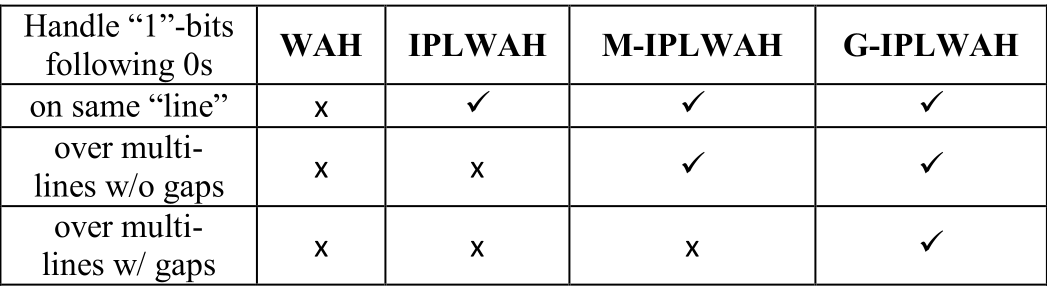
Evolution of the Architecture
The paper traces the genealogy of this technique:
- WAH: Compresses only consecutive groups of zeros.
- IPLWAH: Combines a zero-run with set bits in the very next 31-bit group.
- M-IPLWAH: Combines set bits across multiple consecutive groups.
- G-IPLWAH (Current): The first to allow combination even when there are empty "gap" groups between the set bits.
By utilizing bits for position marking, G-IPLWAH can reference positions beyond the standard 31-bit boundary (up to position 127). This allows several "lines" of social connections to be represented in a single 32-bit word, even if they aren't adjacent.
Experiments & Results: Efficiency Gains
The researchers tested their model using the SNAP (Stanford Large Network Collection) datasets, including Twitter and Google+ ego networks.
Key Findings:
- Space Efficiency: In a walkthrough example, G-IPLWAH reduced an uncompressed vector of 126,272 bits down to just 128 bits. This outperformed M-IPLWAH (160 bits) and WAH (384 bits).
- Speed: Thinner data means faster traversal. The reduction in memory footprint directly led to faster execution of frequent pattern mining algorithms, which are used to recommend "frequently followed" groups of users.
| Feature | WAH | IPLWAH | M-IPLWAH | G-IPLWAH |
|---|---|---|---|---|
| Multi-line Support | No | No | Yes | Yes |
| Gap Tolerance | No | No | No | Yes |
Critical Analysis & Conclusion
The beauty of G-IPLWAH lies in its flexibility. By introducing the parameter, it acknowledges that social data isn't just sparse; it's "clumpy" but disconnected.
Takeaways:
- Industry Impact: For companies managing massive relationship graphs, this compression allows more of the graph to reside in-memory (RAM), drastically reducing I/O bottlenecks.
- Limitations: There is a trade-off. Increasing or reduces the number of bits available to store the length of the zero-run. Finding the "sweet spot" (practically ) is essential for optimal performance.
Future Outlook:
This work sets the stage for "uncertain" social data compression—handling networks where connections aren't binary (1 or 0) but probabilistic. As social data continues to explode, G-IPLWAH provides the necessary "shorthand" for the digital age's vast social maps.