
DICeNod: Harnessing Compressive Sensing to Find Information Hubs in Massive Social Networks
Identifying central nodes for information flow in social networks using compressive sensing
The paper introduces DICeNod, a novel framework for identifying top-k high-betweenness centrality nodes in social networks using Compressive Sensing (CS). By transforming centrality identification into a sparse signal recovery problem, it achieves SOTA discovery of "information hubs" using only O(k log(n)) indirect measurements without requiring full network topology.
TL;DR
Identifying "central" nodes—the bottlenecks of information flow—is critical for everything from viral marketing to preventing network collapses. However, calculating global Betweenness Centrality is notoriously slow and requires a "God's eye view" of the network. This paper introduces DICeNod, a framework that uses Compressive Sensing to recover the top-k central nodes using minimal, indirect, and purely local measurements. It’s faster, scalable to millions of nodes, and doesn't need to know the full graph structure.
The Problem: The High Cost of Knowing Who's Important
In social network analysis, central nodes are the gatekeepers. If you want to spread an idea (or stop a rumor), these are your targets. But calculating these nodes globally is a nightmare for two reasons:
- Computational Cost: Standard algorithms like Brandes’ require time—impossibly slow for Facebook-scale graphs.
- Information Privacy: Social platforms don't share their full link structure. You usually only see your immediate neighborhood.
Current "sampling" methods often fail because they lose critical signal or require direct access to node data that might be restricted.
The Insight: Sparsity and Expansion
The authors make a brilliant observation: Centrality is sparse. In most real-world networks, follow a power law; only a tiny fraction () of nodes have very high centrality. This makes the problem a perfect candidate for Compressive Sensing (CS), a technique used in signal processing to reconstruct a signal from very few samples.
How DICeNod Works
The methodology follows three sophisticated steps:
- Local "Egocentric" Measurement: Instead of global centrality, each node calculates its own "ego-betweenness" using only its immediate neighbors (1-hop).
- Expander Graph Matrix: The system constructs a measurement matrix based on lossless bipartite expander graphs. This matrix dictates which nodes' local scores are summed together in an "aggregated measurement." Using expander graphs ensures that the "information spread" is captured with maximum efficiency.
- The Recovery Phase: Using the aggregated sums (the measurement vector ), the system solves an -minimization problem (Basis Pursuit) to find the sparse vector that identifies exactly which nodes were the central hubs.
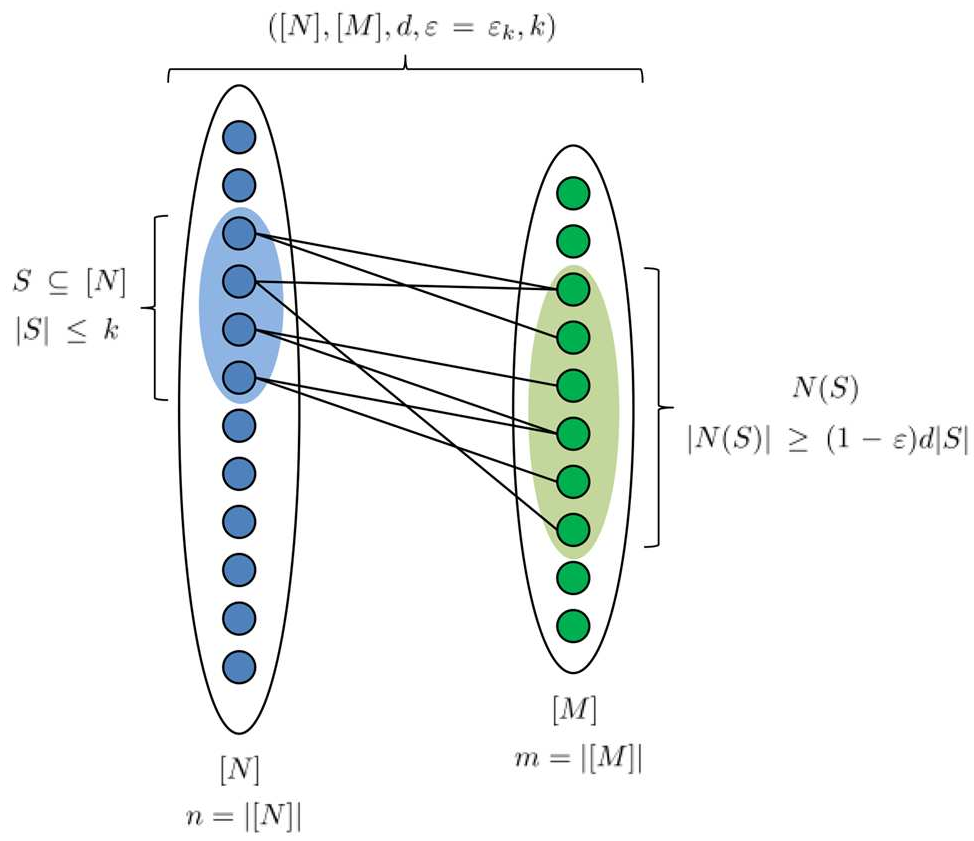 Figure 1: Transitioning from a complex network to a bipartite expander graph for efficient sampling.
Proving the Local-Global Correlation
A critical technical hurdle was proving that "local" betweenness actually tells you anything about "global" importance. The authors validated this across multiple datasets (AstroPh, Twitter, Facebook), finding a Pearson correlation coefficient () as high as 0.99 in some cases.
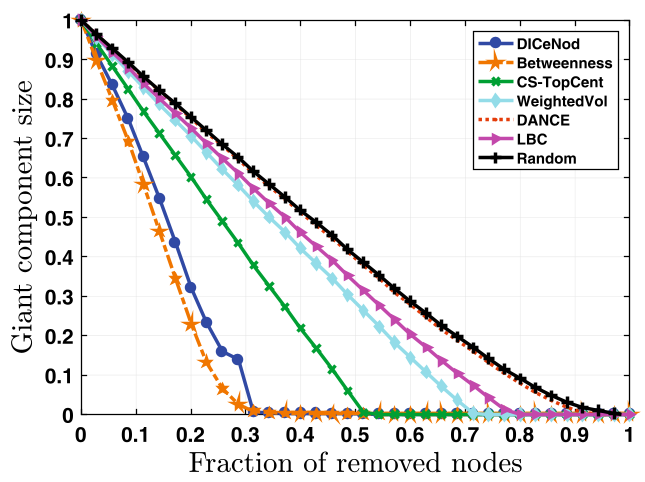 Figure 2: Scatter plots showing the strong positive association between local and global betweenness measures.
Experimental Results: Precision at Scale
DICeNod was tested using the Performance Ratio—a measure of how many operations it avoids compared to exhaustive search.
- Accuracy: In identifying the top-k nodes, DICeNod significantly outperformed sampling-based methods (FastApprox) and other distributed methods (DANCE).
- Speedup: On a Barabási–Albert (BA) network of nodes, DICeNod provided a speedup of over 100,000x.
- Robustness: When used for "network fragmentation" (removing nodes to break down a network), DICeNod was nearly as effective as the ground-truth global algorithm, needing to remove fewer nodes than any other competing approximation.
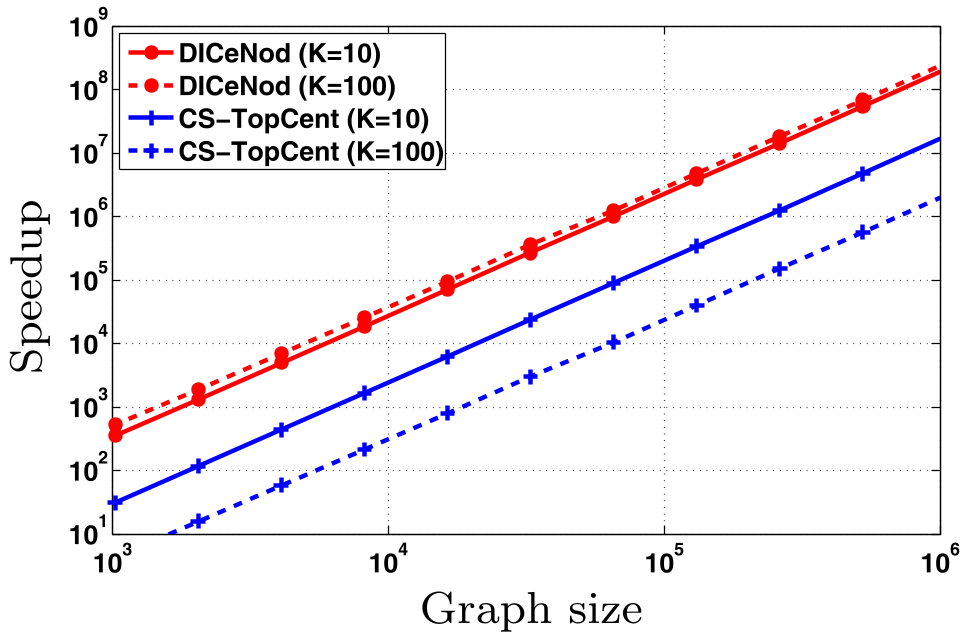 Figure 3: Log-log scale graph demonstrating that as network size grows, DICeNod's speed advantage over standard methods increases exponentially.
Critical Insight & Conclusion
DICeNod represents a shift from calculating importance to reconstructing it. By treating network topology as a set of constraints rather than an open book, the authors have created a tool that is both privacy-aware and mathematically rigorous.
The big takeaway? You don't need to see the whole world to know where the bridges are. If you know how the local neighborhoods connect and you apply the right "compressive" logic, the global structure emerges clearly. This has immediate applications in viral marketing, cybersecurity (protecting bottlenecks), and epidemiology.
Limitations
The primary limitation is the Sparsity Assumption. If a network is "flat" (where everyone is equally central), the CS recovery will fail. However, since almost all human-made and natural networks are scale-free, DICeNod remains a powerful tool for the era of Big Data.