
Decoding the Blogosphere: Computational Mining for Sociological Insights
Computational analysis of thematic blog data for sociological inference mining
This paper proposes a computational framework for "Sociological Inference Mining" using a combination of Topic Modeling (LDA), Named Entity Recognition (NER), and Sentiment Analysis (SentiWordNet). The study analyzes thematic blog data concerning discrimination and violence against women, effectively extracting key actors, societal themes, and emotional shifts across different time periods.
TL;DR
This research presents a scalable computational framework to extract sociological meaning from the "wild west" of blog data. By integrating Topic Modeling (LDA), Named Entity Recognition (NER), and Sentiment Analysis, the authors transform unstructured expressions of social outcry into structured insights regarding thematic shifts, key stakeholder involvement, and public emotional polarity—specifically focusing on global discourse surrounding crimes against women.
The "Digital Treasure House" of Sociology
The blogosphere has long been viewed through a commercial lens (influencer marketing) or a purely technical one (spam filtering). However, the authors argue it is a "treasure house" for cross-cultural psychological and sociological analysis.
The core challenge is the unstructured nature of this data. Unlike news articles, blogs are uninhibited, first-hand, and emotionally laden. This study seeks to bridge the gap between "Big Data" and "Human Meaning," asking: Can we mathematically map the collective consciousness of the internet during a social crisis?
Methodology: The Triadic Algorithmic Combine
The researchers don't rely on a single model but a pipeline designed to answer "What," "Who," and "How."
1. Topic Modeling (The "What")
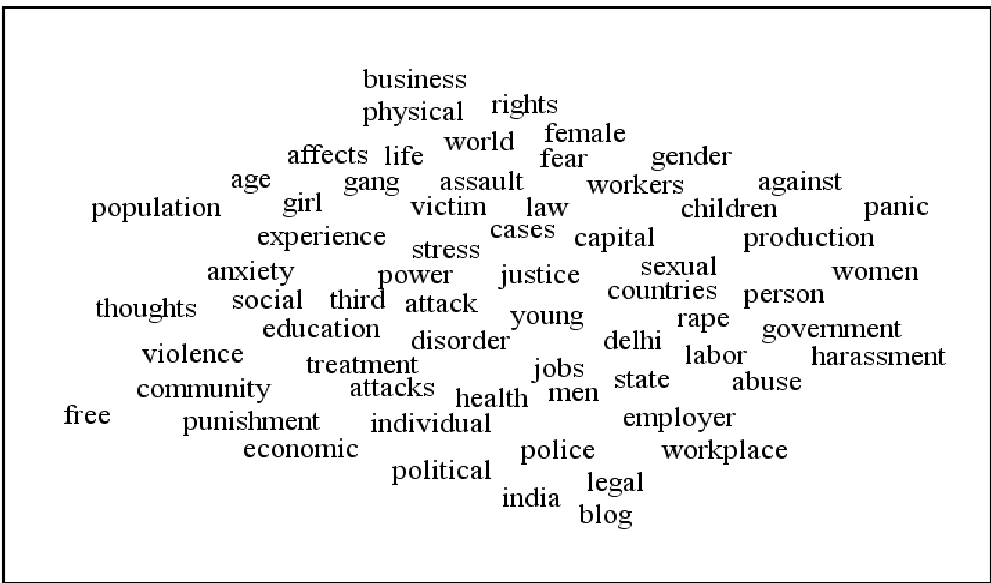
Using the Stanford Topic Modeling Toolbox, they employed Latent Dirichlet Allocation (LDA). The goal was to identify hidden thematic structures across two time periods: June 2012 (baseline) and December 2012 (post-crisis).
2. Named Entity Recognition (The "Who")
By implementing a Conditional Random Field (CRF) model, they extracted seven classes of entities. This allows the system to identify which politicians (e.g., Obama, Shinde) or organizations (e.g., NGO, Supreme Court) are central to the discourse, revealing who the public holds responsible or looks to for hope.
3. Sentiment Classification (The "How")
Instead of a simple "bag of words," they used SentiWordNet with a clever heuristic: Adverb+Adjective combinations. Adverbs act as intensifiers (e.g., "extremely painful"), and the system even accounts for negation (e.g., "not safe"), providing a more granular sentiment score than standard keyword matching.
 The dataset properties showing the massive word counts processed across popular blogging platforms like WordPress and Blogspot.
Experimental Insights: A Nation in Reflection
The study’s most compelling result is the comparison between the two 2012 datasets. Following the tragic 16th December incident in India, the topic proportions shifted drastically.
- Pre-event (June): Topics were broad, covering workplace harassment, gender discrimination, and human rights in the "Third World."
- Post-event (December): The discourse crystallized. The "National Shame" incident led to themes centered on capital punishment, political apathy, and the "Rape Capital" label of Delhi.
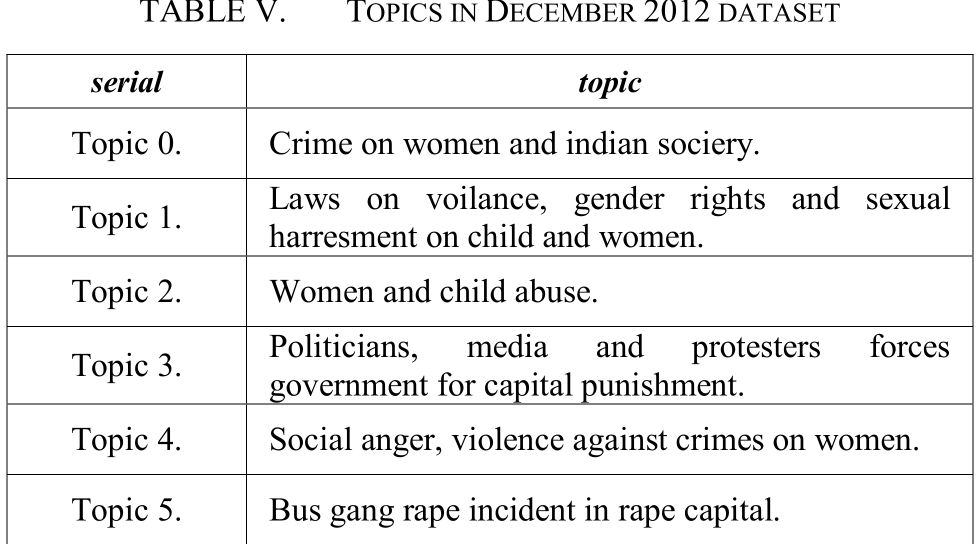 Table showing specific topics in the December dataset, highlighting "Social Anger" and "Bus gang rape incident."
Named Entities: Mapping global vs. local
The NER results showed that the blogosphere connects local tragedies to global patterns. While June's data featured global figures like Obama and Melinda Gates, December's data was dominated by local Indian political figures and legal institutions (e.g., Delhi Police, Shinde, Congress), demonstrating how the blogosphere "narrows its focus" during a localized crisis.
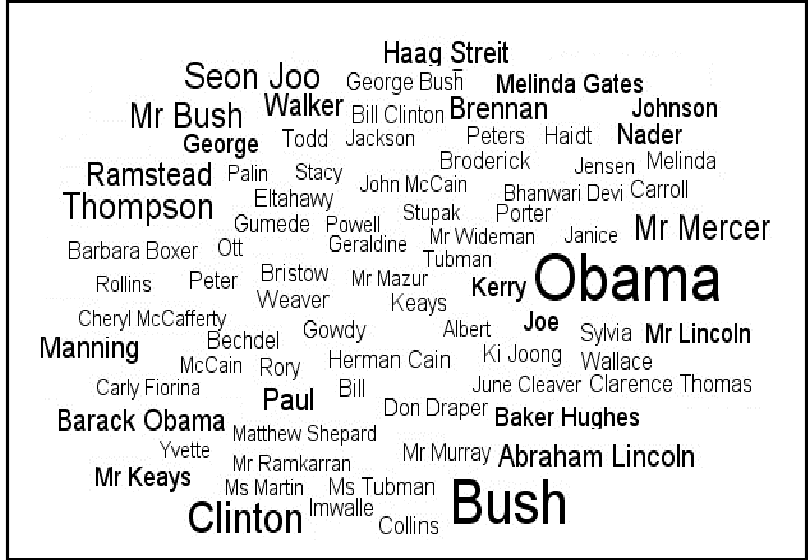 Visualizing prominent figures extracted via NER during the stable June period.
Critical Analysis & Conclusion
The Takeaway
The framework proves that we can extract "Sociological Inferences" automatically. The sentiment analysis revealed a critical nuance: while the anger was palpable, the data was balanced between negative sentiment and "optimism for improvement."
Limitations
- Lack of Aspect-Level Sentiment: The current model gives a "global" sentiment for a post. It cannot yet distinguish if a blogger is "Positive" about a new law but "Negative" about the police.
- Technological Context: Written before the era of Large Language Models (LLMs), the linguistic depth is limited to statistical word patterns rather than semantic understanding.
Future Outlook
This work paves the way for real-time sociological monitoring. By refining these algorithms with modern Transformer-based architectures, researchers could potentially predict civil unrest or track the global adoption of social norms in near real-time.