
What Is Unclear? Decoding the Hidden Metrics of Task Clarity in Crowdsourcing
What Is Unclear? Computational Assessment of Task Clarity in Crowdsourcing
The paper introduces a computational framework for assessing task clarity in crowdsourcing by identifying seven specific "clarity flaws." The authors develop BERT-based and feature-based SVM classifiers, achieving up to 0.74 accuracy in flaw detection, effectively automating the evaluation of task instructions.
TL;DR
Unclear task descriptions are the Achilles' heel of crowdsourcing, leading to poor data quality and worker burnout. This research moves beyond subjective "feelings" of unclarity by defining seven distinct clarity flaws and proving that machine learning (especially SVMs with rich linguistic features) can detect these flaws automatically, often outperforming complex neural models like BERT in data-constrained scenarios.
Background: The Cost of Ambiguity
In the crowdsourcing ecosystem, the "Requesters" (who post tasks) and "Workers" (who complete them) are often separated by a massive communication gap. Unlike a standard workplace, there is no "water cooler" to clarify a confusing email. If a task description like "Make sure the site is indexed" is posted, a worker might waste hours without knowing if the requester wants a technical log or a simple screenshot.
The authors argue that we need an automated "Grammarly" for task design—a tool that flags missing information before the requester hits "Publish."
The Taxonomy of Unclarity
The core of this work is the identification of seven "Clarity Flaws" grounded in human-computer interaction (HCI) literature:
- Difficult Wording: Complex syntax or jargon.
- Important Terms Undefined: Technical terms left unexplained.
- Desired Solution Unspecified: The goal is vague.
- Solution Format Unspecified: No instructions on file types or data structures.
- Steps Unspecified: Lack of a clear workflow.
- Resources Unspecified: Missing links or tools.
- Acceptance Criteria Unspecified: No clear definition of what constitutes "success."
Methodology: Feature Engineering vs. Transformers
The researchers compared two heavyweights in NLP:
- BERT (Transformer): Leveraging deep semantic understanding.
- Linear SVM (Feature-based): Using 6 specific feature types, including Readability indices (Flesch-Kincaid), Subjectivity scores, and POS categories.
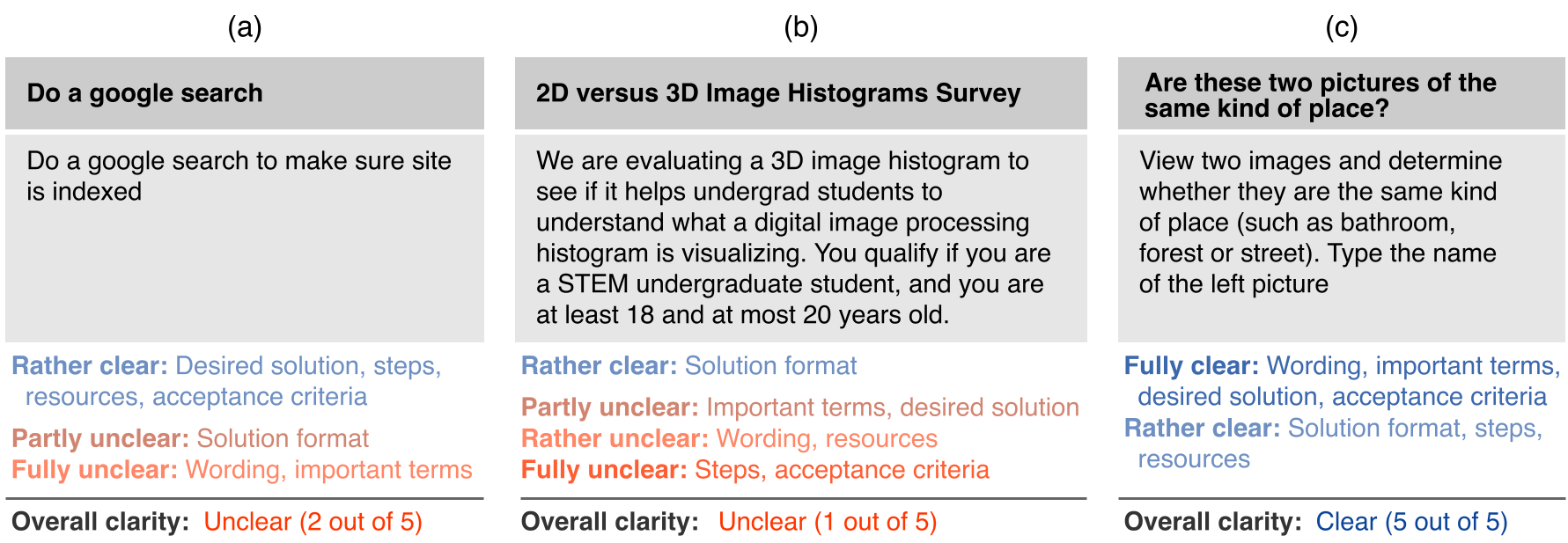 Figure 1: Comparison of clear vs. unclear descriptions. Notice how "Description (c)" provides specific actions compared to the vague nature of (a).
Key Insights: Why "Short" Doesn't Mean "Clear"
One of the most striking findings in the paper is the irrelevance of length. In many text classification tasks (like Wikipedia quality assessment), length is a proxy for quality. Here, the "Length" feature (A2 in the table) was the weakest performer. A long task description can be just as confusing as a short one if it lacks the specific "Acceptance Criteria."
Experimental Performance
The SVM with all features (A1-6) reached an accuracy of 0.73 for overall unclarity. Interestingly, BERT struggled with "Overall Unclarity" compared to the feature-weighted SVM, suggesting that clarity is a composite of specific stylistic markers rather than just latent semantic meaning.
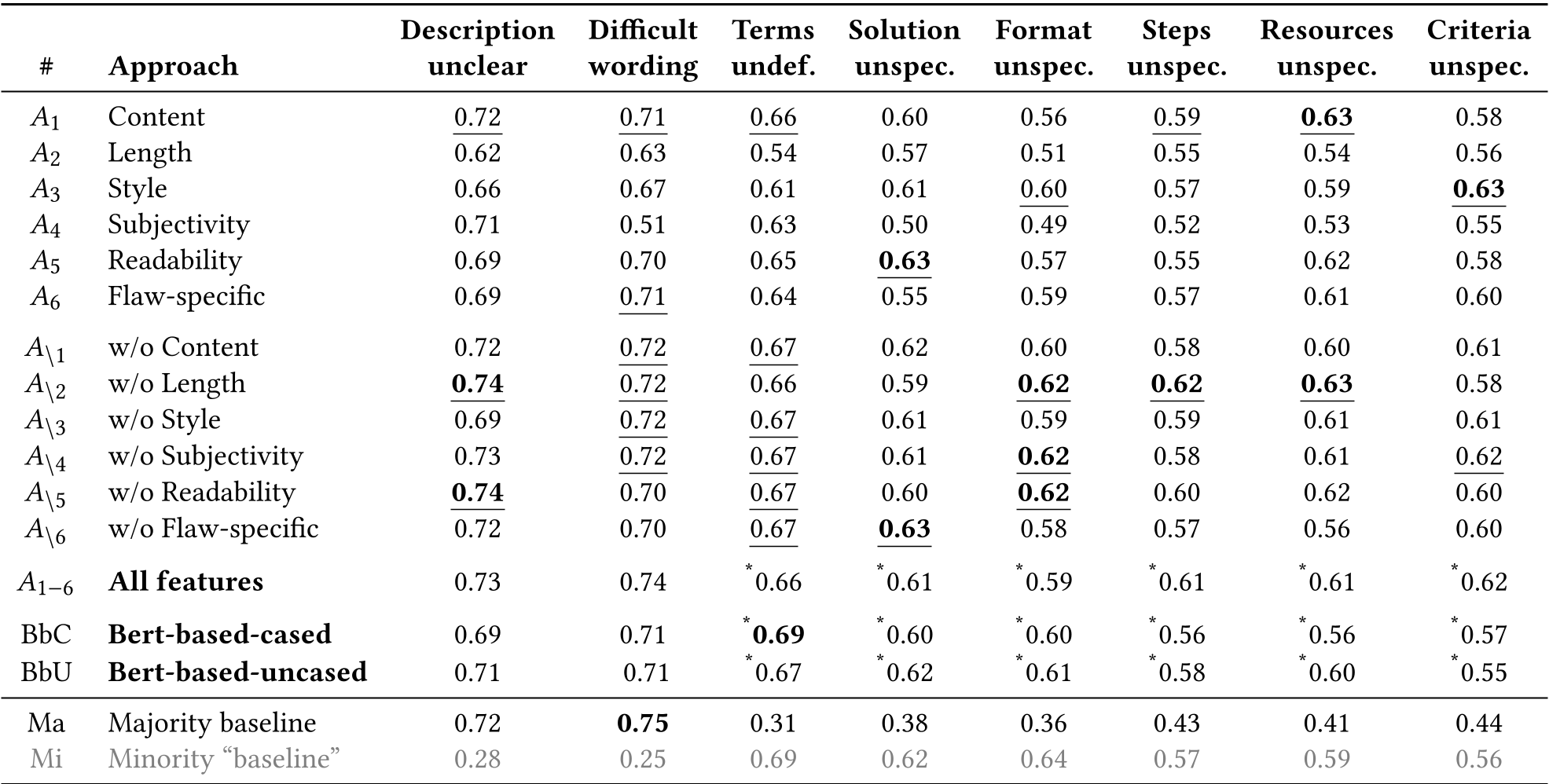 Table 3: Accuracy comparison. Note how A1-6 (SVM) consistently holds its own against or beats BERT (BbU/BbC).
Deep Dive: What Makes a Task Unclear? (RQ2)
- Content is King: TF-IDF (content) features were the strongest indicators of missing resources and undefined terms.
- Style Matters: Part-of-Speech n-grams were highly effective at identifying if "Steps" were missing—likely because instruction-heavy texts use specific imperative verb patterns.
- Readability Metrics: These were surprisingly effective at identifying when the "Desired Solution" was unspecified, suggesting that complex language often masks a lack of a clear goal.
Critical Analysis & Conclusion
While the models are robust, the paper admits a significant hurdles in "Difficult Wording." Because "difficulty" is highly dependent on the worker's background, a universal classifier struggle to capture this nuance without demographic context.
The Takeaway: For platforms like MTurk or Prolific, integrating these classifiers could revolutionize the "Task Design" phase. By providing real-time feedback (e.g., "You haven't specified the solution format!"), we can reduce waste and foster a more sustainable crowdsourcing economy.
Future Outlook: The next logical step is generative correction—not just flagging the flaw, but using LLMs to suggest a clarified version of the text, effectively bridging the gap between novice requesters and expert workers.