
Decoding Healthcare Bottlenecks: An Intuitionistic Fuzzy Approach to Patient Length of Stay
A Computational Intelligence Framework for Length of Stay Prediction in Emergency Healthcare Services Department
This paper introduces a Machine Learning framework designed to predict Patient Length of Stay (LOS) in Emergency Healthcare Services Departments. The core of the system is an Intuitionistic Type-2 Fuzzy Logic System (IT2-FLS) implemented using the Mamdani inference algorithm to handle complex linguistic uncertainties in hospital operations.
TL;DR
Predicting how long a patient will occupy an emergency bed is a "wicked problem" involving medical, financial, and social variables. This paper proposes a computational intelligence framework using Intuitionistic Type-2 Fuzzy Logic (IT2-FLS) to predict Length of Stay (LOS), offering a logic-based alternative to black-box neural networks that better handles the "imprecise" nature of medical data.
The "Why": Beyond Linear Predictions
In many healthcare systems, specifically in Nigeria, the Emergency Department (ED) is a high-pressure environment where overcrowding isn't just an inconvenience—it's a safety crisis. Traditional statistical models (like Linear Regression) assume clear-cut relationships between variables. However, medical reality is blurry.
Terms like "Severe Illness" or "Poor Financial State" mean different things to different clinicians. The authors argue that Type-1 Fuzzy Logic is insufficient because its membership grades are "crisp." To truly model human uncertainty, we need Type-2 Fuzzy Logic, which allows for a "fuzziness of a relation" by adding a second dimension of membership.
Methodology: The Logic of Hesitancy
The proposed framework identifies five critical inputs that determine the LOS:
- Severity of Illness/Emergency Cases (SIC)
- Financial State/Cost of Treatment (FCT)
- Emotional Support/Mental State (EMS)
- Availability of Medical Personnel (AMP)
- Genetic/Hereditary Disorder (GHD)
The Secret Sauce: The Hesitancy Index
Unlike standard models, the Intuitionistic approach considers not just the probability that a patient will stay long, but also the degree of non-membership and the "Hesitancy" involved. This mimics a doctor's intuition: "I'm 70% sure they stay 5 days, 20% sure they won't, and 10% uncertain because of underlying complications."
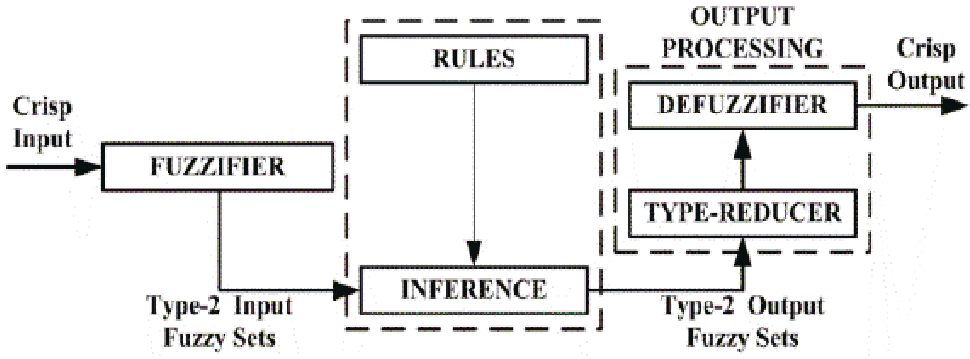 Fig 1: The Interval Type-2 Fuzzy Logic System (IT2-FLS) structural flow.
The system uses Gaussian Membership Functions for smoothness and the Mamdani Inference Engine to map inputs to three output categories: Quick, Normal, or Extended stay.
Experimental Results & Insights
By analyzing data from the University of Uyo Teaching Hospital (UUTH), the model demonstrated how different variables interact.
- The Dominance of Severity: Severity of Illness (SIC) acts as the primary anchor. Even with high financial support, a very high SIC almost guaranteed an "Extended" stay.
- Quantifiable Impact: Implementation of this logic in ED operations is projected to decrease patient experience times by 30%.
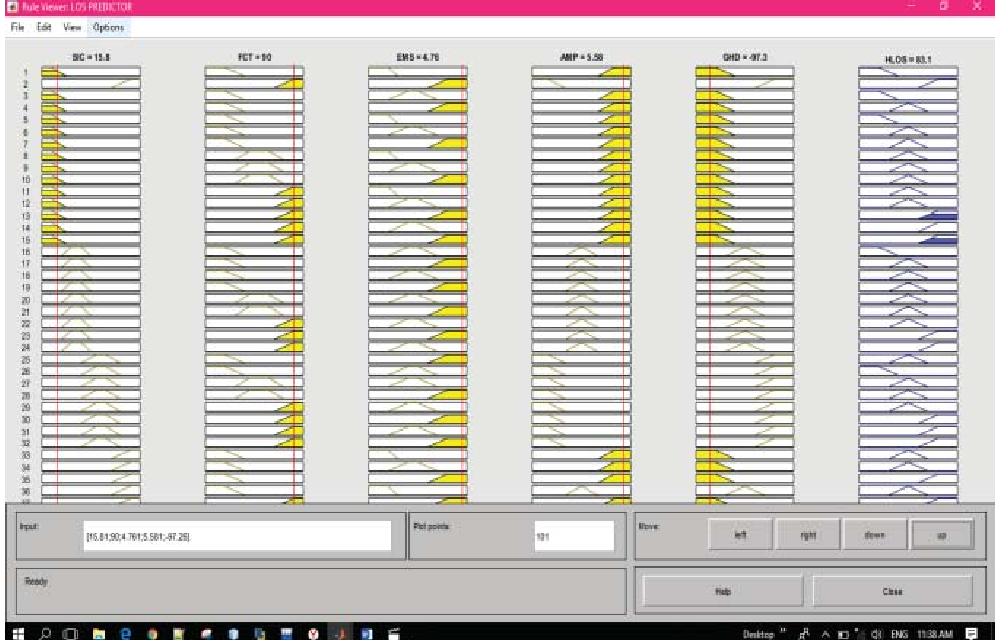 Fig 2: Visualization of contributing variables against the HLOS output.
The surface plots generated by the researchers (e.g., SIC vs. Financial State) reveal that the impact of social factors is most volatile when the medical severity is "Normal"—this is where the model provides the most decision-support value to hospital managers.
Critical Perspective: Context Matters
While the math is rigorous, the paper honestly addresses a regional reality: in Nigeria, over 99% of healthcare costs are borne by the patient. This makes Financial State (FCT) a much heavier weight in LOS prediction than it might be in an insurance-based system like the UK or USA.
Limitations
- Data Granularity: The "Primary Data" relied on a relatively small sample size (20 patients), though supplemented by more extensive secondary household surveys.
- Implementation Barrier: Moving from a MATLAB simulation to a real-time hospital dashboard requires digital infrastructure that many clinics in developing regions currently lack.
Takeaway for the Industry
This research proves that Computational Intelligence doesn't always need "Big Data" or massive GPUs. By using Fuzzy Logic, we can build expert systems that "reason" through socio-medical complexities, providing hospital administrators with the foresight needed to clear bed backlogs before they happen.