
Beyond the Code: Improving Software Quality via Computational Linguistics
Application of Computational Linguistics Techniques for Improving Software Quality
The paper presents the CROSSMINER project, an open-source platform that leverages Computational Linguistics and Big Data to evaluate the quality of Open Source Software (OSS). It introduces Natural Language Processing (NLP) metrics, specifically sentiment and emotional analysis, to assess community support and developer interactions.
TL;DR
While code quality is often measured by syntax and bugs, the CROSSMINER project argues that the human element—found in forums and bug trackers—is equally critical. By applying sentiment analysis to developer communications, this research reduced OSS evaluation time by 40% and streamlined decision-making for industrial software architects.
Background: The Hidden Signals in OSS
Modern software development is synonymous with reusing Open Source Software (OSS). However, choosing the right library isn't just about the code; it's about the community. A library might have clean code but a toxic or inactive support channel, leading to high integration risks. Previous methods focused almost exclusively on static code analysis, ignoring the "vital and potentially hidden information" in natural language.
Methodology: CROSSMINER's NLP Engine
The CROSSMINER platform bridges the gap between Big Data and Software Engineering through four key pillars:
- Source Code Analysis: Traditional extraction of architecture and metrics.
- Natural Language Analysis: Using NLP to quantify community health.
- Workflow-based Extraction: Automating the data pipeline.
- IDE Integration: Bringing these insights directly to the developer's workspace.
Sentimental and Emotional Metrics
Instead of just looking at bug resolution speed, CROSSMINER computes "Sentimental Metrics." It categorizes developer interactions into specific emotions: Surprise, Joy, Love, Sadness, Anger, and Fear.
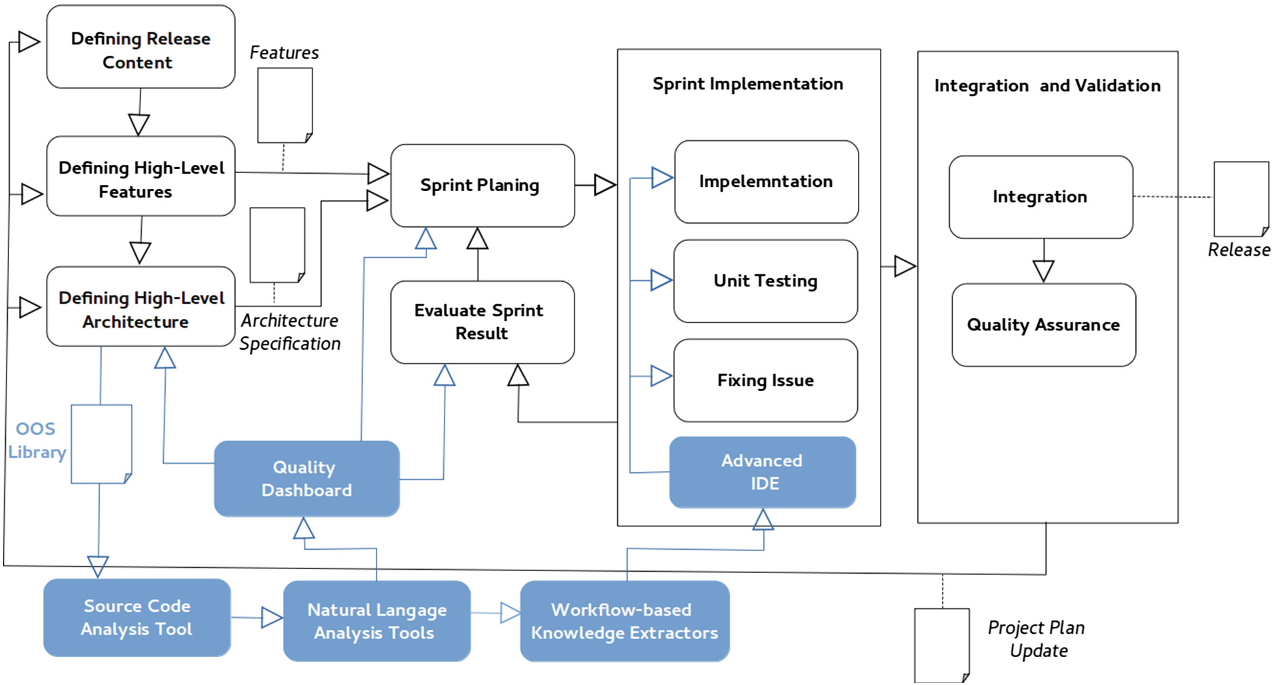 Figure 1: Integration of NLP techniques into the standardized development process at Softeam.
By analyzing a bug tracker's emotional landscape, project leaders can detect "severity" through the frustration levels of users, or "reliability" through the joy and supportiveness of the community responses.
Industrial Evidence: The Softeam and OW2 Use Cases
The paper validates this approach through two major industrial players:
1. Softeam (Commercial Efficiency)
As a company building long-lived products like Modelio, Softeam integrated sentiment analysis into their Agile sprints. Architects used cross-project sentiment data to choose frameworks.
- Time Savings: Evaluation time for project architecture dropped by 40%.
- Onboarding: Developers unfamiliar with new libraries saw a 10% reduction in development time because the tools highlighted the most relevant support information.
2. OW2 (Market Readiness)
OW2, an open-source non-profit, used these tools to develop a Market Readiness Index. This index helps managers select projects based on "business sustainability" rather than just a GitHub star count.
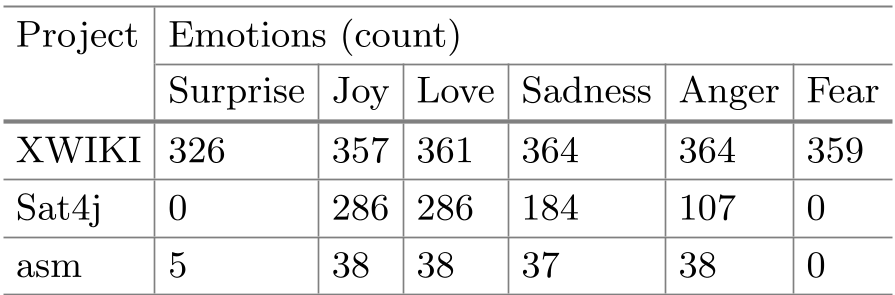 Table 1: Quantitative emotion breakdown (Surprise, Joy, etc.) across different OSS projects like XWIKI and Sat4j.
Deep Insight: Why Why Emotions Matter in Engineering
The core intuition here is that developer emotion is a leading indicator of technical debt. A project filled with "Anger" in its bug tracker likely has undocumented complexities or structural flaws that frustrate users. Conversely, a high "Joy" or "Love" count indicates a mature, supportive ecosystem that lowers the risk for third-party adoption.
Conclusion & Future Outlook
CROSSMINER proves that software quality is a socio-technical phenomenon. The future of AI-assisted development (Copilots, etc.) will likely move beyond autocomplete and into community-aware suggestions, advising developers not just on how to write code, but which libraries are safe to depend on based on real-time community sentiment.
Limitations: The current framework relies on keyword-based or traditional NLP classifiers. Transitioning to Transformer-based models (like BERT or GPT) could further improve the nuance of emotion detection, especially in developer "lingo" which is often heavy on sarcasm or technical jargon.
 Figure 2: The CROSSMINER project vision: Mining knowledge from large repositories.