
CLiMB: Bridging the Image Metadata Gap through Computational Linguistics
Computational linguistics for metadata building (CLiMB): using text mining for the automatic identification, categorization, and disambiguation of subject terms for image metadata
The paper introduces the CLiMB (Computational Linguistics for Metadata Building) Toolkit, a semi-automatic system that utilizes Natural Language Processing (NLP) and Word Sense Disambiguation (WSD) to extract high-quality subject metadata for images from associated scholarly texts. It bridges the gap between manual cataloging and automated indexing by linking extracted terms to authoritative domain-specific thesauri like the Art and Architecture Thesaurus (AAT).
TL;DR
The CLiMB project addresses the critical shortage of subject-based access points in digital image libraries. By applying advanced Natural Language Processing (NLP) to the scholarly texts already associated with images (like curatorial essays), the system extracts, categorizes, and disambiguates metadata terms, linking them to professional thesauri to aid expert catalogers.
Problem & Motivation: The Metadata Bottleneck
In the specialized worlds of art history and architecture, finding an image is only half the battle; understanding its subject matter—the "of" (identifiable objects) and the "about" (interpretive meaning)—is vital for research. However, human cataloging is time-consuming. Studies show that catalogers often assign fewer than eight terms per image, and many legacy records have no subject descriptors at all.
Prior attempts to solve this typically relied on keyword matching or Content-Based Image Retrieval (CBIR). Keyword search is plagued by polysemy (one word, many meanings), while CBIR often misses the abstract iconology that art historians crave. The CLiMB team's insight was that the rich descriptive text surrounding images in catalogs and textbooks is an untapped goldmine of metadata.
Methodology: The CLiMB Pipeline
The CLiMB Toolkit doesn't replace the cataloger; it empowers them. The architecture follows a semi-automatic workflow:
- Text Segmentation & Association: The system identifies which segments of a text (sentences or paragraphs) refer to which specific image anchor.
- Semantic Classification: Using Naive Bayes, the system classifies text spans into functional categories like Image Content, Historical Context, or Biographical Information.
- Linguistic Analysis: This involves POS tagging and NP chunking to extract candidate noun phrases.
- Word Sense Disambiguation (WSD): This is the core technical challenge. How do you know if a "panel" refers to a section of a wall (architecture) or a wood painting (fine arts)?
The Disambiguation Hierarchy
The system employs a specific "backing off" strategy for disambiguation:
- Modifier Lookup: Looking at surrounding words (e.g., "ceiling" in "ceiling coffers").
- SenseRelate: Utilizing WordNet definitions and the Lesk algorithm to measure word overlap.
- Thesaural Mapping: Final linking to the Art and Architecture Thesaurus (AAT), the Union List of Artist Names (ULAN), and the Thesaurus of Geographic Names (TGN).
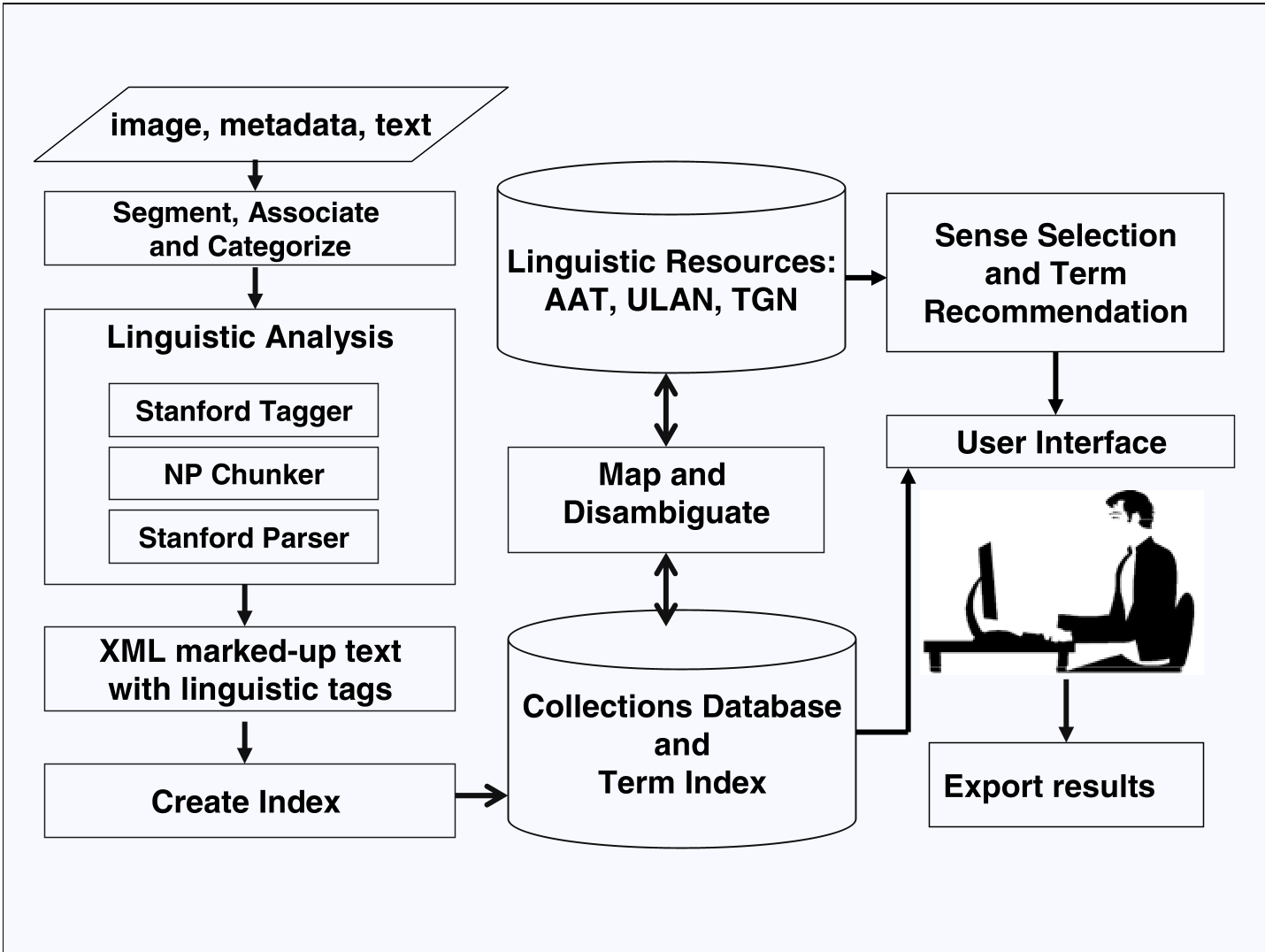 Figure 1: The overall architecture of the CLiMB Toolkit, showing the transition from raw text and images to disambiguated metadata.
Experiments & Results
The researchers tested their system across several art and architecture collections, including the National Gallery of Art.
- Semantic Labeling: The "Image Content" classifier hit an impressive 83% accuracy, proving that text mining can reliably distinguish between descriptions of visual items and historical fluff.
- Disambiguation Performance: While human experts agreed 91% of the time, the CLiMB algorithm achieved roughly 55% accuracy. While this sounds modest, it represents a nearly 20% absolute improvement over baseline keyword methods.
 Table 1: Comparison between CLiMB algorithm accuracy and baseline methods for two different labelers.
Critical Analysis & Conclusion
Takeaway
CLiMB successfully proves that context matters. By treating image metadata as a linguistic problem rather than just a visual one, the project opens doors for high-precision retrieval in digital libraries.
Limitations & Future Work
The primary bottleneck observed was the reliance on WordNet for initial disambiguation. Because WordNet is a general-purpose resource, it often misses the nuanced definitions found in a specialized resource like the AAT. For example, WordNet's primary sense of "feet" (body part/measurement) isn't even present in the AAT's 42 senses, which focus on furniture components.
Future iterations aim to map directly to domain-specific ontologies and explore "Social Tagging" (like the steve.museum project) to combine expert extraction with crowd-sourced insights. As we move into the era of LLMs, the groundwork laid by CLiMB regarding the importance of structured, thesaural-linked metadata remains a cornerstone for high-fidelity museum informatics.