
Beyond the Friend Button: Quantifying Trust in Mobile Social Networks via Fuzzy Logic
A Computational Model for Measuring Trust in Mobile Social Networks Using Fuzzy Logic
This paper introduces a computational trust model for Mobile Social Networks (MSNs) using fuzzy C-means clustering and a multi-faceted inference mechanism. The method maps subjective trust into numerical values, achieving a precision increase of up to 17% in trust prediction over standard classification baselines.
TL;DR
Quantifying human trust is notoriously difficult because "trust" isn't a binary 0 or 1—it is a spectrum of perception. This paper presents a fuzzy-logic-driven computational framework that clusters users by profile similarity and calculates trust through a multi-dimensional lens (location, prestige, and behavior). Tested on a real-world multi-national social network, the model significantly improves trust prediction accuracy by treating membership as a gradient rather than a hard boundary.
The Challenge: Mapping Intuition to Algorithms
In the physical world, trust is built over years of face-to-face interaction. In Mobile Social Networks (MSNs), we make split-second decisions based on sparse data: a profile picture, a registration date, or a common friend.
Current SOTA methods often struggle with:
- Subjectivity: One user’s "trusted friend" is another's "acquaintance."
- Sparsity: Most users aren't directly connected, yet they rely on each other for information.
- Rigidity: Standard classification labels (Trust/Distrust) fail to capture the nuanced "gray areas" of social dynamics.
Methodology: The Fuzzy Approach
The researcher, Farzam Matinfar, breaks the problem into two distinct phases: Fuzzy Clustering and Trust Inference.
1. User Clustering
Instead of putting users into boxes, the model uses Fuzzy C-means clustering. Variables like age (mapped to linguistic terms like "Teen" or "Young Adult"), Persian language proficiency, and registration date determine a user's membership degree in various clusters.
2. Multi-Dimensional Trust Criteria
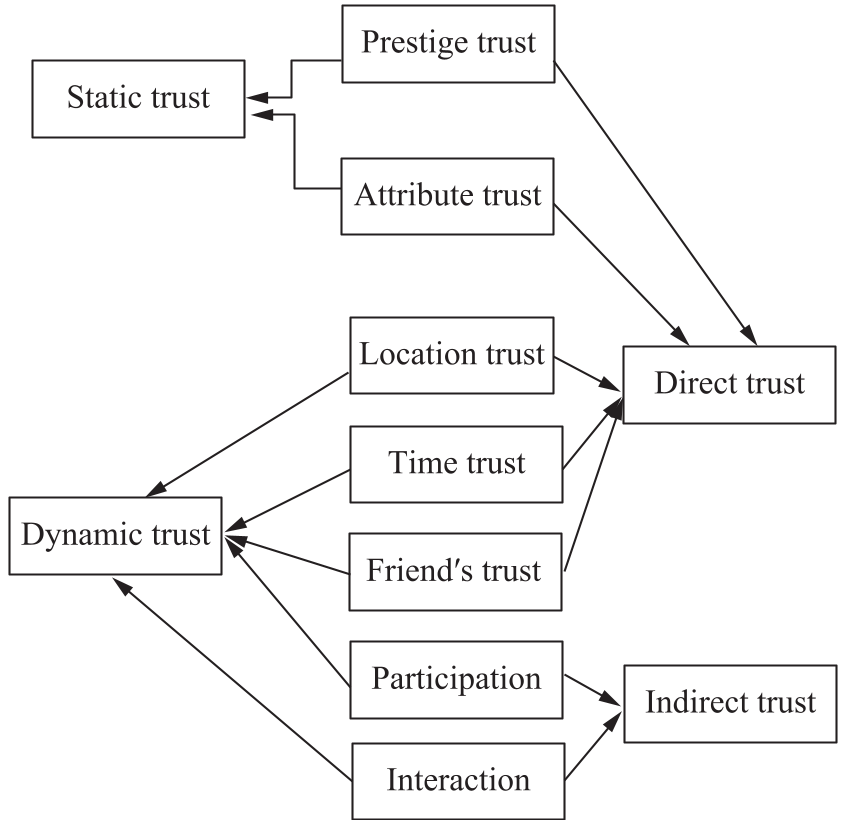
The core innovation lies in the seven-factor formula for direct trust:
- Attribute Trust: Similarity in profiles.
- Prestige Trust: Measured by the "quality" and quantity of incoming links (positive vs. negative).
- Interaction Trust: Frequency and recency of communication (using a decay factor ).
- Location-based Trust: Calculated using IP address proximity.
- Time Trust: The ratio of private to public messages during "closing hours," suggesting intimacy.
3. Transition and Aggregation
For users who aren't friends, the model finds intermediate "bridge" users. Usefully, the model applies a function across paths to ensure that indirect trust is never stronger than the weakest link in the chain—a logic that mirrors human caution.
Experimental Results
The model was validated using the Saadi Foundation dataset, a social network for Persian language learners across 39 countries.
Key Performance Metrics:
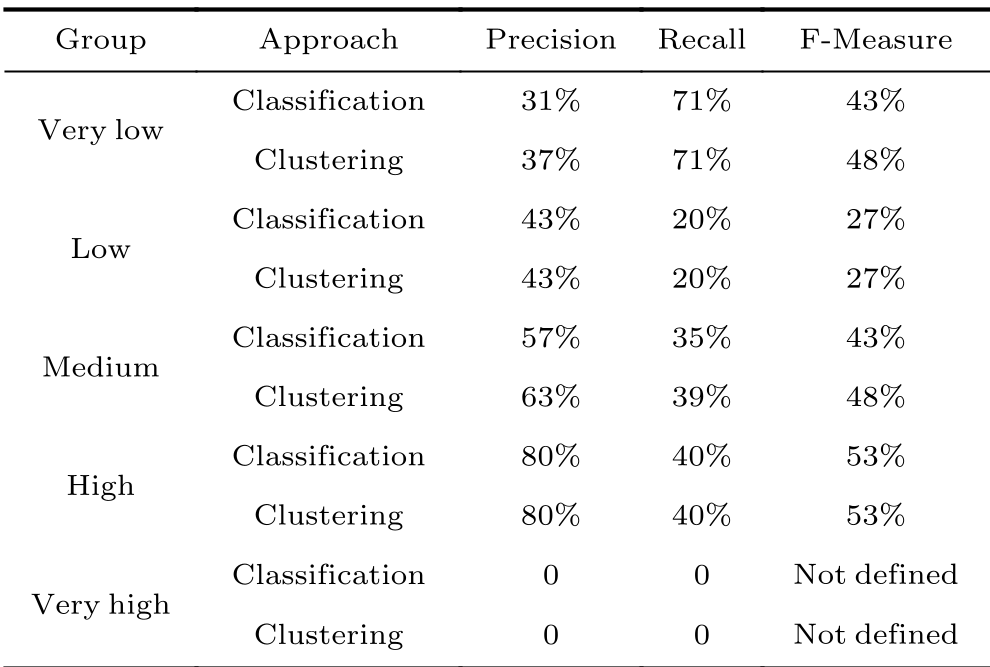
- Clustering vs. Classification: Clustering achieved a higher F-measure across almost all categories. In the "High Trust" category, it reached 49% precision compared to 43% for classification.
- The Power of Location: The study found a massive correlation between IP similarity and trust. 63% of users with high location similarity were correctly predicted as having "high" or "very high" trust levels.
- Refined Precision: By weighing prestige and location more heavily in a second iteration, the author boosted mean precision from 39% to 56%.
Critical Insight: Why Does This Work?
The success of this model stems from its Inductive Bias toward human-like reasoning. By using fuzzy membership, the model acknowledges that a user can belong to multiple social circles simultaneously. Furthermore, the inclusion of "Prestige" acts as a form of "Social Proof," which is a dominant psychological driver in digital environments.
Conclusion & Future Look
Matinfar’s work demonstrates that while trust is a "soft" concept, it can be hardened into a predictive tool through fuzzy mathematics. However, the model has limits—the weights () for different criteria were largely static in this study.
The next frontier? Deep Reinforcement Learning to dynamically adjust these weights based on real-time user behavior, potentially creating a "self-correcting" trust ecosystem that can detect sybil attacks or deceptive behaviors as they evolve.
Keywords: Trust Calculation, Fuzzy Clustering, Mobile Social Networks, Social Computing.