
Beyond Logic: Bridging the Gap Between Neuroscience and Affective Computing
Computational models of emotions for autonomous agents: major challenges
This paper provides a comprehensive review of Computational Models of Emotions (CMEs) for autonomous agents, identifying four critical gaps in current research. It proposes a novel three-level biologically inspired framework that leverages neuroscience findings to create more believable and robust affective agents.
TL;DR
Building truly "intelligent" autonomous agents requires more than just faster reasoning; it requires artificial emotion. While current Computational Models of Emotions (CMEs) help agents mimic human-like reactions, they are often brittle and lack a solid biological foundation. This paper analyzes why current models hit a ceiling and proposes a blueprint for the next generation of "Biologically Inspired CMEs" that treat emotion as an emergent property of the brain's architecture.
The "Believability" Bottleneck
In the quest to build social robots (like Kismet) or training simulations (like EMA), we have relied heavily on Appraisal Theory. This psychological framework suggests that emotions arise from evaluating stimuli against goals (e.g., "Is this event good for me?").
However, the authors point out a major flaw: Psychological theories describe the "What" but not the "How." Developers are forced to fill the gaps with "working assumptions"—arbitrary code that doesn't reflect how biological brains actually handle stress, fear, or joy. This leads to agents that feel "scripted" rather than truly "affective."
The Four Grand Challenges
- Cognitive Integration: Emotions aren't a side-car; they modulate attention and memory. Current agents keep them in isolated modules.
- Unification: There is no "Grand Unified Theory" of emotion, leading to fragmented implementations.
- Scalability: Most architectures are so rigid that adding a new "discovery" about the brain requires a total rewrite.
- Biological Evidence: We ignore decades of neuroscience research on the Amygdala and the Prefrontal Cortex in favor of simple "if-then" logic.
Methodology: The Three-Level Refinement
The authors propose a radical shift in how we build CMEs, moving from abstract logic to a layered biological approach.
Level 2: The Functional Model (The Psychology)
Here, the agent is mapped through high-level constructs: personality, memory, and culture. It defines what functions need to interact.
Level 3: The Architectural Model (The Biology)
This is the "Secret Sauce." Instead of coding a "Fear Module," the developers model synthetic versions of brain structures:
- The Amygdala: Acting as the sensory input interface and emotional evaluator.
- The Hippocampus: Providing context to those emotions.
- The Prefrontal Cortex: Regulating and inhibiting emotional outputs based on long-term planning.
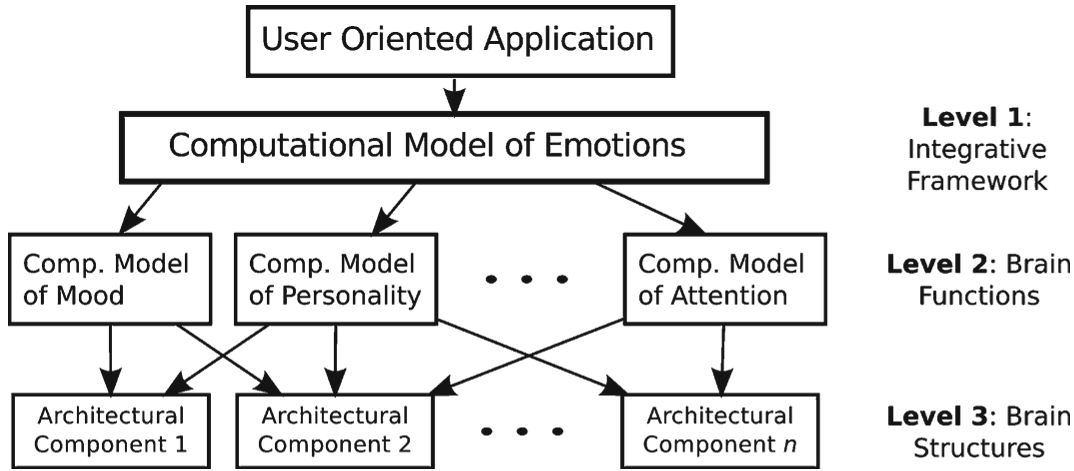 In this framework, Level 3 (The AME) refine the psychological concepts into actual synthetic brain structures, allowing emotions to "emerge" naturally.
Why the Amygdala Matters
The paper dives deep into the Amygdala, specifically its Lateral, Basal, and Central nuclei. By mimicking this internal circuitry, an agent doesn't just "calculate" fear; it processes sensory data through a pathway that links perception directly to action-readiness. This provides a level of Inductive Bias that makes the agent’s behavior inherently more human-like.
Experimental Anchors: From Software to Hardware
The authors review several key systems to prove the value of integrated emotional modeling:
- FLAME: Used Fuzzy Logic to show that learning and emotions together make virtual pets significantly more believable.
- EMA: Demonstrated that emotional modulation of decision-making creates virtual humans that soldiers can actually relate to in high-stress training.
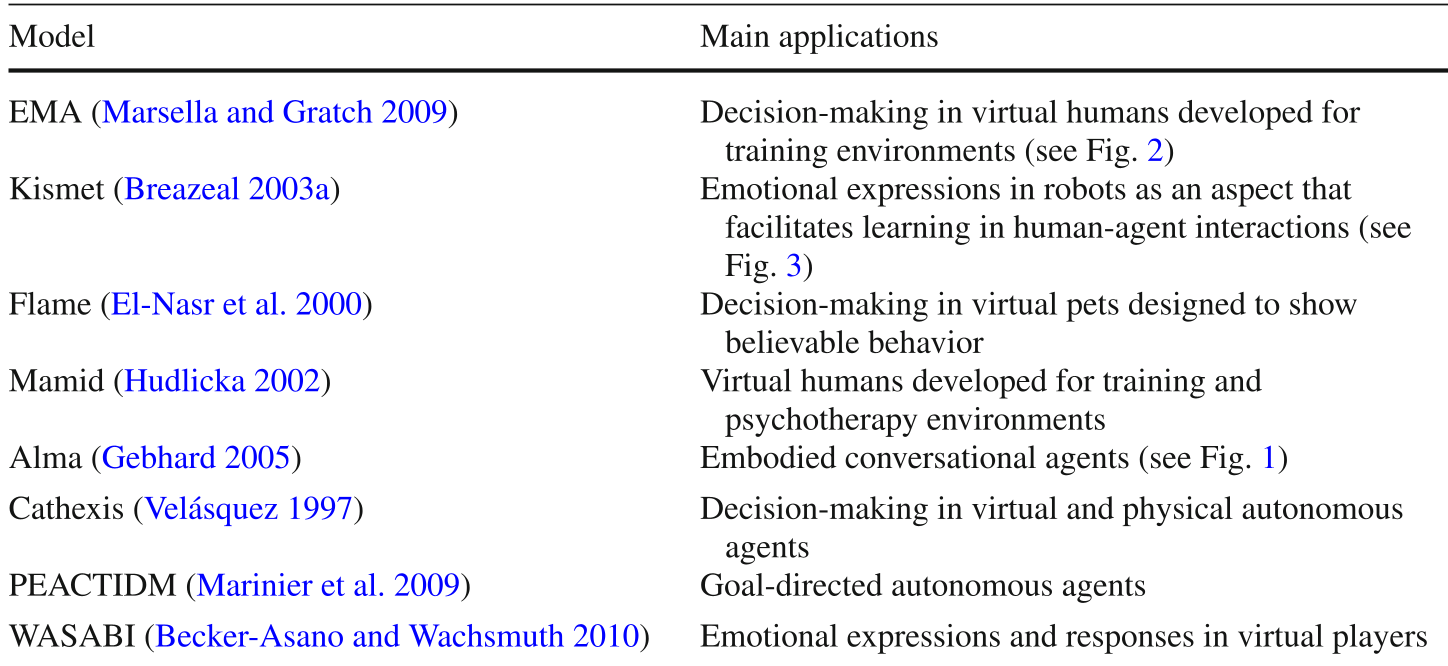 Table 1: A summary of established models and their specific application domains.
Conclusion: Toward Affective Intelligence
The takeaway is clear: we cannot achieve Artificial General Intelligence (AGI) by ignoring the "irrational" side of human nature. The next breakthrough in AI won't come from a new optimization algorithm, but from a better understanding of the Biological Substrates of our feelings.
By adopting the proposed three-level methodology, researchers can build agents that don't just show emotions on a screen but use emotions to navigate a complex, social world.
Limitations & Future Work
The proposed framework is a "Top-Down" methodology; however, the actual "Bottom-Up" implementation of synthetic neurons still faces massive computational overhead. The next step for the field is a standard for Affective Benchmarking—how do we quantify if an agent's "fear" is actually realistic?