
Predicting the Heartbeat: A Machine Learning Approach to Player Emotions
Computational Models of Players' Physiological-Based Emotional Reactions: A Digital Games Case Study
The paper introduces a generalizable methodology for building predictive models of players' emotional reactions (arousal and valence) using physiological data (SC, HR, EMG) and game event logs. By applying feature selection and machine learning, specifically Multilayer Perceptrons, the study achieves high-accuracy predictions of how specific gameplay events impact player affect.
TL;DR
Researchers have developed a predictive framework that uses body signals—heart rate and skin conductance—to "guess" how a player will feel after a specific game event. By moving away from static rules to dynamic Multilayer Perceptron (MLP) models, they achieved significantly lower error rates in predicting emotional shifts, paving the way for games that truly "know" their players.
The "Static Rule" Trap
Most current "biofeedback" games are remarkably simple: if your heart rate goes up, the game gets harder (or easier). This assumes that every player reacts to a "jump scare" or a "looted item" in the exact same way. In reality, a seasoned horror fan reacts differently than a newcomer. The core motivation of this study was to break this "fixed reaction" assumption by building individualized affective models.
Methodology: From Biosensors to Neural Nets
The team monitored 24 participants playing the survival horror game Vanish. They tracked 1,160 specific reactions tied to events like "lights failing" or "creature cries."
The Feature Engineering Loop
Instead of just looking at raw heart rate, the authors extracted 12 specialized features, including:
- E{r}: The baseline emotional value just before the event.
- σ{r}: The volatility of the signal.
- Dh: The time lag between the emotional peak and trough.
 Figure: The process of segmenting a player's emotional waveform based on game event triggers.
Experimental Results: Machines That Feel
The study compared three major machine learning architectures: Linear Regression (LR), M5 Model Trees (M5P), and Multilayer Perceptrons (MLP).
| Model | Arousal Error (ΔA) | Valence Error (ΔV) |
|---|---|---|
| Linear Regression | 0.3114 | 0.4010 |
| M5P Trees | 0.2959 | 0.3962 |
| MLP (Neural Net) | 0.2389 | 0.3238 |
The MLP was the clear winner. The data suggested that emotional reactions are non-linear and complex, making the "black box" nature of neural networks more effective than transparent linear models. Interestingly, Feature Selection (using Genetic Algorithms and Best First search) showed that we don't need dozens of sensors; most of the predictive power comes from just a few key physiological markers.
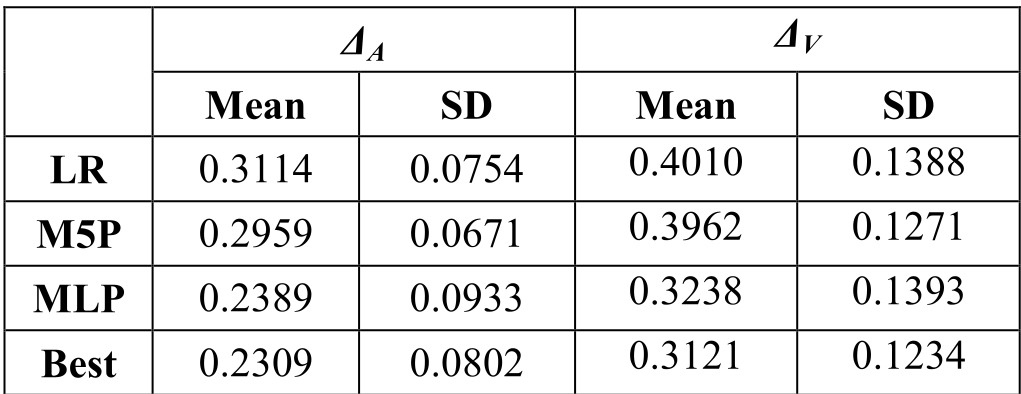 Table: Comparison of RMS Error across different ML algorithms.
Critical Insight: Why This Matters
The real value here isn't just "detecting" emotion—it's predicting it.
- AI Game Masters: Imagine a game that simulates 1,000 possible level layouts and chooses the one it predicts will maximize your specific fear or joy.
- Rapid Prototyping: Developers can use these models to "stress test" a game's emotional pacing before a single human tester even sits down.
Limitations & Future Horizon
While powerful, the model is a "black box," making it hard for designers to understand why a player reacted a certain way. Furthermore, the current study didn't fully account for long-term habituation—the fact that the 10th jump scare is never as scary as the first. The authors propose using hierarchical clustering in the future to group "player types," making the models more robust even with less data.
Conclusion
This work represents a foundational shift in Affective Gaming. By treating player emotion as a predictable computational variable, the industry moves closer to the "Holy Grail": games that adapt their narrative, difficulty, and atmosphere to the unique physiological fingerprint of every individual player.