
Beyond Coding: Mastering the Logic-Decomposition-Abstraction (LDA) Pipeline in Rural Education
Computational Thinking (CT) Problem Solving Orientation Based on Logic-Decomposition-Abstraction (LDA) by Rural Elementary School Children Using Visual-Based Presentations
This paper introduces the Logic-Decomposition-Abstraction (LDA) orientation within the Collaborative Computational Thinking Design Practices (CCTDP) framework. It explores how rural elementary school children in Malaysia develop problem-solving skills by integrating Computational Thinking (CT) into English lessons across STEM themes, achieving enhanced engagement and structured cognitive flow.
TL;DR
Computational Thinking (CT) is often misconstrued as merely "learning to code." This research reframes CT as a universal problem-solving orientation. By implementing the Collaborative Computational Thinking Design Practices (CCTDP) framework, educators helped rural Malaysian children tackle complex STEM problems within English lessons. The result? A sophisticated LDA (Logic-Decomposition-Abstraction) workflow that turned unstructured groups into effective problem-solving teams.
The "Thinking" Gap in STEM
In the transition to Society 5.0, rural students face a double disadvantage: limited exposure to digital tools and a lack of training in higher-order thinking. Most prior works treat CT as a technical skill (coding/robotics) rather than a cognitive one. The authors argue that even high-achieving students struggle with "open-ended" problems because they haven't been taught how to think structurally.
Methodology: The LDA Orientation
The core of this work is the LDA orientation, a subset of the CCTDP framework. It leverages two powerful engines:
- CT Fundatmentals: Logic, Algorithms, Decomposition, Patterns, and Abstraction.
- TRIZ Principles: A systematic Russian theory for inventive problem-solving (segmentation and universality).
The Architecture of Collaborative Solving
Students follow a trajectory of "weaning off" teacher support:
- Logic: Predicting outcomes and analyzing what exists (e.g., "The old man is poor, he doesn't have a fridge").
- Decomposition: Breaking a large goal (cleaning a house) into specific chores (kitchen, bedroom, garden).
- Abstraction: Moving from the mess of details to a "whole picture" visual representation before final planning.
 Note: The CCTDP framework integrates CT, TRIZ, and English literacy to empower rural learners.
Real-World Evidence
The study observed 10-year-olds in Kedah, Malaysia. Faced with a scenario to help an elderly villager, students demonstrated an evolving cognitive flow:
- Leadership & Logic: One student naturally took charge, delegating roles based on linguistic or practical strengths.
- Visual Iteration: Before writing a final plan, students utilized "rough papers" to sketch diagrams—a form of abstraction that simplified the complexity of the task.
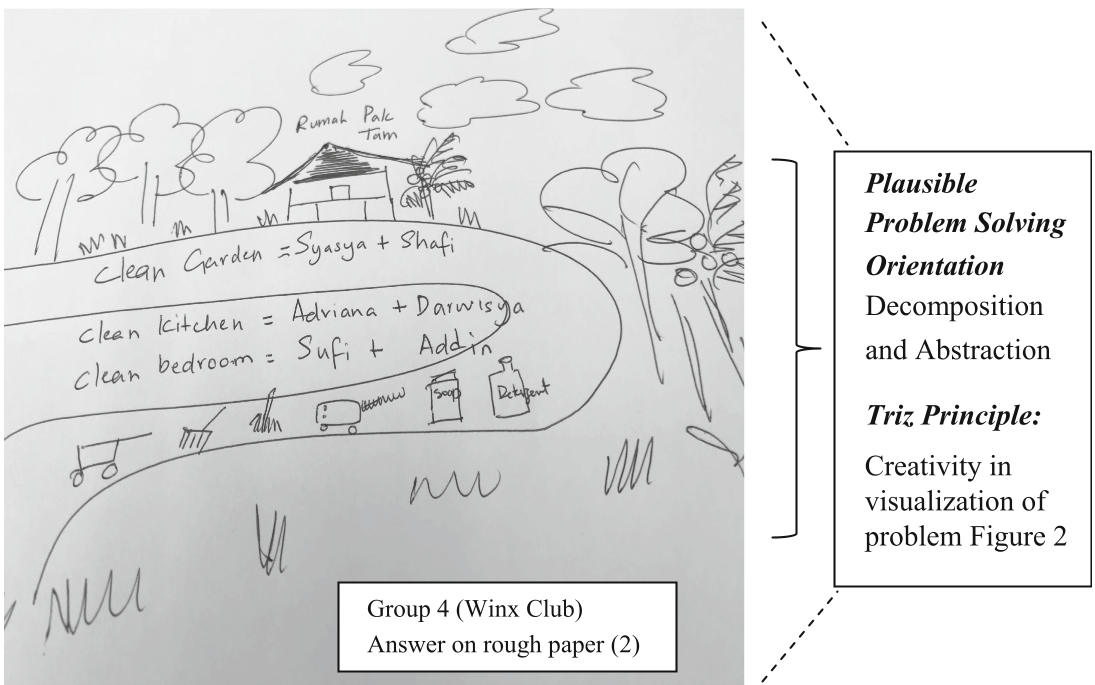 Fig: Group 4's visual abstraction of the solution, moving from chaotic ideas to a structured diagram.
Critical Analysis: Why This Matters
The most striking takeaway is the Democratization of CT. By embedding these skills into a humanities subject (English), the authors prove that:
- CT is Domain-Agnostic: It improves scientific thinking even when the medium is a second language.
- Interaction over Instruction: The natural social interactions (gestures, laughter, negotiation) are not distractions; they are the mechanism for cognitive growth.
- Self-Efficacy: When teachers move from "instructors" to "facilitators," students gain the confidence to migrate from "rote thinking" to "open CT."
Conclusion & Future Look
The LDA orientation represents a significant step toward an inclusive digital economy. While this paper focuses on qualitative observational data, it sets a theoretical foundation for the final level of CCTDP: migrating students to actual programming codes after they have mastered the "open" thinking required to solve real-world problems.
Takeaway: Future STEM curricula must prioritize the orientation of thought over the syntax of code.