
Computational Tools for Uniform Legal Interpretation: Bridging AI and the CISG
Computational Tools for Uniform Legal Interpretation: A Use Case
This paper proposes a computational framework to achieve uniform legal interpretation of the 1980 Vienna Sales Convention (CISG). It leverages semantic technologies like XML (Akoma Ntoso), OWL ontologies, and the Carneades rule language to create machine-readable legal texts and reasoning modules.
TL;DR
Achieving consistency in international law is notoriously difficult due to diverse domestic backgrounds. This paper presents a roadmap for using Semantic Web technologies (XML, OWL) and Rule Engines (Carneades) to transform the 1980 Vienna Sales Convention (CISG) from static text into a machine-readable, transparent logical model. By formalizing legal concepts, the author aims to eliminate "interpretive drift" and ensure the treaty is applied uniformly worldwide.
The "Homeward Trend" Problem
The CISG is the "constitution" of international trade, yet its application often suffers from a lack of uniformity. Judges and arbitrators tend to interpret international terms through the lens of their own domestic legal systems—a phenomenon known as the "homeward trend."
The root cause is linguistic and logical ambiguity. While online databases exist, they are primarily "text-centered." To truly achieve a global jurisconsultorium, we need to move toward a "meaning-centered" web where the legal logic is as explicit as a computer program.
Methodology: From Raw Text to Legal Logic
The author proposes a three-step pipeline to digitize the CISG's interpretive framework:
1. Structural Backbone (XML & Akoma Ntoso)
The first step is moving beyond raw PDFs. By using Akoma Ntoso, a specialized XML standard for legislative documents, the CISG is broken down into structured components (preamble, articles, paragraphs). This allows for rich metadata—such as legislative history (travaux préparatoires) and case digests—to be directly linked to specific provisions in a machine-readable way.
2. Conceptual Hardening (Ontologies)
To solve terminological ambiguity, the author uses Natural Language Processing (NLP) via tools like TermRaider to extract key concepts. These are then organized into an OWL (Web Ontology Language) model. This creates a "TBox" (Terminological Box) that defines exactly what constitutes a "sale of goods" or "place of business," preventing interpreters from substituting international definitions with domestic ones.
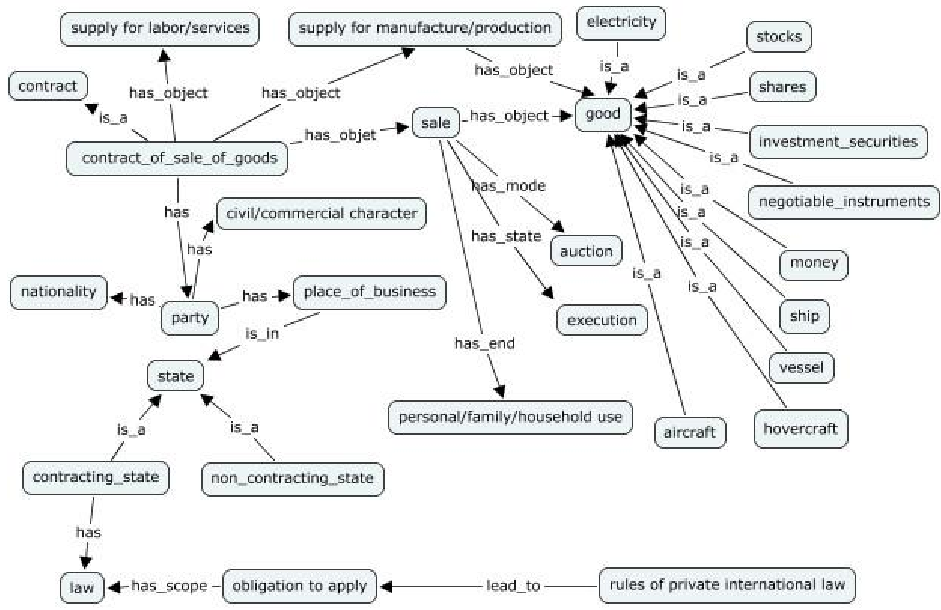 The figure above illustrates the conceptual dependencies required to determine if the CISG applies to a specific case.
3. Rules and Argumentation (Carneades)
The final layer is the "Legal Logic." Using the Carneades rule language, the author formalizes the conditions under which the CISG applies (Articles 1–3). This turns the laws into a set of if-then statements that allow a computer to "reason" through a case and output a predictable legal conclusion based on established facts.
Experimental Insight: The Power of Visualization
The author demonstrates that by mapping the CISG's sphere of application into a graph, one can immediately identify logical overlaps and exclusions. For instance, the exclusion of "sales of electricity" or "sales by auction" (Article 2) is explicitly handled in the ontology, ensuring no arbitrator can mistakenly apply the CISG to these domains.
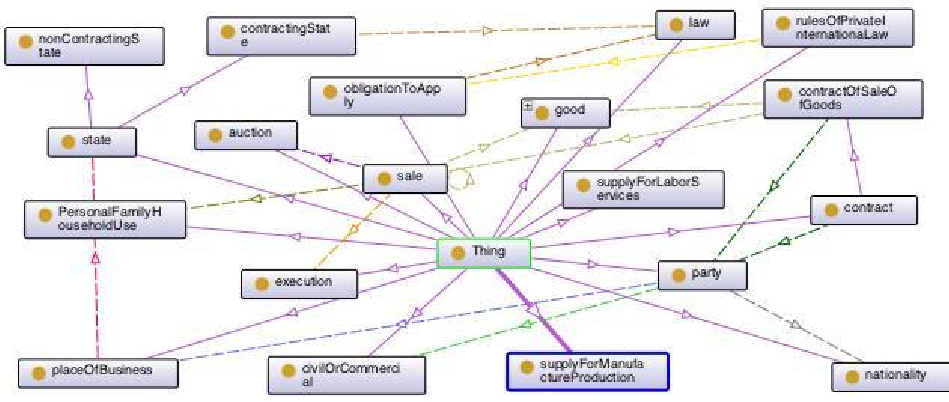 The OWL model provides a rigorous hierarchy that serves as the 'ground truth' for the reasoning engine.
Critical Perspective & Conclusion
While the paper successfully models the "intermediate layer" of legal interpretation (deriving consequences from established facts), it acknowledges a significant hurdle: The Fact-Recognition Problem.
Software remains limited in its ability to extract and formalize "raw facts" from messy, real-world evidence. However, by focusing on the Uniform Interpretation of the law itself, the author provides a vital tool for transparency.
Key Takeaway: Uniformity in law is not just a human duty; it is a computational challenge. By treating legal theories as models that can be "implemented," we can achieve a level of global judicial predictability previously thought impossible.