
Computer Science Communities: Who is Speaking, and Who is Listening?
Computer Science Communities: Who is Speaking, and Who is Listening to the Women? Using an Ethics of Care to Promote Diverse Voices
This research investigates gender representation across nine major Computer Science (CS) subfields by analyzing 20,000 research records and over 500,000 author names. Using name-to-gender inference algorithms, the study categorizes subfields by their diversity levels and argues for an "Ethics of Care" framework to address systemic underrepresentation.
Executive Summary
TL;DR
Diversity in computing is often discussed as a general problem, but this paper reveals it is a community-specific crisis. By analyzing over 500,000 authors, the researchers found that while subfields like Human-Computer Interaction (HCI) are making progress, core technical fields like AI and Systems Architecture remain heavily male-dominated (~80-90% male). The authors argue that scientific institutions like the ACM have a moral "duty of care" to actively intervene, suggesting that inclusive science is fundamentally better science.
Background Positioning
This work serves as a critical bridge between quantitative bibliometrics and feminist philosophy. It moves the conversation from "counting heads" to a normative argument for why institutional gatekeepers must change their structural approach to minoritised groups.
Problem & Motivation: The Homogeneity Trap
Why does it matter if computer science is homogeneous? The authors point to a "birdsong" analogy: for decades, ornithologists studied only male birdsong because they assumed only males sang. It was only when female researchers entered the field that the complexity of female birdsong was finally recognized.
In CS, the stakes are higher. A lack of diverse voices leads to:
- Algorithmic Bias: Narrow perspectives in training data and model design.
- The Pipeline Effect: A steady drop-off of women from undergraduate levels to senior faculty positions.
- Institutional Inertia: A tendency to treat computing as a "neutral" science, ignoring the masculine connotations that entered the field when it transitioned from clerical work to a high-status "profession" in the 1980s.
Methodology: Mapping the Landscape
The researchers categorized CS into nine distinct subfields, ranging from Machine Learning (ML) to Information Systems (IS). Using the Microsoft Academic API, they processed thousands of records through a rigorous name-to-gender inference pipeline.
The Inference Pipeline
- Primary Pass:
gender-guesser(Offline, high transparency for Anglophone names). - Secondary Pass:
genderize.io(Online API, better for culturally diverse/non-Anglophone names). - Categorization: Subfields were ranked by their Male-to-Female authorship ratios.
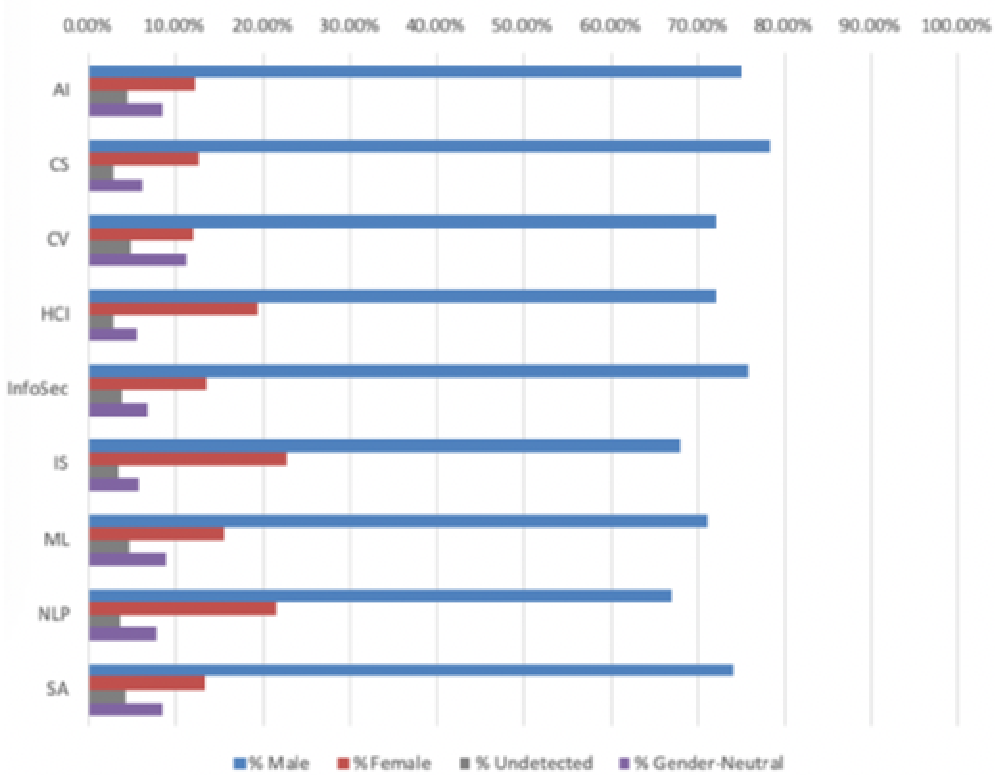 Figure 1: (a) Overall gender distribution including neutral/undetected names. (b) Direct male-to-female ratio comparison across the 9 subfields.
Two Worlds of Computing: The Results
The data revealed a stark divide in the CS ecosystem:
- The "Less Diverse" Tier (10-20% Female): Artificial Intelligence, Computer Vision, Machine Learning, and Systems Architecture. These fields are often associated with heavy mathematical abstraction, which historically carries a stronger "masculine" bias.
- The "Slight Improvement" Tier (20-30% Female): HCI, Information Systems, and Natural Language Processing. The authors hypothesize that areas focusing on human interaction or language naturally attract and retain more diverse voices, or are more attuned to resolving social biases.
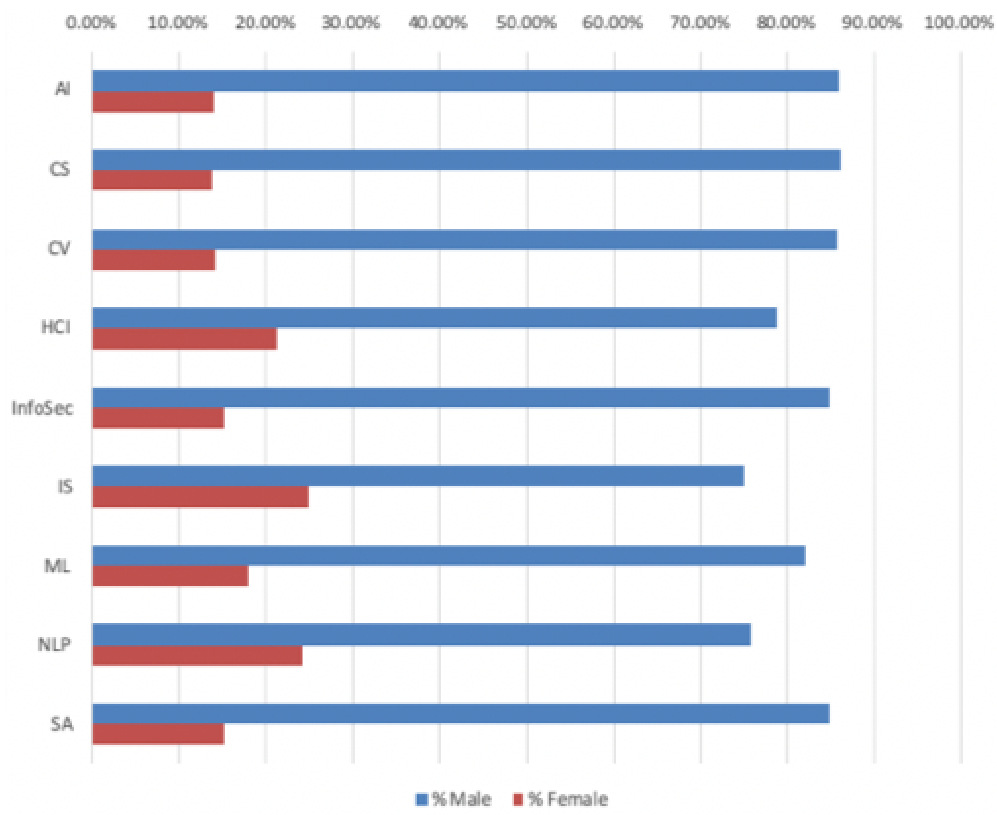 Figure 2: The direct comparison highlights that in fields like CV and ML, women are outnumbered nearly 5 to 1 in publication records.
Deep Insight: Toward an Ethics of Care
The core of this paper is the application of Ethics of Care (CE) to the ACM. Unlike traditional deontology (rules) or utilitarianism (outcomes), CE focuses on:
- Interdependence: Recognizing that researchers are not isolated atoms but parts of a community.
- Responsiveness: Actively listening to the needs of the marginalized rather than just "not discriminating."
- Nurturing: Suggesting that institutional leaders have a responsibility to foster the growth of talent that has been historically suppressed.
Institutional Recommendations
The authors call for the ACM to:
- Establish a Diversity Dashboard: Annual, public metrics for each subfield community.
- Incentivize Best Practices: Rewrite the "Academic Pipeline" by providing concrete rewards for inclusive mentorship.
- Active Accountability: Moving beyond "passive avoidance" of discrimination toward "active correction" of systemic disadvantage.
Critical Analysis & Conclusion
Takeaway: This study proves that "neutrality" in science is a myth that preserves the status quo. To achieve the fairness and transparency the FAccT community strives for, we must acknowledge that the subfields building our future are currently excluding the majority of the population.
Limitations:
- Binary Bias: The researchers admit that automated gender inference—based on first names—fails to account for non-binary identities and may cause representational harm.
- Metric Narrowness: Authorship is only one measure of impact; it does not capture the "invisible labor" of minoritised groups in service or teaching roles.
Future Outlook: The next frontier for this research is qualitative—interviewing the women who "leaked" out of the academic pipeline to understand the cultural barriers that quantitative data can only hint at.