
Ontology Learning: The Grand Tour from Linguistic Patterns to Deep Transducers
Computer science review
This review article provides a comprehensive survey of Ontology Learning (OL) from text, categorizing methods into linguistic, statistical, and machine learning approaches (including Deep Learning). It maps the state-of-the-art frameworks like Text2Onto and LExO while identifying the critical gap in automated axiom generation and standardized evaluation.
TL;DR
Ontologies are the backbone of the Semantic Web, yet their manual creation is a "knowledge acquisition bottleneck." This review explores how the field has moved from simple hashtag-like keyword extraction to Deep Learning transducers capable of turning English sentences into formal logic. While we have mastered "Concepts," the industry still struggles to automate "Axioms"—the logical rules that allow AI to actually reason.
The "Knowledge Bottleneck" and the Quest for Automation
In the era of AI, we need more than just raw data; we need structured knowledge. Ontologies provide this structure by defining classes, relations, and axioms. However, building them is a Herculean task for human engineers.
The core challenge in Ontology Learning (OL) is the trade-off between automation and expressiveness. Most tools can extract a list of terms (Concepts) or a hierarchy (Taxonomy), but very few can capture the "logic" (Axioms) that defines the domain's soul—such as "A Human cannot be a Vegetable" (Disjointness).
Methodology: Mapping the Learning Layers
The paper categorizes the evolution of OL into three distinct waves:
1. The Linguistic & Statistical Wave
These methods rely on "Hearst Patterns"—syntactic templates like "[NP] such as [NP], [NP]". While high in precision, they suffer from poor recall because human language is infinitely varied.
2. The Traditional Machine Learning Wave
Algorithms like SVMs and Inductive Logic Programming (ILP) allow for better classification of concepts into existing hierarchies. However, they require heavily pre-processed, "sanitized" data.
3. The Deep Learning Frontier
The most exciting shift is treating ontology learning as a Translation Task. Using Encoder-Decoder architectures (similar to Neural Machine Translation), researchers are now attempting to "translate" definitory sentences directly into Description Logic (DL).
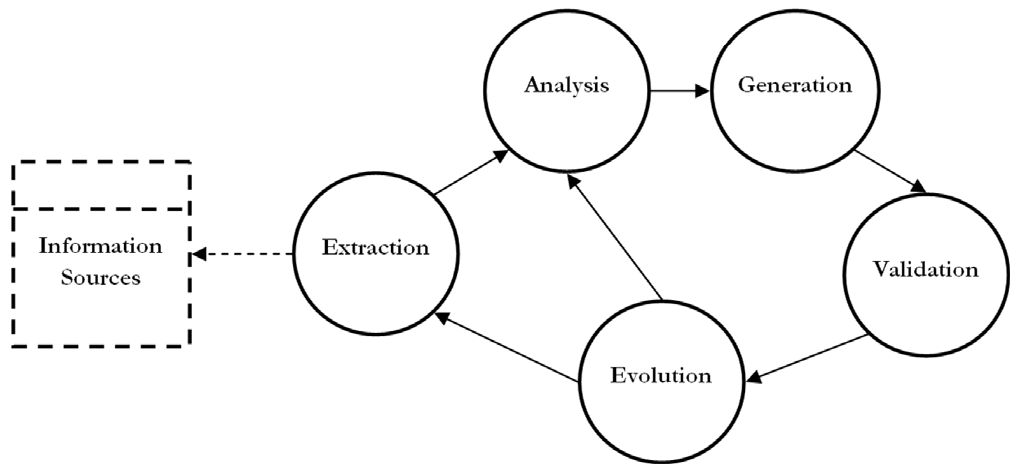 Figure 1: The standard lifecycle of automated ontology generation, from extraction to evolution.
Frameworks: From Gate to LExO
The article provides a "Battle Cards" style comparison of major OL frameworks:
- Text2Onto: The user-friendly veteran. It uses a "Probabilistic Ontology Model" (POM) to remain language-independent.
- LExO (Learning Expressive Ontologies): A pioneer in generating OWL DL axioms by analyzing the dependency tree of a sentence.
- OntoLearn: Famous for its ability to bootstrap from online glossaries and "forests of domain trees."
(Note: Refer to Table 2 in the paper for a detailed comparison of manual intervention vs. specific knowledge requirements.)
The "Evaluation" Crisis
A recurring theme in the paper is the Subjectivity of Truth. How do we know if a learned ontology is "good"?
- Gold Standard: Compare the AI's result to a human-made ontology (but who made the human one "correct"?).
- OntoClean: A formal method of checking meta-properties like "Rigidity" and "Unity," which is powerful but requires extreme manual effort to set up.
Critical Insight: Why the Axiomatic Layer is the "Final Boss"
The survey concludes that while we can extract concepts with nearly 98% accuracy (using word embeddings like Skip-gram), our ability to extract Formal Axioms is still in its infancy. Real-world language is messy; "definitory" sentences found in textbooks are rare in the wild.
Conclusion & Future Outlook
The "Grand Tour" reminds us that while we have moved far beyond simple keyword lists, the dream of a fully autonomous, language-independent knowledge engineer is not yet realized.
Future Directions:
- Large Language Models (LLMs): The paper hints at the power of Deep Learning; today’s LLMs could potentially bridge the gap where previous RNNs failed.
- Cross-Lingual OL: Moving beyond English-centric models to support low-resource languages.
- Neuro-Symbolic Integration: Combining the "intuition" of Deep Learning with the "rigor" of formal logic.
For practitioners, the takeaway is clear: automation can do 80% of the heavy lifting (taxonomies and terms), but the final 20% (the logical axioms) still requires a human "Ontologist" to ensure the AI's "worldview" makes sense.