
Moving Beyond Rigid Workflows: Social Protocols for Agile Human Collaboration
Computer Support for Agile Human-to-Human Interactions with Social Protocols
This paper introduces the concept of "Social Protocols," a novel framework designed to provide computer support for agile Human-to-Human (H2H) interactions. By integrating extended social networks with multi-layered workflow models, the proposed system enables groups to rapidly adapt their collaborative processes to internal and external changes.
TL;DR
In the realm of collaborative software, we often face a paradox: humans are naturally agile, yet the systems we use—like workflow engines and groupware—are notoriously rigid. This paper by Willy Picard introduces Social Protocols, a framework that treats the "how" of collaboration as a living, negotiable process. By combining social network modeling with a three-layer workflow architecture and a "Meta-process" mechanism, it allows teams to rewrite their interaction rules on the fly.
The Agility Gap: Why Current Systems Fail Humans
Most workflow systems operate on a "Design-then-Execute" philosophy. Once a process starts, it’s locked. However, in the real world:
- A team member becomes unavailable (internal change).
- A critical tool breaks down or weather conditions shift (environmental change).
Traditional models lack the Inductive Bias for human adaptability. They treat processes like code to be executed, rather than social agreements to be maintained. Picard argues that for H2H (Human-to-Human) interactions to be agile, the computer support must understand the Social Environment—not just who is there, but what resources and tools they bring to the table.
Methodology: The Three Layers of Social Protocols
The author breaks down the complexity of H2H interactions into a hierarchical structure that mirrors Object-Oriented Programming (OOP):
- Abstract Social Protocol (The Interface): Defines roles (e.g., Chairman, Participant) and a sequence of activities without deciding who does what or which tools are used.
- Implemented Social Protocol (The Class): Maps those abstract activities to specific IT tools (e.g., "Post Idea" becomes a "Forum Post").
- Social Process (The Object/Instance): The live interaction where specific people (John, Susan) are assigned to roles and the current state is tracked.
Core Architecture: The Social Network + Workflow
Unlike typical workflows, a Social Protocol includes an Abstract Social Network. This graph models the "who" and the "what" (information systems) simultaneously.
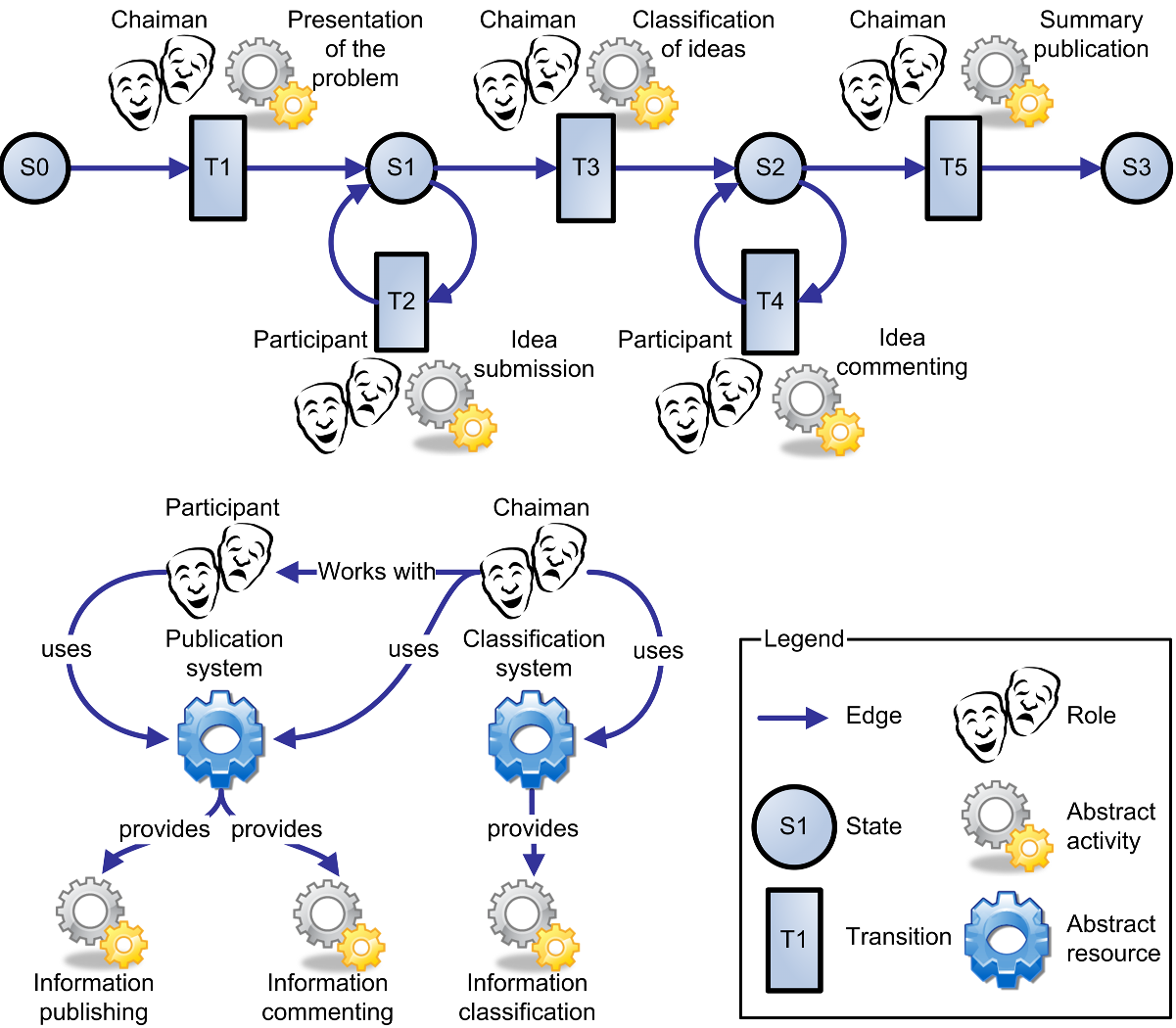 Figure 1: An Abstract Social Protocol example for a brainstorming session, showing interdependencies between roles and activities.
The Secret Sauce: Meta-processes and RTI (Run-Time Interference)
The most profound contribution of this work is the Meta-process. If a group realizes their current workflow is failing, they don't just "break" the system; they trigger a Meta-process.
A Meta-process is essentially a "protocol about the protocol." It provides a structured way for collaborators to debate and vote on changes to their current social process. The paper identifies five levels of the adaptation taxonomy:
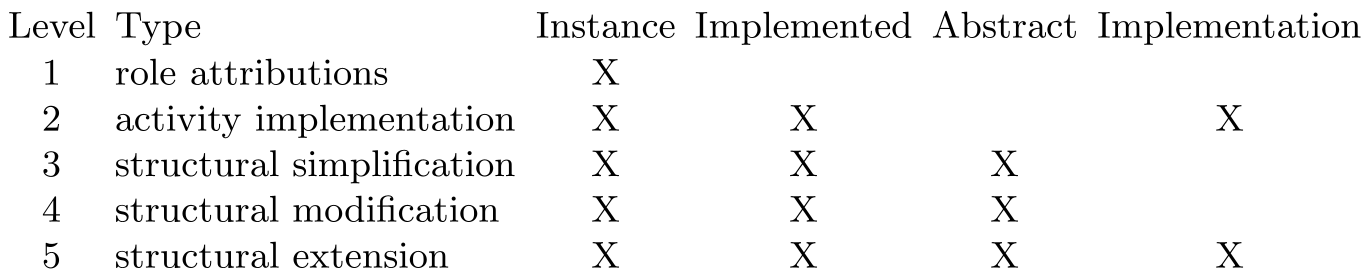 Table 1: The five levels of adaptation, ranging from simple role changes to full structural extensions.
- Level 1-2: Adjusting who does what or which tool to use (Low complexity).
- Level 3-5: Deleting, modifying, or adding entirely new steps to the workflow (High complexity, affecting the underlying Abstract Protocol).
Critical Analysis: Is This Practical?
Picard’s work bridges the gap between Social Network Sites (SNS)—which are great at "who" but bad at "how"—and Workflow Management Systems (WfMS)—which are the opposite.
Strengths:
- Formal Rigor: Using Petri Nets as a foundation for the Interaction Protocol ensures that the state transitions remain logically sound even during modification.
- Holistic Social View: Integrating Information Systems into the social graph correctly identifies that tools are "collaborators" in modern work.
Limitations:
- The "Meta" Overhead: The paper assumes collaborators have the time and will to engage in a structured meta-process to change their rules. In high-pressure environments, this might be a bottleneck.
- Consistency Risks: While the paper mentions "validity," the mathematical proof of maintaining process integrity during Level 5 (structural extension) changes is a massive challenge in distributed systems.
Conclusion & Future Outlook
This paper marks a shift from Computer-Supported Collaborative Work (CSCW) as a "digital track" to CSCW as a "digital facilitator." By allowing the protocol to be an object of negotiation, Picard provides a blueprint for systems that can survive the chaos of real-world human interaction. Future work in this area will likely involve AI agents acting as "Social Protocol Mediators," helping humans navigate these Meta-processes more efficiently.