
Computer Use at the Precipice: Why Your Agent's SOTA Score Might Be a Lie
Computer Use at the Edge of the Statistical Precipice
The paper introduces DigiWorld, a robust benchmark for Computer Use Agents (CUAs), alongside the PRISM design principles. It exposes critical flaws in existing benchmarks where simple replay scripts can outperform frontier models, and proposes a new hierarchical bootstrap statistical framework for reliable agent evaluation.
TL;DR
Meta Superintelligence Labs has issued a wake-up call for the AI agent community. They demonstrate that current "Frontier" agents often succeed on benchmarks not through reasoning, but through "blind replay"—essentially memorizing click sequences. By introducing the PRISM framework and the DigiWorld benchmark, they provide a path toward evaluations that are actually resistant to gaming and statistically sound.
The "Memorization" Scandal
The most shocking revelation of this paper is the Replay Equivalence. In a deterministic environment with a fixed starting state, an agent's success is basically a measure of its pass@k.
To prove this, the authors built a 1MB script that blindly clicks the screen without even "looking" at it. On major benchmarks like OSWorld, this tiny script outperformed frontier models like Claude Opus. This suggests that current benchmarks are measuring memorization capacity rather than actual visual grounding.
The PRISM Framework: A New Gold Standard
To stop agents from "cheating," the authors propose five non-negotiable principles for environment design:
- Privileged Verification: Use internal system state (SQL/DB) instead of "LLM-as-Judge" to check success.
- Realistic Environments: No more toy apps; use production-grade complexity.
- Integrity-Checked: Ensure every generated task is actually solvable.
- Sandboxed: No live internet dependencies that drift over time.
- Multifactorial Variability: Change themes, UI states, and data profiles independently.
 Figure: The 15 DigiWorld applications provide a diverse, sandboxed playground for testing genuine reasoning.
Methodology: Fixing the "Wald" Illusion
Standard AI reporting uses Wald confidence intervals, which treat every task like a coin flip. This paper proves this is wrong. Tasks within an app are correlated. If an agent fails to "scroll," it will fail 10 different tasks that require scrolling in that app.
The authors introduce a Hierarchical Bootstrap. Instead of just resampling "success/fail" bits, they resample:
- The Scenarios (to account for task difficulty).
- The Configurations (to account for UI/Theme variability).
- The Rollouts (to account for agent stochasticity).
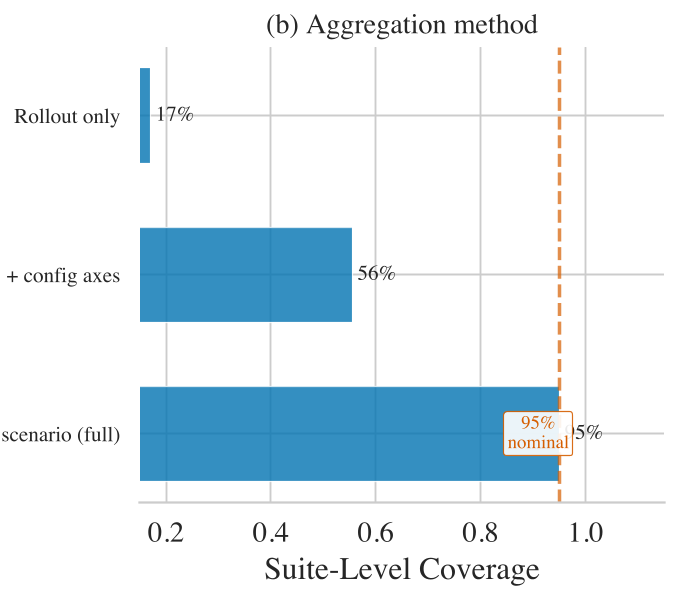 Figure: Only the full hierarchical bootstrap (bottom right) achieves the required 95% coverage, whereas standard methods (left) severely underestimate uncertainty.
Experimental Showdown
When tested on DigiWorld—which features 3.2 million unique configurations—the "blind" replay agent finally failed (dropping from 70% to 6.9%).
Under the new rigorous statistical lens, the rankings of top-tier models (Claude, Gemini, GPT) grew much closer. In many cases, the "gaps" reported in previous literature were revealed to be within the margin of error when hierarchical correlations were properly modeled.
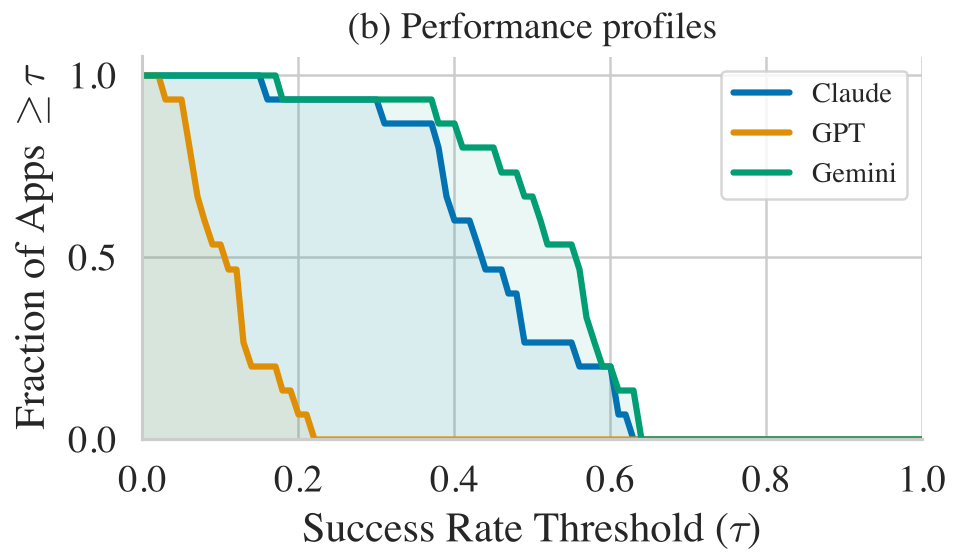 Figure: The Hierarchical Bootstrap CIs show significant overlap between Claude and Gemini, suggesting that current "rankings" are often premature.
Critical Insight: The Cost of Rigor
Is it more expensive to run 20 rollouts across multiple configurations? Yes. But as the authors argue, a cheap evaluation that measures the wrong thing is not a bargain.
The transition to Multifactorial Variability (changing themes and starting states) is the only way to ensure that an agent can actually "see" and "reason." If shifting an app to "Dark Mode" causes an agent to fail, that agent isn't ready for the real world—no matter how high its static benchmark score is.
Conclusion
This work marks a transition in the CUA field from "Wild West" leaderboards to scientific maturity. By open-sourcing DigiWorld and the aggregation framework, the authors have provided the tools necessary to build agents that don't just memorize, but actually understand how to use a computer.