
Deciphering Digital Adiposity: How AI Links BMI to Popularity and Social Circles
Using Computer Vision to Study the Effects of BMI on Online Popularity and Weight-Based Homophily
This study presents an end-to-end computer vision pipeline using the "Face-to-BMI" system to infer Body Mass Index from Instagram profile pictures. It conducts a cross-cultural analysis involving 197,000 users from the US and Qatar to investigate the relationship between BMI, online popularity, and social network homophily.
TL;DR
Researchers from MIT and QCRI have developed a pipeline that uses computer vision to "read" BMI from Instagram profile photos. By analyzing nearly 200,000 users in the US and Qatar, they discovered two striking trends: thinner individuals attract more followers, and people tend to "flock together" based on similar weight profiles. The study highlights how physical attributes significantly shape our virtual social hierarchies.
Background & Motivation: Scaling the Study of Obesity
Obesity is more than a medical condition; it is a social phenomenon. However, studying its social dynamics is notoriously difficult because people don't typically post their weight in their social media bios. While researchers have previously used "Human-in-the-loop" crowdsourcing to label bodies, such methods cannot scale to millions of users.
The authors' insight was to leverage the Face-to-BMI system—a specialized tool that predicts weight status based on facial adiposity. By applying this to a cross-cultural dataset, they aimed to see if Western "fat-stigma" translates to other regions like Qatar and how it influences network structures.
Methodology: The Face-to-BMI Pipeline
The architecture relies on a multi-stage process to ensure data quality in the noisy environment of social media:
- Face Localization: Using Face++ to detect bounding boxes and filter out non-human or multi-person photos.
- Feature Extraction: A Deep Neural Network (DNN) trained for face recognition extracts high-dimensional vectors representing facial geometry.
- Regression: These features are fed into an Epsilon Support Vector Regression (SVR) model to output a continuous BMI value.

The system was qualitatively validated against Instagram samples, showing a clear visual progression from lower to higher inferred-BMI scores.

Key Findings: Popularity and Homophily
1. The "Thinness Premium"
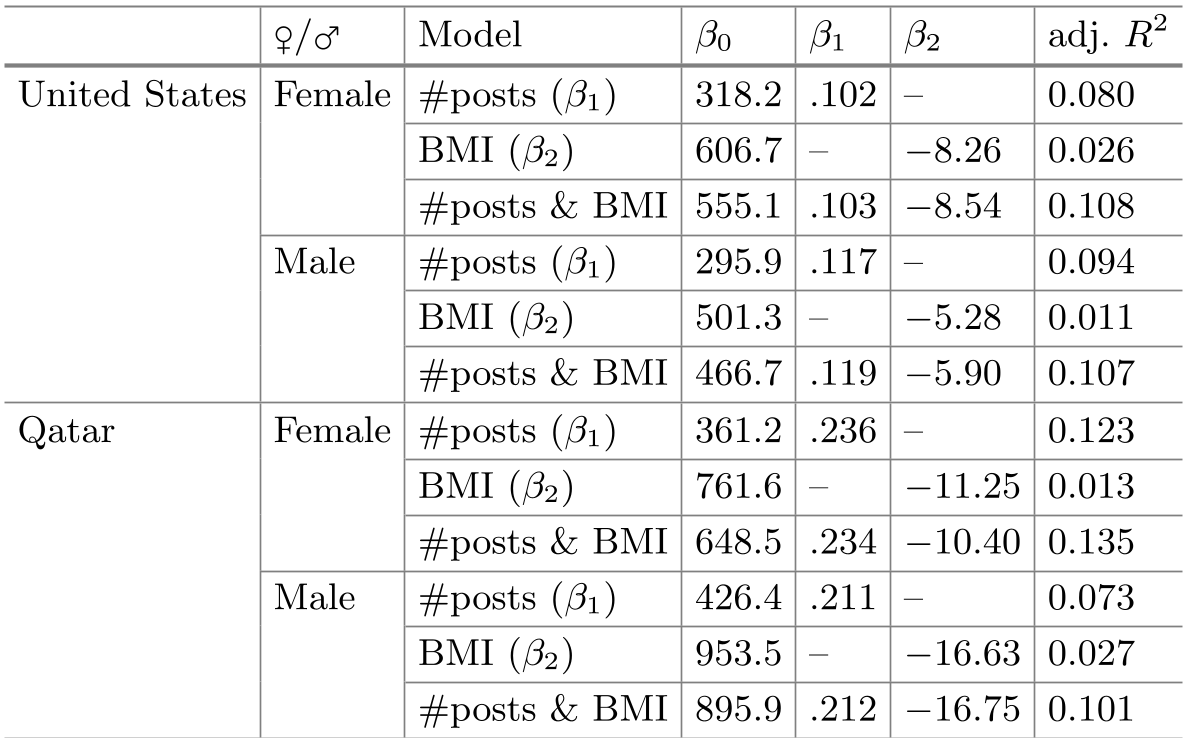
The study found a consistent negative trend: as BMI increases, the number of followers decreases. To ensure this wasn't just because "active users are thinner," they controlled for the number of posts. Even when posting frequency was identical, the BMI "penalty" persisted.
- Cultural Nuance: In the US, the negative impact of BMI on followers was most severe for women. In Qatar, surprisingly, the effect was stronger for men.
2. Weight-Based Homophily
Are we friends with people who look like us? The researchers built social networks based on mutual comments. By comparing empirical data to 10,000 random permutations (shuffled network nodes), they found that the BMI difference between friends was significantly smaller than expected by chance. This suggests assortative mixing—we gravitate toward social circles with similar body compositions.
Critical Analysis & Discussion
While the study provides a powerful population-level lens, it carries significant caveats:
- Algorithmic Bias: Though the authors found no race/gender bias, they noted the difficulty of accurately predicting BMI for women wearing head covers (common in Qatar), though manual checks showed no gross errors.
- Direction of Causality: The "Reverse Causality" hurdle—do popular people become thinner, or do they simply use better angles and "photoshopping" to appear thinner as their audience grows?
- Privacy & Ethics: The ability to infer health metrics from a simple profile picture raises massive privacy concerns. As AI makes our faces "searchable" for specific physical traits, the risk of automated discrimination increases.
Conclusion
This work sits at the intersection of Computer Vision and Computational Social Science. It moves beyond mere "image recognition" to "social inference," proving that our physical bodies—even in their digital representations—dictate the structure and success of our online lives. Future work may need to address the "filter bubble" of physical appearance and how these AI tools can be used to combat, rather than reinforce, social stigmas.