
Evolutionary Vision: Automating Agricultural Grading via Genetic Programming
Agricultural produce grading by computer vision using Genetic Programming
This paper presents a Genetic Programming (GP) based framework for the automated grading of agricultural produce, including mangoes, apples, grains, and rice. By evolving task-specific computer vision programs from a library of generic operators, the system achieves SOTA-competitive classification accuracy in quality inspection and variety discrimination.
TL;DR
Can a single vision system learn to grade mangoes, apples, and rice without manual code changes? This paper demonstrates an evolutionary approach using Genetic Programming (GP) to "evolve" task-specific computer vision programs. By moving beyond simple shape analysis and incorporating color and texture operators, the authors developed a system that matches or exceeds the performance of Neural Networks and SVMs in the agricultural domain.
Problem & Motivation: The "Fragile" Nature of Grading
Grading agricultural produce is a high-stakes commercial task. High-grade fruit fetches premium prices, but manual inspection is prone to human error and high costs.
The technical challenge lies in diversity. A vision system designed to detect blemishes on a smooth mango is virtually useless for classifying varieties of wheat or detecting paddies in sticky rice. Traditionally, engineers had to hand-craft specific feature extractors for every new product. The authors' insight was to mimic the adaptability of animal vision: why build a fixed system when you can build an "engine" that learns the features itself?
Methodology: The Jasmine Framework
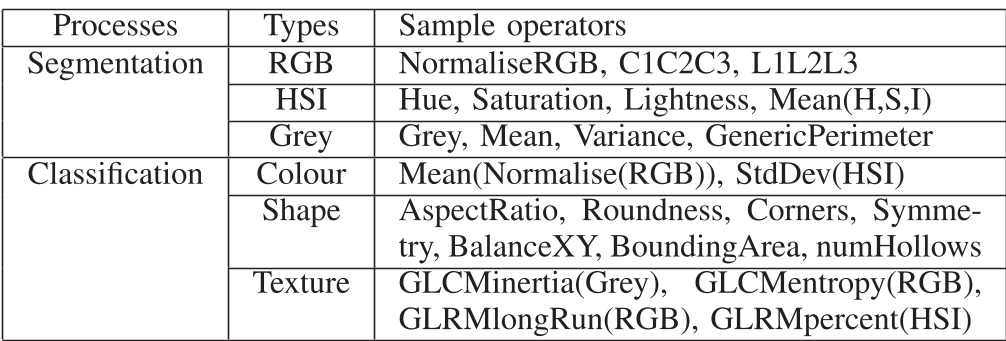
The researchers employed a framework called Jasmine, which uses Genetic Programming to "breed" programs. While many GP systems try to solve everything at once, Jasmine uses a two-stage pipeline:
- Segmentation Stage: Evolved first to isolate the fruit/grain from the background.
- Classification Stage: Evolved using the output of the first stage to determine quality or variety.
Architecture Highlights
The "Evolutionary Engine" selects from a library of:
- Morphological Operators: 41 operators for shape (Aspect ratio, symmetry).
- Color Operators: 31 operators for RGB and HSI spaces.
- Textural Operators: 123 operators (GLCM/GLRM) for surface consistency.
To prevent the search space from exploding, the system uses Linear Discriminant Analysis (LDA) to identify the 20 most effective operators before the full evolutionary run begins.
Experiments: From Fruit to Grains
The system was tested against four distinct tasks:
- Mango Blemishes: Separating export-quality fruit from blemished ones.
- Apple Varieties: Discriminating between six types like Cox, Gala, and Pink Lady.
- Grain Classification: Distinguishing wheat from barley.
- Sticky Rice Grading: Identifying premium kernels, broken fragments, and contaminants (paddies).
Results and SOTA Comparison
The results were striking. In the Mango Blemish Inspection task, the system not only improved upon the "Original Jasmine" (which only used shape) but actually beat both Neural Networks (NN) and Support Vector Machines (SVM).

For Purple Sticky Rice Grading, the GP-evolved system achieved 97.42% accuracy, proving that these "evolved" programs can handle the subtle textural differences between premium rice and brownish-purple contaminants.
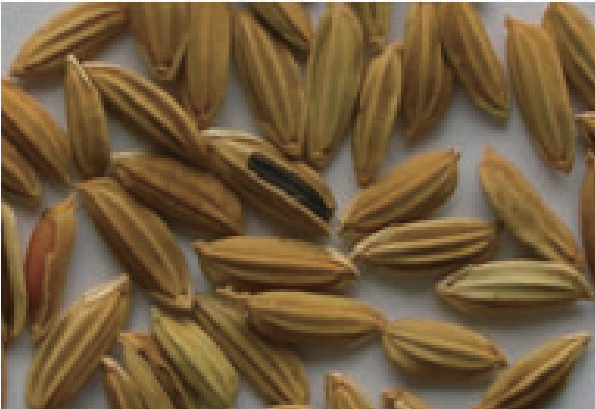 (Top: Paddies; Bottom: Premium-grade kernels)
Critical Analysis & Conclusion
The core takeaway is that Genetic Programming is not just an academic curiosity—it is a viable competitor for industrial inspection.
Why it works:
- Feature Evolution: Unlike SVMs that rely on a fixed feature set, GP can discover complex non-linear combinations of color and texture that a human might not think to program.
- Efficiency: The evolved programs are often "lighter" than deep neural networks, making them suitable for real-time grading on edge hardware.
Limitations & Future Work: The study primarily relies on 2D images. However, many agricultural defects are 3D in nature. The authors suggest that the next frontier is integrating 3D properties (volume, surface curvature) into the GP framework to enable fuller fruit inspection.
In an era dominated by "Black Box" deep learning, this work reminds us that evolutionary strategies offer a transparent, flexible pathway toward truly adaptive machine vision.