
From Vine to AI: Deep Diving into the Smart Viticulture Revolution
Computer Vision and Machine Learning for Viticulture Technology
This paper provides a comprehensive review of Computer Vision (CV) and Machine Learning (ML) applications in viticulture and introduces the GrapeCS-ML database, a curated image dataset for smart vineyard research. The study evaluates multiple ML classifiers across various tasks, establishing baseline performance for color-based berry detection and disease identification.
TL;DR
Agriculture is entering the era of "Precision Viticulture." This paper provides a seminal review of how Computer Vision (CV) and Machine Learning (ML) are replacing manual labor in vineyards. Beyond the review, the authors introduce GrapeCS-ML, a comprehensive database that links visual imagery with chemical ground truth (Brix/pH), setting a new benchmark for automated grape monitoring.
The "Blind Spot" in Modern Farming
For centuries, viticulturists have relied on their eyes and hands to estimate harvest yields and detect mildew. However, manual sampling is destructive and often fails to capture the spatial variability of a massive vineyard. While robotics and GPS-guided tractors have entered the field, they often lack the "eyes" to distinguish a diseased leaf from a healthy one under shifting sunlight or to count berries hidden behind thick canopies. The core challenge is simple but brutal: How do we make machines see and understand a biological environment as well as an expert grower?
Methodology: Bridging Visual Cues and Chemical Truth
The paper's contribution is twofold. First, it systematizes the literature into five critical domains:
- Yield Estimation: Using shape and texture to predict crop weight.
- Vineyard Management: Automated pruning and shoot characteristic assessment.
- Disease Detection: Identifying fungal infections like downy mildew.
- Quality Evaluation: Assessing bunch compactness and seed maturity.
Secondly, it addresses the data scarcity problem with the GrapeCS-ML Database. Unlike previous datasets, this links 2,078 images across 15 varieties to actual laboratory data.
Architecture of Discovery
The researchers tested seven machine learning classifiers, including Support Vector Machines (SVM), k-Nearest Neighbors (k-NN), and Stacked Autoencoders (SAE), across four color spaces (RGB, YCbCr, HSV, Lab) to find the optimal "vision configuration" for grape detection.
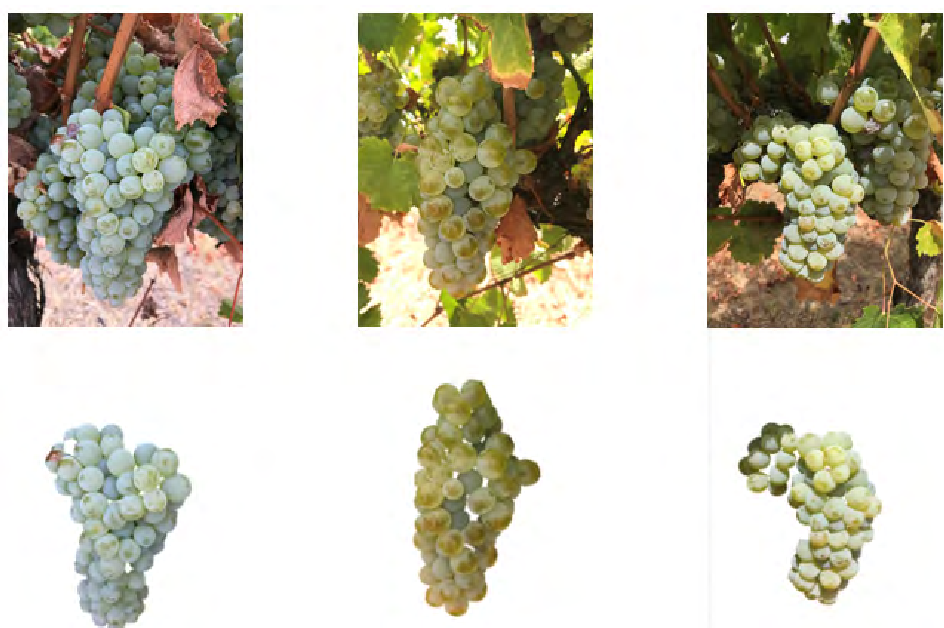 Figure: The process from raw field images to segmented bunch regions.
Experiments: Performance Benchmarks
The study provides a rigorous comparison of algorithms for berry detection.
- The Winner: SVM emerged as the most robust classifier, particularly for red cultivars where it achieved a 89.1% classification rate.
- The Efficiency Choice: k-NN performed surprisingly close to more complex deep learning models like SAE, suggesting that in resource-constrained edge devices (like field drones), simpler models might offer the best trade-off.
- Color Space Insight: For white grapes, the HSV color space proved superior, providing better contrast between green berries and green leaves.
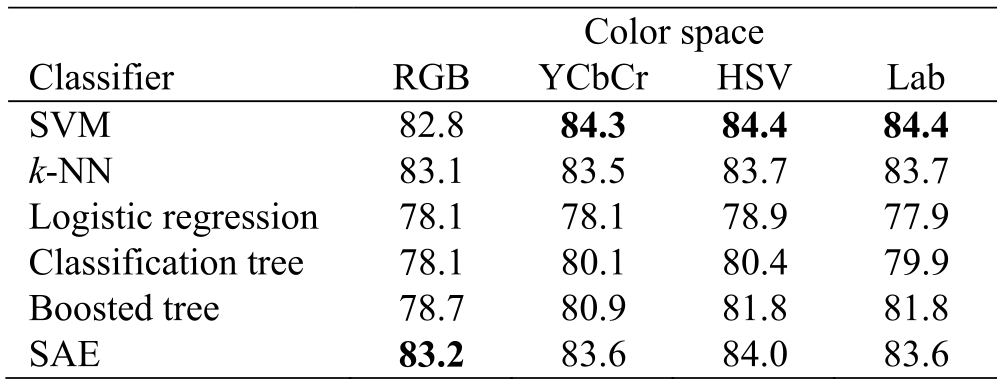 Table: Benchmark results showing SVM and k-NN performance across different color spaces.
Critical Insight: Why This Matters
The true value of this work isn't just in the 89% accuracy; it's in the standardization. By providing a public database, the authors have created a "sandbox" for AI researchers to solve agricultural problems without ever stepping into a vineyard.
However, the paper acknowledges a significant technical bottleneck: Occlusion. When grapes are hidden by leaves, 2D vision systems struggle. The future lies in the transition from 2D image processing to 3D reconstruction and Deep Learning (CNNs/Transformers), which can leverage temporal data to "see through" the canopy.
Summary & Future Outlook
This paper serves as the roadmap for the "Vineyard of the Future."
- Takeaway: Data-driven viticulture reduces chemical use through targeted spraying and optimizes logistics via accurate yield forecasts.
- Limitations: High sensitivity to lighting conditions remains a hurdle for in-field real-time systems.
- What's Next?: We expect to see these CV models integrated directly into harvesting robots and smartphone apps for growers, turning every farmer into a data scientist.