
Bee-Optimized Learning: Transforming Facebook into a Personalized Classroom
Computers and Mathematics with Applications
This paper presents a personalized educational recommendation system integrated into Facebook, utilizing an Artificial Bee Colony (ABC) algorithm to suggest auxiliary materials. The system achieves SOTA performance in recommendation accuracy and computational efficiency compared to random search methods by optimizing for learning styles, material difficulty, and user interests.
TL;DR
Educational researchers have successfully repurposed Facebook into a smart learning hub. By implementing an Artificial Bee Colony (ABC) algorithm, this study creates a system that scans social media posts and recommends only those that match a student's learning style (visual or verbal) and current ability level, achieving high-precision recommendations in under 4 seconds.
Background: The Social Media Paradox in Education
Facebook has long been a double-edged sword for students. While it offers a wealth of shared resources and collaborative potential, the sheer volume of "noise" makes it difficult to find materials that actually help. Traditional recommendation systems often focus on popularity, but in education, a "popular" video might be too easy, too hard, or format-incompatible with a student's cognitive needs.
The Problem: One Size Does Not Fit All
The authors identified a critical gap in e-learning logic:
- Style Mismatch: A visual learner thrives on infographics, while a verbal learner needs text. Generic feeds ignore this.
- Difficulty Gap: Based on Constructivist Theory, learning only happens when the material is slightly above the student's current level (the "target ability"). Most feeds provide content that is either trivial or incomprehensible.
- Optimization Complexity: Matching interests, styles, and difficulty across thousands of posts is a "combinatorial explosion" problem that traditional linear searches cannot solve efficiently.
Methodology: The Swarm Intelligence Approach
To solve this, the researchers turned to nature—specifically, the foraging behavior of honeybees. The Artificial Bee Colony (ABC) algorithm treats "food sources" as potential sets of recommended materials.
The Algorithm Mechanics
The system employs three types of "bees" to find the optimal set of materials:
- Employed Bees: Scout for initial material sets and evaluate their "nectar" (fitness value).
- Onlooker Bees: Watch the employed bees and choose the best material sets to refine further based on probability.
- Scout Bees: If a set of materials doesn't improve after several attempts, the scout bee abandons it and searches for a completely new, random direction to avoid getting stuck in "local optima."
The Fitness Function
The "nectar" (suitability) of a post is calculated using a complex formula that penalizes mismatches:
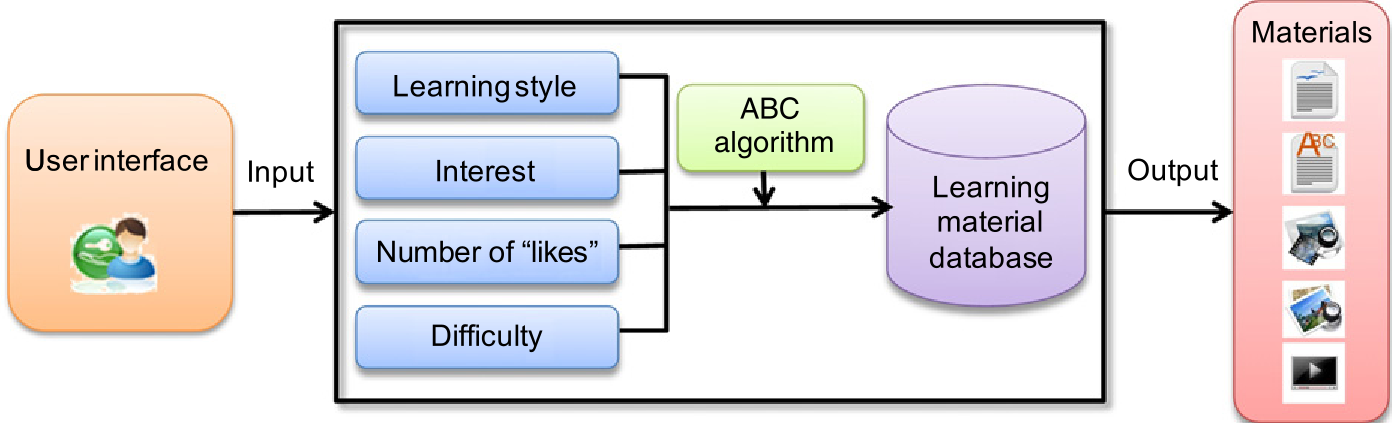 Figure 1: The architecture showing the flow from learner profile to the ABC-optimized Facebook interface.
Experimental Results: Speed vs. Precision
The study tested the system on datasets ranging from 200 to 2,000 posts.
Key Findings:
- Superior Accuracy: The ABC algorithm reached a fitness score roughly 8x better than random selection methods (0.08 vs. 0.62).
- Rapid Convergence: The system finds near-optimal recommendations in fewer than 100 iterations, making it viable for live web applications.
- Low Latency: Even with 2,000 candidate posts, the average execution time remained under 4 seconds, ensuring a smooth user experience on the Facebook UI.
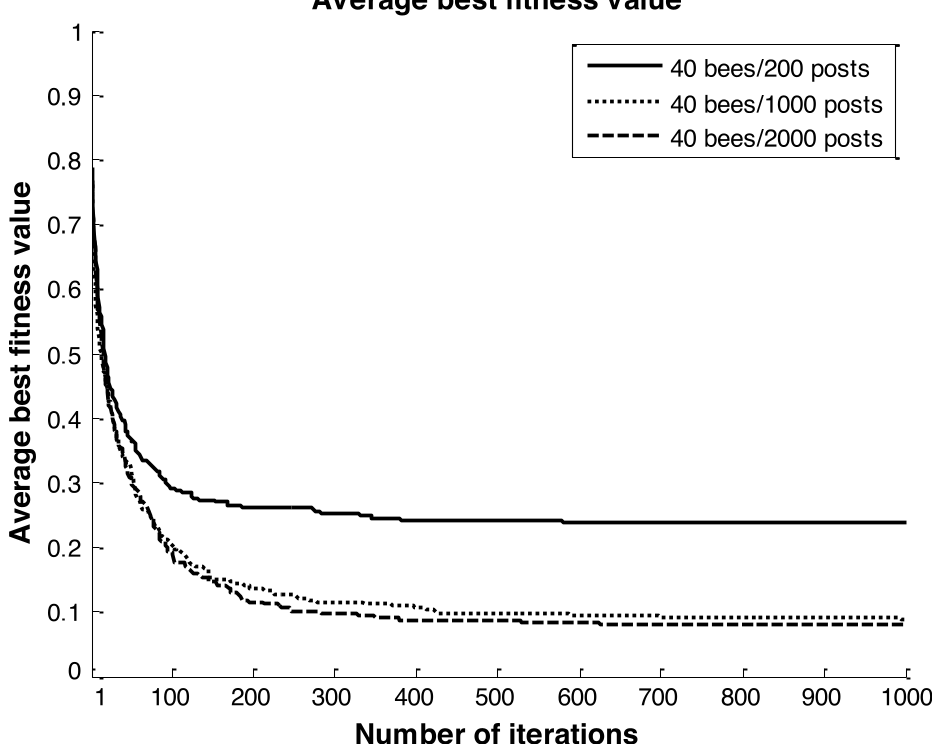 Figure 2: The fitness value drops sharply in early iterations, demonstrating the ABC algorithm's efficiency in finding optimal materials.
Critical Analysis & Future Outlook
The strength of this work lies in its Inductive Bias—the assumption that learning is a multi-dimensional matching problem rather than just a keyword search. By using the ABC algorithm, the authors proved that complex pedagogical theories can be computationally modeled.
Limitations: The system relies on "likes" as a proxy for popularity, which can be misleading in an academic context (a funny meme might get more likes than a high-quality lecture).
What's Next? The next frontier for this technology is applying it to Multi-modal Learning. Imagine an AI bee swarm that doesn't just look at difficulty labels, but uses Computer Vision to determine if a video is truly "visual" or just a "talking head."
Conclusion
This research provides a blueprint for the future of "Social Learning." By treating the discovery of educational content as a swarm optimization problem, we can turn distracted social media browsing into a highly efficient, personalized learning journey.