
Modeling the Invisible Plague: PDE and Mixed Delays in Social Network Malware Propagation
Computers and Mathematics with Applications
This paper develops a novel SARS-like reaction–diffusion Partial Differential Equation (PDE) model to simulate malware propagation in social networks. By integrating mixed delays (discrete and distribution delays) into an SIR (Susceptible-Infected-Removed) framework, the study identifies critical thresholds for local stability and the occurrence of Hopf bifurcation.
TL;DR
Researchers have moved beyond simple ODEs to model malware as a spatial-temporal phenomenon. This paper introduces a Reaction-Diffusion PDE model that accounts for mixed delays (discrete and distribution), identifying the "tipping point" (Hopf Bifurcation) where a network shifts from stability to periodic infection outbreaks.
Background: Why ODEs Are Not Enough
Most existing malware models treat a network as a "well-mixed" tank where every node has an equal chance of hitting any other. In reality, users have geographic or "cyber-spatial" positions, and their mobility patterns affect how viruses leap from one device to another. This study treats malware propagation like a physical diffusion process, using Partial Differential Equations (PDEs) to capture these dynamics more accurately.
The Core Challenge: The Complexity of "Mixed Delays"
In a social network, immunity isn't instantaneous (), nor is the recovery process uniform (). When these delays are combined with spatial movement (diffusion), the mathematical complexity explodes. The authors sought to answer: At what point does the delay in response actually cause the system to destabilize?
Methodology: The SIR-PDE Framework
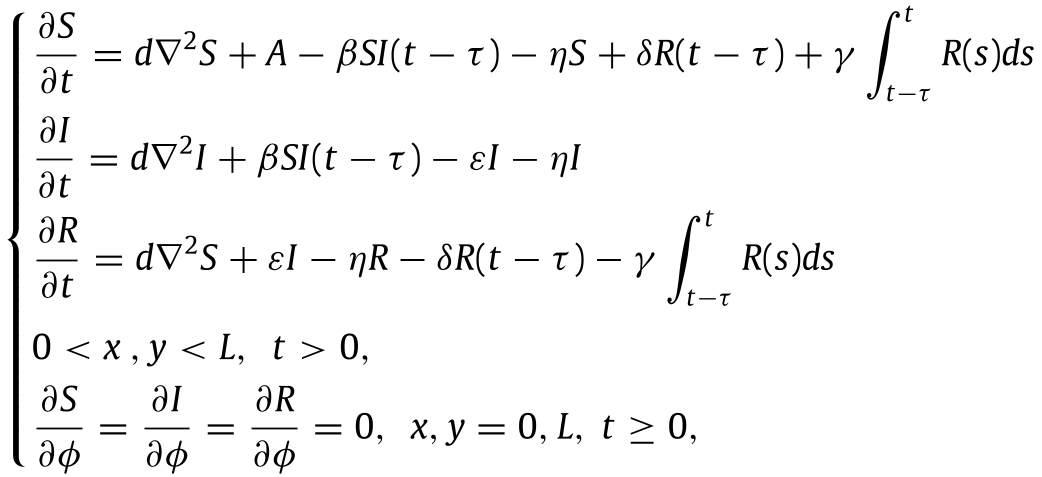
The authors propose a system of three equations representing Susceptible (), Infected (), and Removed () nodes.
Model Architecture
The model incorporates the Laplace operator () to represent the mobility of users. The term represents the infection rate with a discrete delay, while the integral captures the distributed nature of recovery and immunity loss.
Analytical Insights
- Stability Analysis: Using matrix theory, the authors derived conditions ( through ) under which the network remains at a "steady state" of infection.
- Hopf Bifurcation: This is the most critical technical contribution. The authors proved that as the time delay increases past a certain threshold , the system loses its equilibrium and begins to oscillate. This means malware counts will periodically spike and dip, making management much harder.
Experimental Validation
Using MATLAB simulations, the authors verified their mathematical proofs.
Stability vs. Oscillation
In the stable regime (), the infection levels settle into a predictable, constant value. However, once the delay exceeds the critical threshold, the system enters a limit cycle.
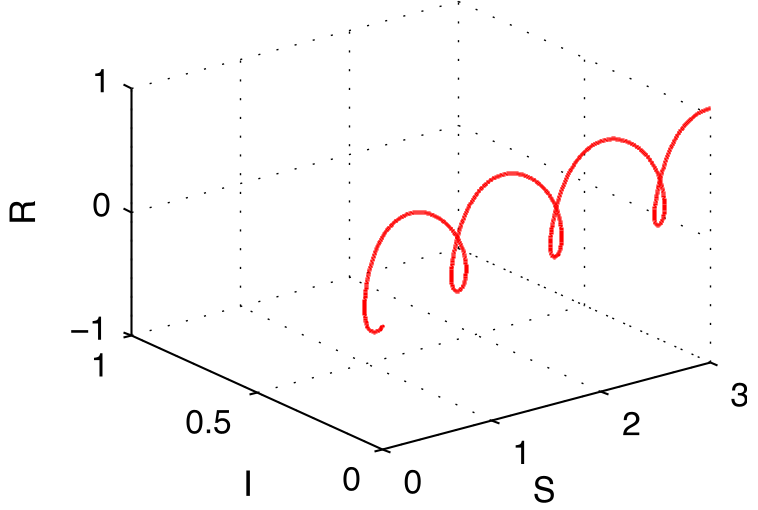 Note: Notice how the waveform transitions from a flat line (stable equilibrium) to a repeating wave (periodic oscillation) as the delay increases.
Sensitivity Analysis
The study also explored which "knobs" we can turn to control the spread:
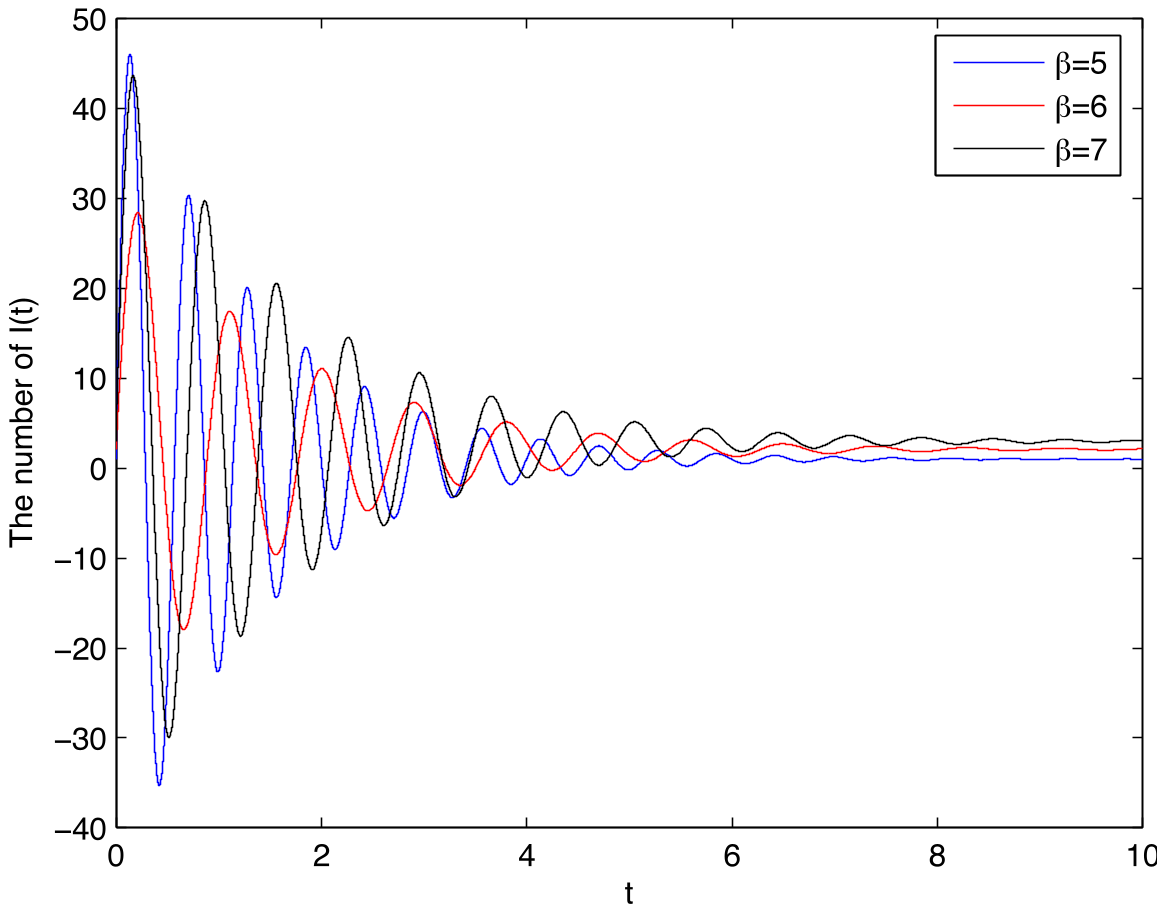
- Infection Rate (): Increasing naturally spikes the number of infected nodes.
- Transfer Rate (): Increasing the rate at which nodes move from "Infected" to "Removed" (e.g., faster patch deployment) significantly lowers the peak infection density.
Deep Insight: A Warning for Network Architects
The takeaway for cybersecurity professionals is clear: Latency is the enemy of stability. If the time it takes to detect or react to a malware threat (the delay ) exceeds a calculated threshold, the network's infection dynamics will become non-linear and oscillatory.
Limitations & Future Work
While the local stability analysis is robust, the paper stops short of proving Global Stability—meaning we don't yet know if the system will return to equilibrium after a massive, non-local shock. Future research needs to explore optimal control theory to find the most cost-effective way to keep the transmission below the Hopf threshold.
Conclusion
By bridge clinical epidemic theory with network topology, Du and Wang have provided a rigorous framework for understanding how malware lives and moves in a modern, mobile, and delayed world.