
GSGP-LS: Revolutionizing Regional Innovation Forecasting with Semantic Evolution
Computers and Operations Research
The paper proposes a novel forecasting model for Regional Innovation Systems (RIS) using Geometric Semantic Genetic Programming (GSGP) integrated with a Local Search Optimizer (GSM-LS). It achieves state-of-the-art performance in predicting complex socio-economic indicators like patent counts and technological innovation activity across 259 European regions.
Executive Summary
TL;DR: This paper introduces an advanced forecasting framework for Regional Innovation Systems (RIS) by combining Geometric Semantic Genetic Programming (GSGP) with a Local Search Optimizer. By moving the evolutionary process from the "syntactic" code level to the "semantic" output level and refining solutions with a linear optimizer, the model achieves unprecedented accuracy in predicting patents and innovation outputs across Europe.
Context: Positioned at the intersection of evolutionary computation and regional economics, this work represents a major SOTA advancement. It moves beyond simple "black-box" forecasting to provide a tool capable of handling the high variance and non-linearity intrinsic to socio-economic data.
Problem & Motivation: Why is Innovation Hard to Predict?
Historically, forecasting regional innovation has been plagued by the complexity and dynamism of socio-economic environments. Traditional models (like Linear Regression) assume simplicity, while standard Machine Learning (like Neural Networks) often fall into the trap of overfitting or getting stuck in local optima.
The authors' core Insight is that innovation isn't just a set of independent variables; it’s an evolutionary process. To capture it, we need an algorithm that can explore the "functional space" of possible relationships without being blinded by the specific "syntax" or structure of the equations.
Methodology: The Power of Semantic Local Search
The heart of the paper lies in Geometric Semantic Genetic Programming (GSGP). Unlike standard GP, which swaps branches of trees (syntax), GSGP uses operators that have specific geometric properties in the semantic space (the vector of outputs).
1. Geometric Semantic Crossover (GSXO)
It creates an offspring that is a convex combination of its parents, ensuring the offspring's performance is bounded between the parents—inducing a much smoother, unimodal error surface.
2. The Local Search Optimizer (GSM-LS)
To speed up convergence and find the "sweet spot" of these functions, the authors introduced a Local Search (LS) step. This step treats the mutation as a multivariate linear regression problem.
The model uses Singular Value Decomposition (SVD) to solve for co-efficients () that minimize the error for the combined parent and random perturbance trees, effectively "fine-tuning" the evolutionary step.
Experiments & Results
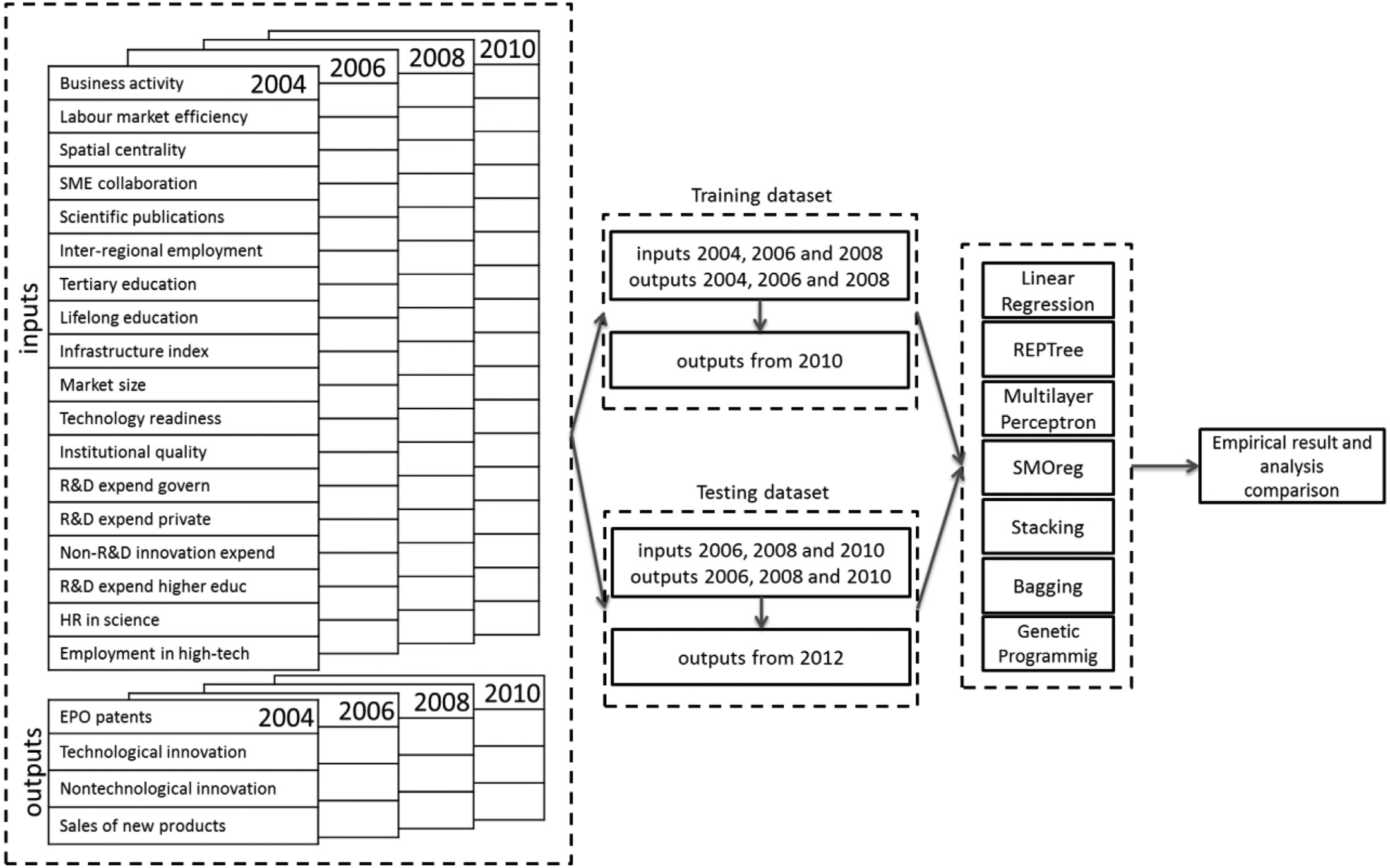
The study utilized objective data from 259 NUTS 2 regions (2004–2012). The task: predict outputs like Patent Counts () and Technological Innovation () using 18 regional determinants.
SOTA Comparison
GSGP-LS was tested against a battery of algorithms, including Multi-Layer Perceptrons (MLP), Support Vector Regression (SMOreg), and standard GP.
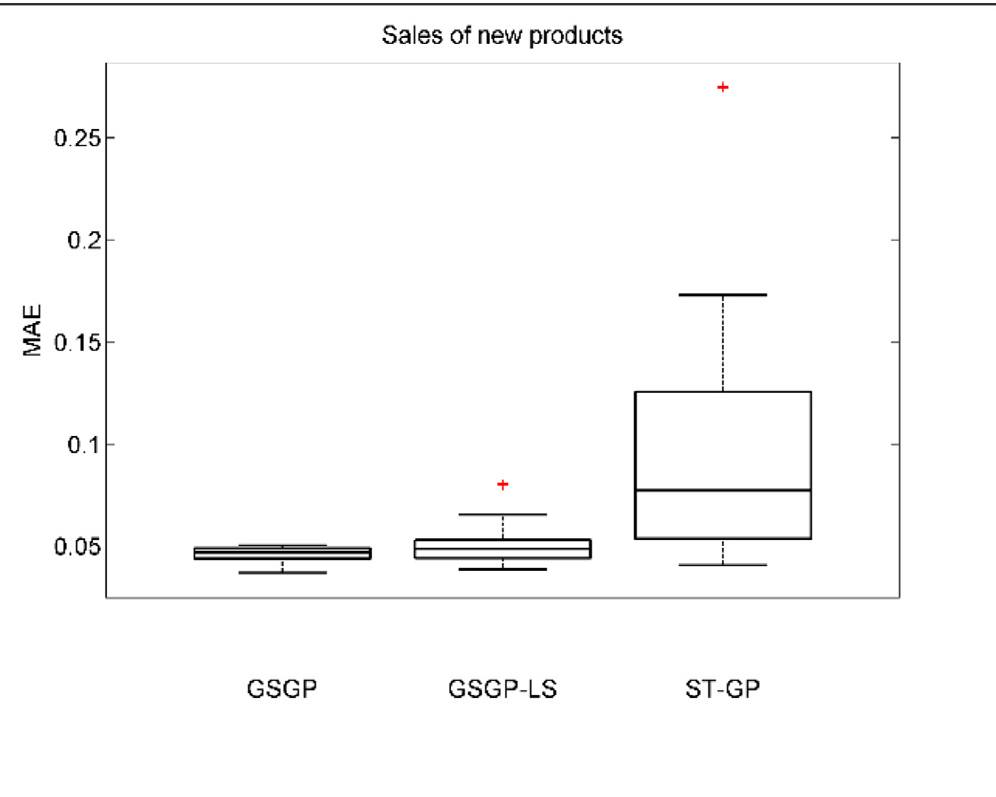
- GSGP-LS Error: Consistently the lowest (MAE ~0.014 for patents).
- Versus MLP: While MLPs showed good training fit, their testing performance was significantly worse, indicating that the GSGP-LS approach generalizes far better to unseen socio-economic shifts.
Critical Analysis & Conclusion
Takeaway
The integration of local search into GSGP creates a powerful balance between exploration (finding new functional forms) and exploitation (optimizing the constants of those forms). This is particularly effective for RIS data, where the signal-to-noise ratio is often low.
Limitations & Future Work
The primary limitation highlighted is data lag; Community Innovation Survey data is often released with several years of delay. Future iterations of this work could benefit from incorporating "Nowcasting" techniques—using real-time web-scraped data or social media trends to supplement the lagging official statistics.
In conclusion, the GSGP-LS model is not just a mathematical curiosity; it is a robust high-performance tool ready for real-world policymaking applications.