
SocioRank*: Bridging the Gap Between Community Structures and Social Roles
Computers and Electrical Engineering
SocioRank* is a novel graph-based framework for the concurrent detection of communities and social roles in cyber-social networks. By integrating an iterative edge-removal process based on betweenness centrality with multi-metric node ranking, it achieves high-fidelity social structure mapping on email interaction datasets.
TL;DR
Understanding how people group together and the specific roles they play within those groups is central to social network analysis. SocioRank* is a dual-purpose method that identifies hidden sub-communities and ranks individuals (from leaders to reserved members) using robust graph metrics. Tested on real email data, it achieves high accuracy in mapping digital interactions to real-world social hierarchies.
Problem & Motivation: The Disjoint Discovery Gap
In the landscape of Social Network Analysis (SNA), community detection (who is with whom) and role discovery (who does what) are often treated as separate research silos. Existing "joint" methods often force users into predefined "slots" (e.g., "Bridge" or "Hub"), which may not reflect the nuanced behavior of a specific group.
The authors of SocioRank* recognized that to truly understand a network, one must solve both problems concurrently. They argue that behavioral communication patterns (how often and with whom you email) are the most reliable indicators of your social standing.
Methodology: The SocioRank* Dual Pipeline
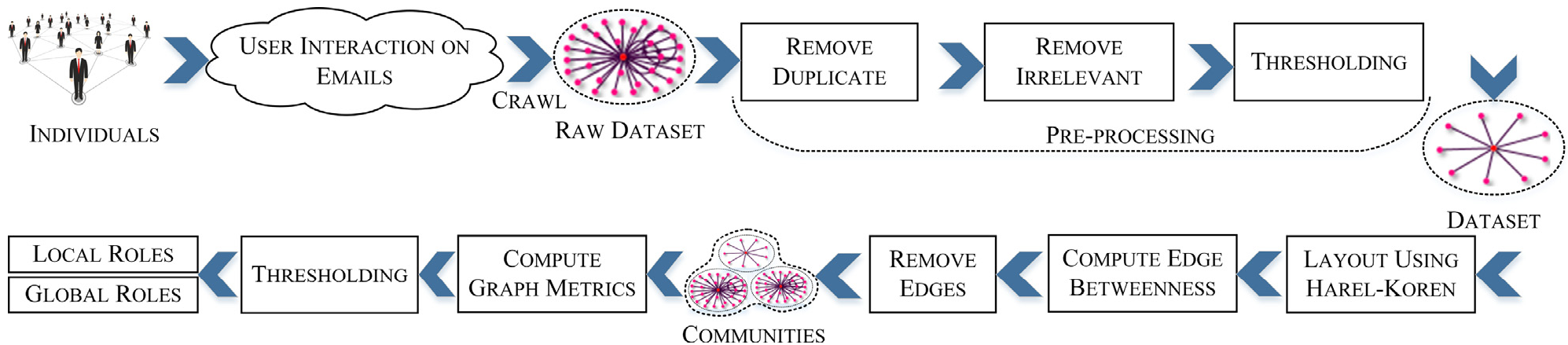
The SocioRank* framework operates in two distinct tiers: Structural Decomposition and Centrality-Based Ranking.
1. Community Partitioning
Instead of simple clustering, SocioRank* uses an iterative edge-removal strategy. By calculating Edge Betweenness—a measure of how many shortest paths pass through a link—the algorithm identifies "bridges" between communities. Removing these bridges causes the network to naturally break into cohesive "islands" or sub-communities.
2. Multi-Metric Role Discovery
Once communities are split, the system calculates several centralities to classify roles:
- Degree Centrality: Popularity and direct influence.
- Betweenness Centrality: Control over information flow (gatekeeping).
- Closeness Centrality: Accessibility to the rest of the network.
The model identifies Influential Individuals () as those with high degree and high betweenness, while Reserved Individuals () are those with low connectivity and a larger "distance" from the network core.
Experiments: Email Data as a Social Mirror
The authors validated SocioRank* using a dataset of 68 students in a computer science class, tracking their emails over a semester.
Key Findings:
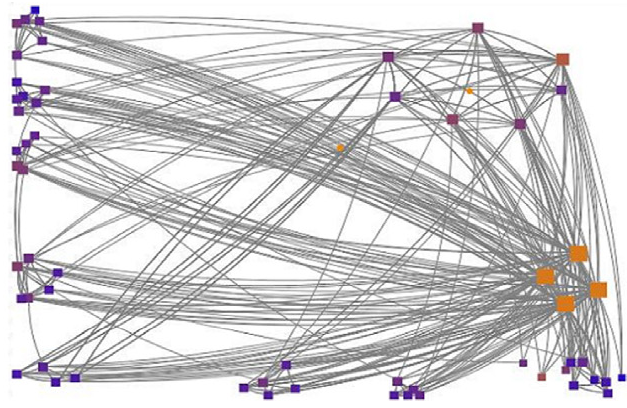
- Community Structure: The algorithm successfully identified 10 sub-communities. Most students formed groups centered around software projects or study circles.
- Quantitative Thresholds: Global leaders were identified by a Degree , whereas sub-community leaders () required a Degree within their local cluster.
- Ground Truth Alignment: The "Influential" nodes identified by the algorithm corresponded exactly to class representatives who distributed course materials, while "Reserved" nodes matched students who preferred to work in isolation.
Critical Analysis & Conclusion
Takeaway
SocioRank* proves that unsupervised graph metrics can effectively replace complex supervised models for role detection if the underlying interaction data (like emails) is high-quality. It provides a blueprint for any organization to map its informal hierarchy.
Limitations
- Static vs. Dynamic: The paper treats the network as a static snapshot. In reality, social roles shift over time as projects start and end.
- Content Blindness: The method focuses entirely on metadata (who sent what to whom) and ignores the content of the emails, which could offer deeper psychological insights.
Future Outlook
The next frontier for SocioRank* involves cross-platform analysis—merging LinkedIn, Twitter, and Email data to create a "Universal Social Rank" that captures an individual’s influence across professional and social dimensions.