
Integrating Multi-Agent Systems and CNNs: A New Frontier for Social Network Perception
Computers and Electrical Engineering
This paper introduces a parallel integration of Multi-Agent Systems (MAS) and Convolutional Neural Networks (CNN) to enhance search efficiency and connection awareness in social networks. By leveraging a modified BDI logic for agents and a unique neuron receptive field structure for CNNs, the model achieves superior performance in network perception and synchronization.
TL;DR
This research presents a novel architecture that merges Multi-Agent Systems (MAS) with Convolutional Neural Networks (CNN) to solve the efficiency and perception challenges in modern social networks. By treating interpersonal relationships as dynamic agent interactions and using CNNs to process prior knowledge of social attributes, the framework achieves significantly higher search accuracy and network synchronization compared to traditional distributed methods.
Background & Motivation: The Perceptual Bottleneck
In an era of massive information expansion, the primary hurdle in social networking isn't just data storage; it's perception. Standard search engines treat social data as static entries, ignoring the "fluidity" of human relationships.
The author identifies two critical pain points:
- Structural Isomerism: Data across different platforms (Media Sharing, Instant Messaging, etc.) is inconsistent.
- Perceptual Difficulty: Users struggle to capture "useful" connection information, leading to chaos and information overload.
Methodology: The Parallel Integration
The core of the paper lies in its hybrid design, described as a "parallel integration."
1. The Multi-Agent Layer (The Brain)
Instead of simple nodes, the system uses agents governed by BDI (Belief-Desire-Intention) logic. These agents don't just store data; they "think" and revise their intentions based on:
- Internal Thought Conditions: The agent's existing knowledge base.
- External Interaction Factors: Feedback from other agents and the environment.
The model uses Gray Sequence Theory to calculate trust between agents, ensuring that information retrieval is not only fast but reliable.
2. The CNN Layer (The Eyes)
Unlike CNNs used for image recognition, this architecture uses "Attribute Territory Knowledge" to code social features into a format the network can process.
- Receptive Field Structure: Each neuron connects to a local receptive field in the previous layer to extract local relational features.
- Weight Sharing: All neurons in a feature plane share weights, significantly reducing the complexity of the model while maintaining translation invariability.
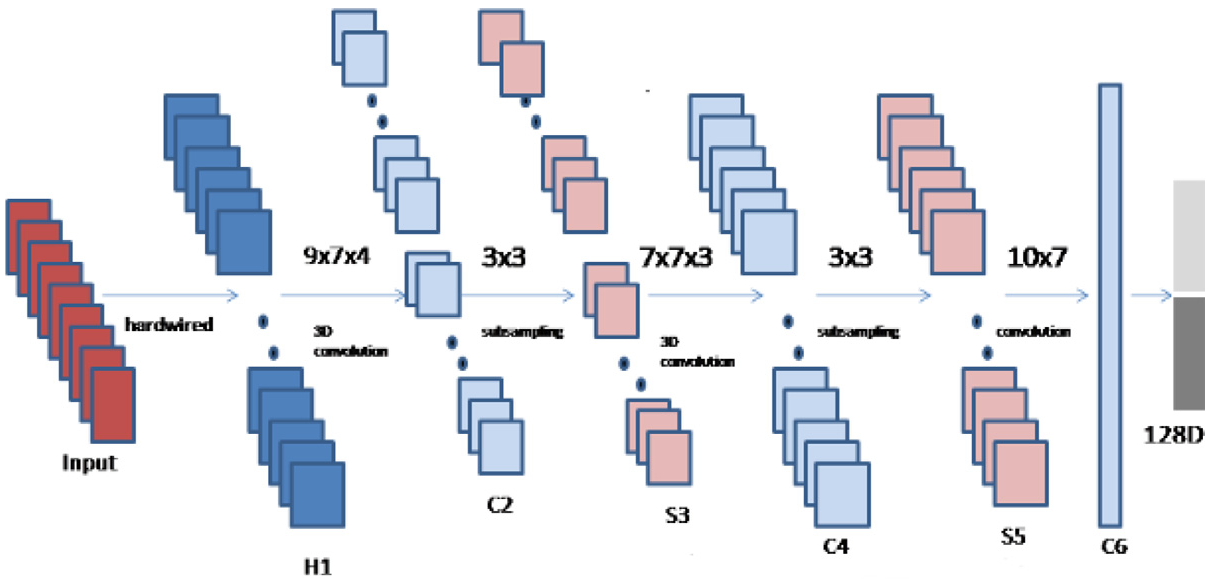 Figure: The basic systematic architecture for the neural network model proposed in the study.
Search and Perception Pattern
The proposed "Perception Engine" works through three modules:
- Ontology Integration: Converts heterogeneous data (videos, text, links) into a unified RDF graph.
- Data Indexer: Extracts implicit visibilities and relationships.
- Query Integration: Accepts user keywords and returns an intersection of "Visibility" and "Data Match."
Experimental Validation
The author conducted extensive numerical simulations comparing the proposed method against Distributed Methods and Natural Methods.
Key Findings:
- Efficiency: The system throughput remains stable even as network complexity increases.
- Delay: System latency is significantly lower than baseline models when dealing with large-scale node interactions.
- Synchronization: Using a nodal function based on Lyapunov stability, the network reaches synchronization regardless of the number of nodes, meaning information flows through the network with minimal error.
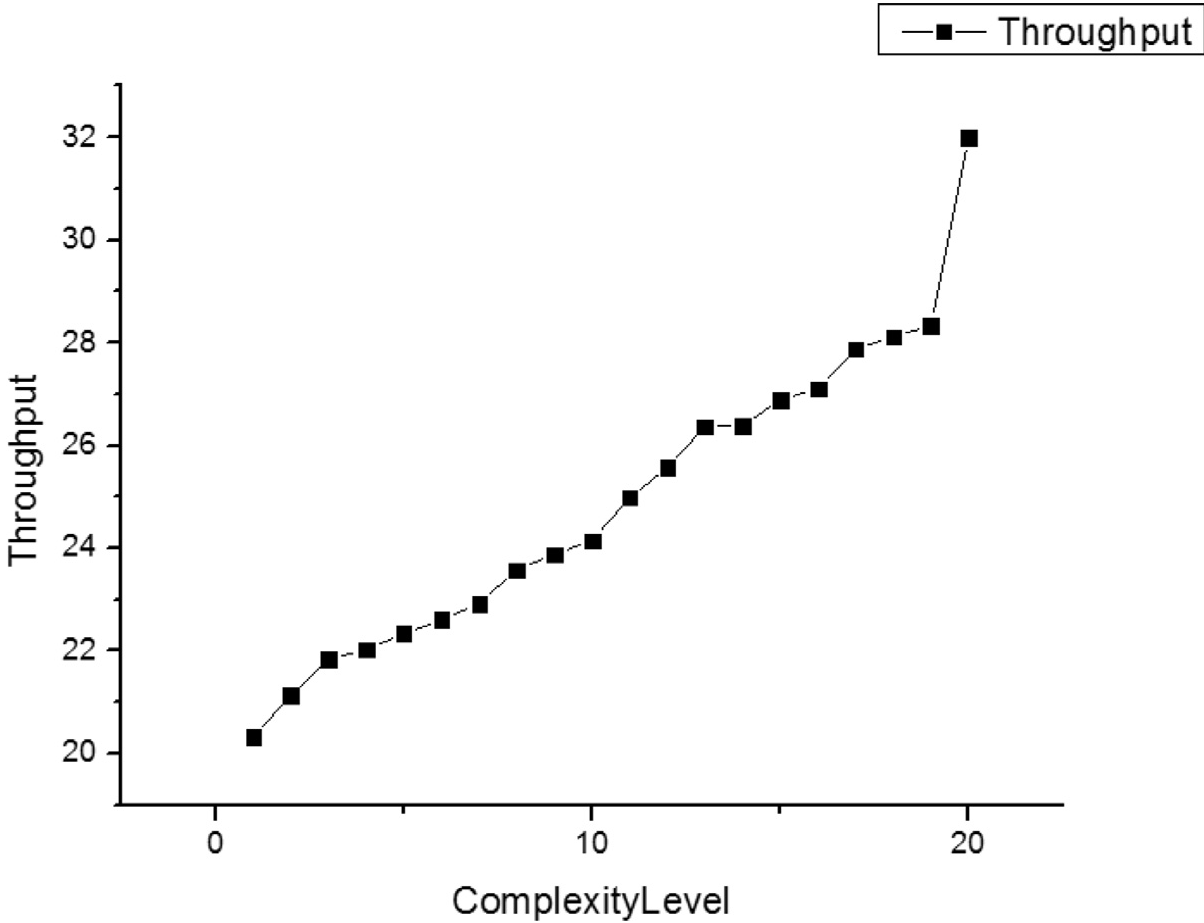 Figure: System throughput efficiency under increasing complexity, demonstrating the robustness of the MAS-CNN approach.
Critical Insight & Conclusion
The true value of this work is the shift from passive retrieval to active perception. By incorporating "Trust Analysis" and "Sensation Patterns," the model mimics how humans naturally prioritize information from their social circles.
Limitations: While the theoretical framework is sound, the paper relies heavily on simulations. Real-world implementation would need to address the privacy concerns of "implicitly getting user interests" and the computational cost of maintaining BDI logic for millions of simultaneous agents.
Future Work: The integration of State Space Models (SSM) or more advanced GNNs (Graph Neural Networks) could further refine the "perception" capabilities of this multi-agent framework.