
D-Trust: Why Trust Erosion is the Secret to Realistic Social Network Modeling
Computers and Electrical Engineering
The paper introduces D-Trust, a multi-dimensional trust evaluation model for social networks that combines attribute similarity, interaction behavior, and mutual friends. It achieves a more realistic trust assessment by integrating a time decay factor based on Newton's Law of Cooling to account for the dynamic decline of trust over time.
TL;DR
In the digital world, is a "friend" you haven't spoken to in five years as trustworthy as one you talked to yesterday? Most algorithms say yes; D-Trust says no. This paper introduces a dynamic trust model that combines demographic similarity, interaction frequency, and mutual friends, while introducing a physics-inspired time decay factor to model the natural erosion of human trust.
The Problem: The "Static Trust" Fallacy
Most existing Social Network Analysis (SNA) models treat trust as a static value or a simple graph-edge weight. This ignores two fundamental human realities:
- Context Multiplicity: Trust isn't just about who you follow; it's about shared interests and mutual connections.
- Temporal Decay: Trust has a "half-life." Without interaction, the psychological bond weakens.
Prior works like AUTrust or EigenTrust often result in scores that are either too idealistic (staying high forever) or too coarse (ignoring the nuances of why people trust each other).
Methodology: The D-Trust Framework
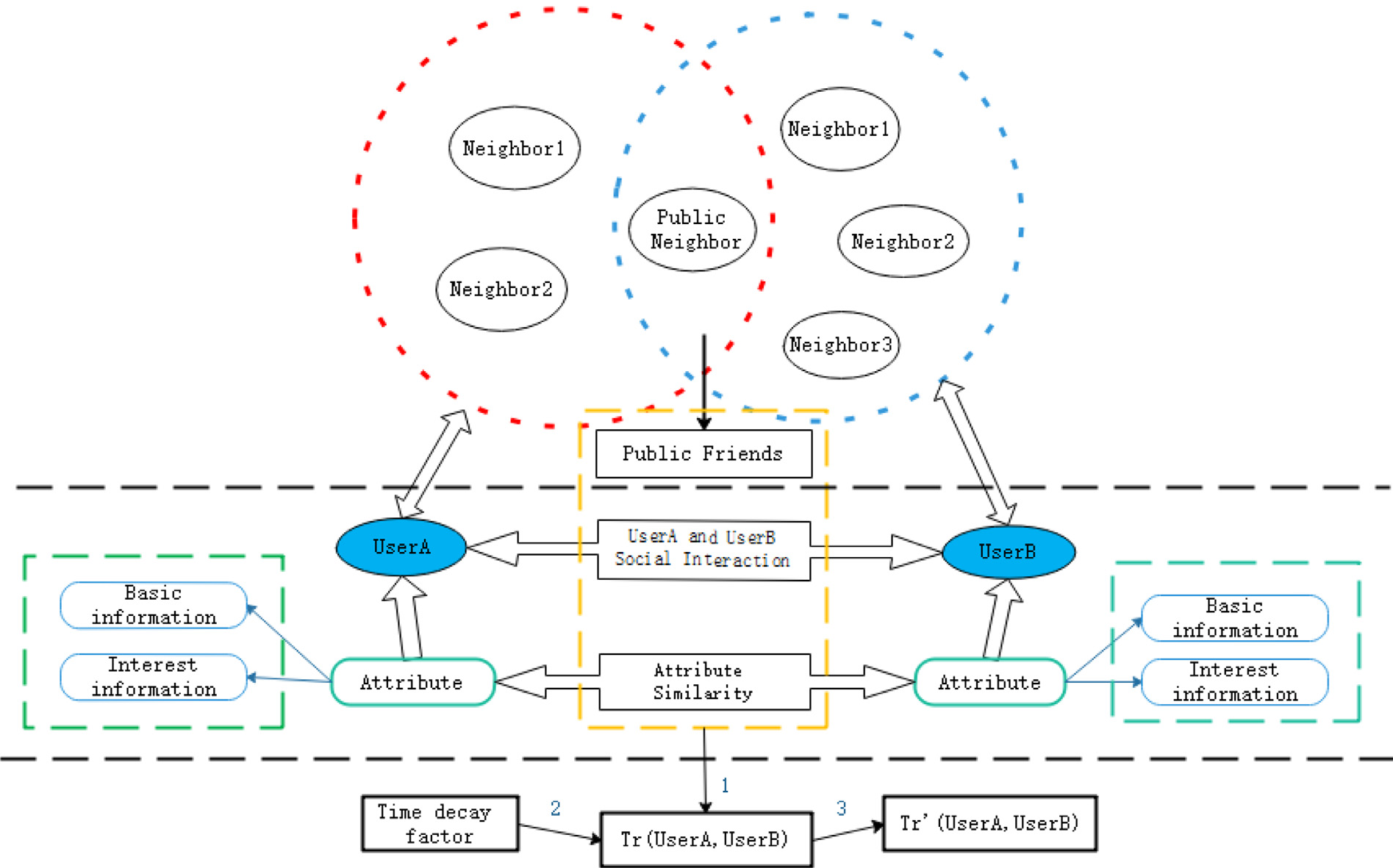
The authors propose a multi-dimensional approach to calculate Direct Trust. The model breaks down trust into three pillars:
- Attribute Similarity (AS): Using Jaccard similarity to compare age, gender, and interests (sports, movies, etc.).
- Interaction Behavior (IN): Measuring the ratio of interactions (retweets, comments, mentions) between two users relative to their total social activity.
- Public Friends (PF): Leveraging "Dunbar’s Number" (stipulated at 150) to quantify how mutual connections validate a stranger's profile.
The Core Equation
The static trust is calculated as a weighted sum:
Introducing Physics: Newton’s Law of Cooling for Trust
The most innovative part of this paper is the treatment of time. The authors argue that trust follows an exponential decay similar to how a physical object cools down. When interaction () is zero for a duration , the trust value is adjusted: This ensures that the model reflects the "lag" and "decay" found in real-world social relationships.
Experiments & Results
The authors validated D-Trust using a real-world dataset from Tencent Microblog.
Key Insights from the Data:
- The Weight of Similarity: In sparse networks, attribute similarity () proved to be the most stable predictor of trust compared to interaction frequency.
- Sensitivity Comparison: Compared to AUTrust and I-Trust, D-Trust showed higher sensitivity to user behavior changes and temporal gaps.
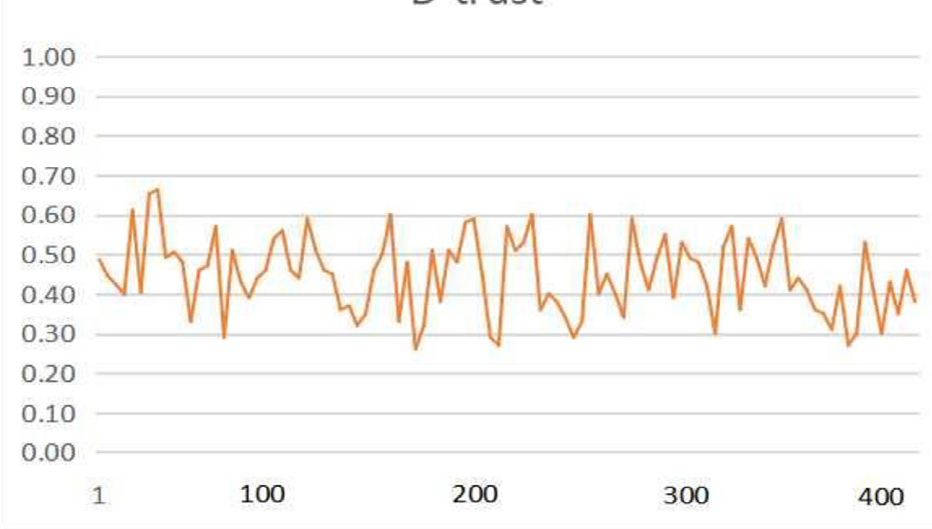 Fig 6: D-Trust (blue) shows more realistic fluctuations compared to the nearly constant I-Trust or the overly high AUTrust.
The Cooling Effect in Action
The study demonstrated that as time increases without interaction, the trust score predictably drops. This prevents "stale" trust from influencing recommendation systems or security protocols.
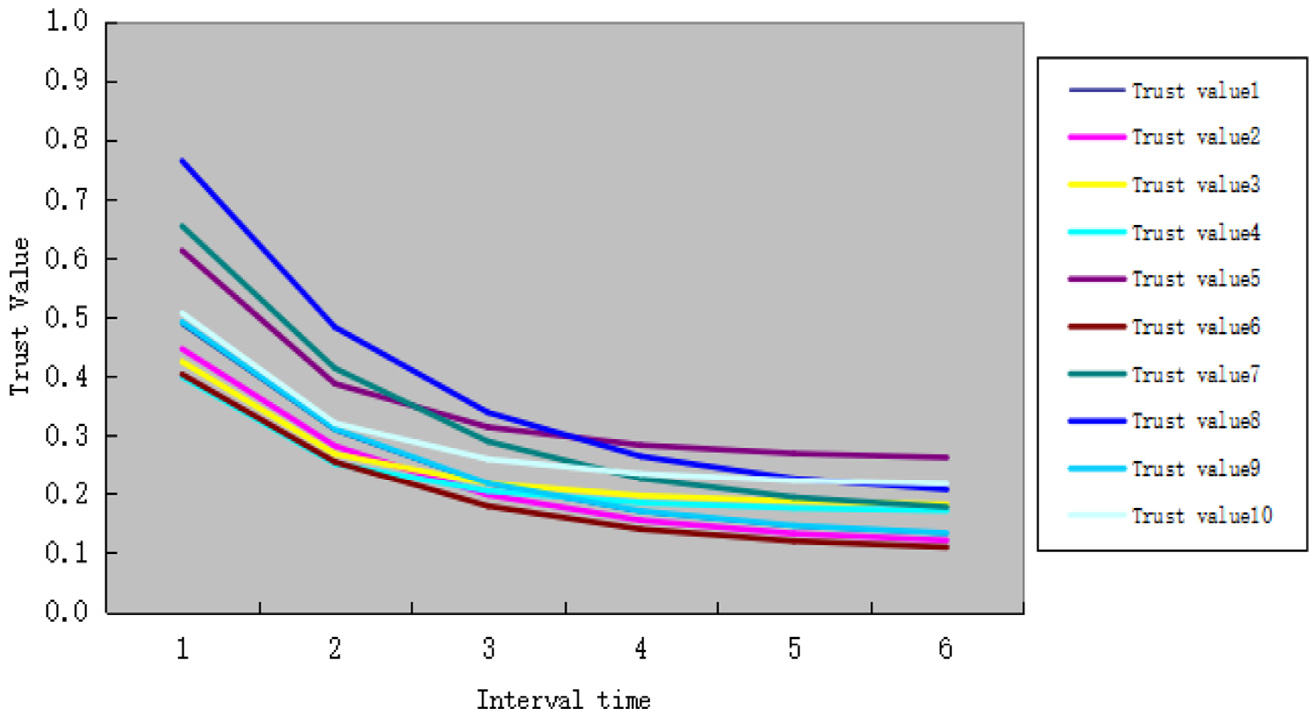 Fig 7: Visual representation of trust erosion over time.
Critical Analysis & Takeaway
Value: D-Trust moves the needle by moving away from "pure graph" approaches toward "sociological" approaches. By treating trust as a dynamic state rather than a static attribute, it provides a blueprint for more resilient social security measures.
Limitations:
- Weight Subjectivity: The weights () are set manually based on the specific network characteristics; an automated, deep-learning-based weight optimization would be a logical next step.
- Direct vs. Indirect: The current model focuses primarily on direct trust between adjacent nodes. Expanding this decay factor to Trust Transitivity (e.g., "A trusts B, B trusts C") remains a challenge.
Future Outlook: Integrating this time-decay factor into Graph Neural Networks (GNNs) could significantly improve their performance on dynamic graphs where edges appear and disappear over time.