
SheepIT: Precision Behavior Monitoring via Edge Machine Learning
Computers and Electronics in Agriculture
This paper presents an enhanced behavior monitoring system for sheep in smart agriculture, utilizing low-power microcontrollers and Decision Trees (DT) to classify five distinct activities. The core contribution is the integration of an "infracting" state—identifying when sheep eat from restricted vine branches—achieving over 91% global accuracy on a real-world dataset.
TL;DR
Researchers from the University of Aveiro have developed a clever monitoring mechanism for "Smart Sheep" that prevents them from eating expensive grapevines while they weed vineyards. By deploying optimized Decision Trees on low-power microcontrollers, they achieved 91.78% accuracy in distinguishing five behaviors, including a unique "infracting" state, while ensuring the code is light enough to run on-device for months.
Context: Why "Smart Sheep" in Vineyards?
In "Smart Farming," sheep are often used as natural lawnmowers in vineyards. However, they have a bad habit: they eventually stop eating the grass and start eating the young vine buds and leaves, which destroys the crop. The SheepIT project aims to solve this by creating a collar that monitors behavior and applies a stimulus (conditioning) only when the sheep is "infracting."
The technical challenge is twofold:
- Hardware Constraints: The algorithm must run on a tiny microcontroller with minimal battery draw.
- Imbalanced Data: Sheep spend 70% of their time eating peacefully. Detecting a 2-second "run" or "infraction" is a needle-in-a-haystack problem.
Methodology: From Physics to Machine Code
The researchers moved beyond simple threshold-based logic to a supervised Machine Learning (ML) approach.
The Feature Engineering Pipeline
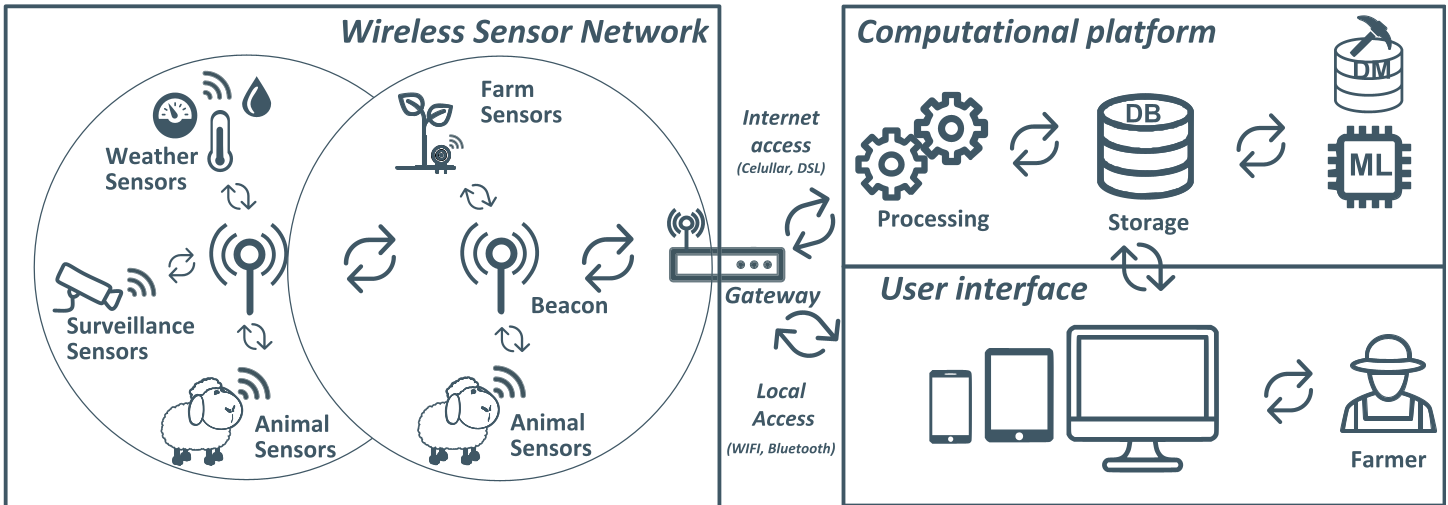
Instead of sending raw accelerometer data (which would kill the battery), the system calculates features locally. They started with 27 features, including:
- Static Features: Pitch, Roll, Yaw, and Ultrasound distance to the ground.
- Dynamic Features: Variance, Zero Crossing, and Dominant Frequency of acceleration.
- Temporal Features: The "History" of states (e.g., how long has the sheep been in this state?).
Feature Selection: Less is More
Running 27 features on a microcontroller is inefficient. Using the oneR algorithm, the team identified that 10 features (primarily Pitch and Distance to Ground) provided the best balance. Interestingly, while the ultrasound distance (dist.mm) was the #1 predictor of eating vs. infracting, it wasn't enough on its own to distinguish moving from running.
The "Infinite Loop" Trap
A fascinating insight from this paper is the danger of "Stateful" features. When the authors added prevState (Previous State) as a feature, the accuracy jumped to a staggering 96%.
However, the model became useless. Because sheep stay in one state for a long time, the Decision Tree learned a "lazy" rule: If the previous state was Eating, the current state is probably Eating. In a real-world deployment, this creates an infinite loop where the collar gets stuck in the first state it detects and never switches, regardless of what the sheep is actually doing.
Results: A Feasible Balance
The team settled on Case 4: 10 physical features + nEqualStates (a counter of how long a state has lasted). This broke the infinite loops while maintaining high precision.
| Metric | Case 1 (No History) | Case 4 (Optimized) | Case 3 (High Acc, but Buggy) |
|---|---|---|---|
| Accuracy | 91.00% | 91.78% | 98.40% |
| Macro-F1 | 0.7031 | 0.7086 | 0.9359 |

The confusion matrix shows that the model is exceptionally good at identifying Eating (10,043 correct) and significantly improved the detection of Infractions by reducing false positives through the temporal feature.
Critical Insight & Conclusion
This work highlights a critical lesson for AI in IoT: Validation isn't just about the F1-score; it's about the logic. A model can have 99% accuracy on a static dataset but fail in the field if it creates logical deadlocks.
By carefully pruning features and checking for "hidden loops" in the Decision Tree, the authors produced a model that is both computationally lightweight and biologically sensible. Future work will likely focus on synthetic data generation to further refine the detection of rare "Running" and "Infraction" events in even more diverse terrains.