
Intelligent Medical Routing: A Trust-Based Model for IoT Hospital Evaluation
Computers in Biology and Medicine
This paper proposes a hospital confidence evaluation model for IoT-based mobile health systems in social networks. It integrates national authoritative rankings with third-party user feedback to create a balanced assessment mechanism that optimizes medical resource distribution in developing countries.
TL;DR
In developing nations, the "medical squeeze" is a life-threatening reality—top-tier hospitals are overwhelmed while local clinics are ignored. This paper introduces a Hospital Confidence Evaluation Index that combines official government data with real-time third-party user feedback. By applying a recursive iteration model to mobile IoT systems, the authors provide a personalized "recommendation engine" for patients, effectively balancing the load across the healthcare system.
The Motivation: Breaking the Medical Monopoly
The paper highlights a staggering statistic: in China, only 7% of the population receives 80% of medical resources. This imbalance stems from a lack of trust; patients default to famous hospitals even for minor ailments, leading to:
- Astronomical wait times that jeopardize emergency care.
- High misdiagnosis rates caused by doctor burnout.
- Social contradictions between patients and medical staff due to perceived inefficiencies.
The authors' core insight is that trust is not static—it is a composite of professional authority and peer experience. By quantifying both, they can steer patient flow more rationally.
Methodology: Quantifying Trust in Two Dimensions
The framework splits hospital evaluation into two distinct "Eigenvalues":
1. National Authoritative Evaluation ()
This reflects the "hard power" of a hospital, covering:
- Legal Structure: Policy compliance and reform pace (Eq. 1).
- Technical Quality: Equipment, personnel capacity, and random government spot-checks (Eq. 2 & 3).
- Information Reliability: The accuracy and timeliness of the hospital's data broadcasting.
2. Third-Party Web Review ()
This captures "soft power" and user experience:
- Hospital Reputation: Post-treatment feedback on cleanliness and management.
- User Confidence: Subjective preference influenced by word-of-mouth and waiting times.
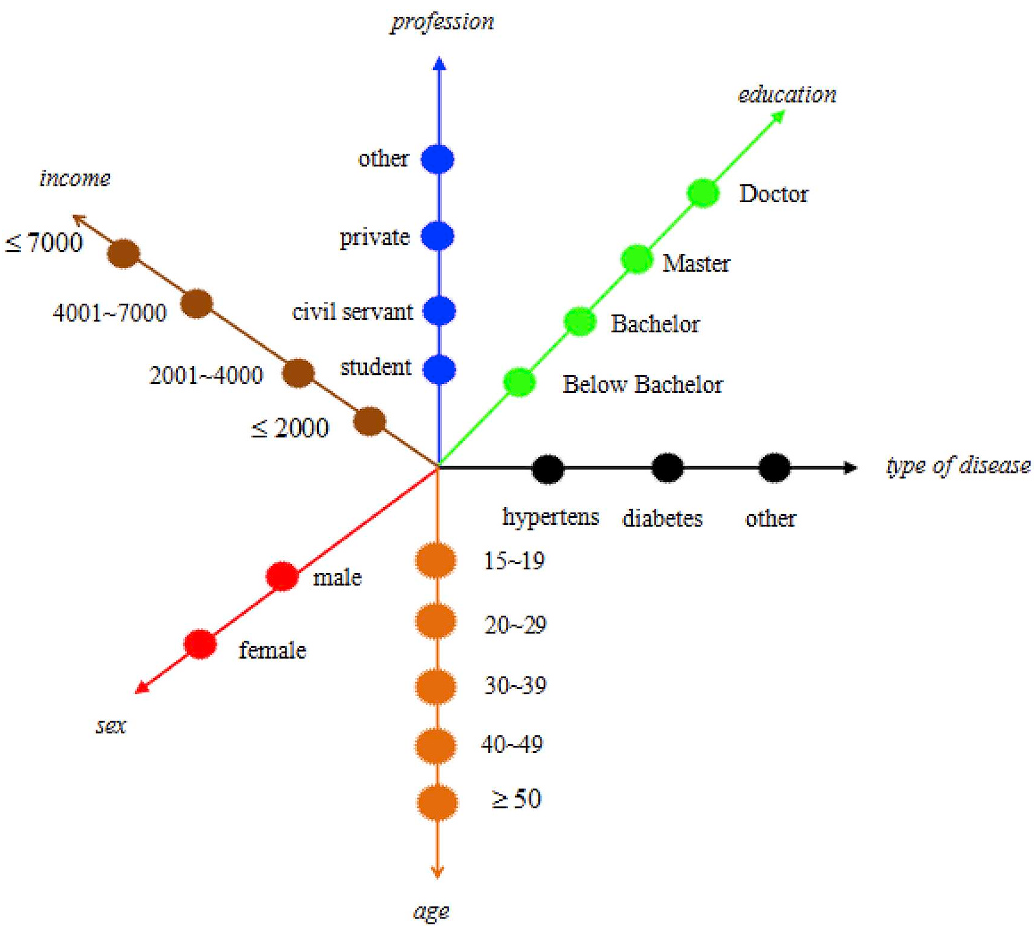 Figure: The Control Variable model used to weight evaluations based on user demographics.
The Iterative Model
The system doesn't just provide a score; it uses a Recursive Iteration Mechanism (Eq. 10-12). As more users evaluate the hospital via their mobile APPs, the scores update in real-time, allowing the system to converge on a "true" utility value for different segments of the population.
Experimental Results: The Divergence of Trust
The study utilized data from the "Mobile Medical" project involving over 32 million treatment records across seven hospitals.
Key Findings:
- The "Xiangya" Effect: Famous hospitals initially had 90+ trust scores. However, as third-party data regarding long wait times and poor service flowed into the model, their confidence ratings dropped significantly—sometimes down to 50.
- Demographic Sensitivity:
- Income: Higher-income individuals ( 7000 RMB) prioritized national rankings. Low-income groups ( 2000 RMB) gave higher trust scores to community hospitals ranking lower nationally but providing better cost-efficiency.
- Education: PhD and Master's degree holders showed higher trust in specialized technical tiers, whereas undergraduate users were more influenced by service quality.
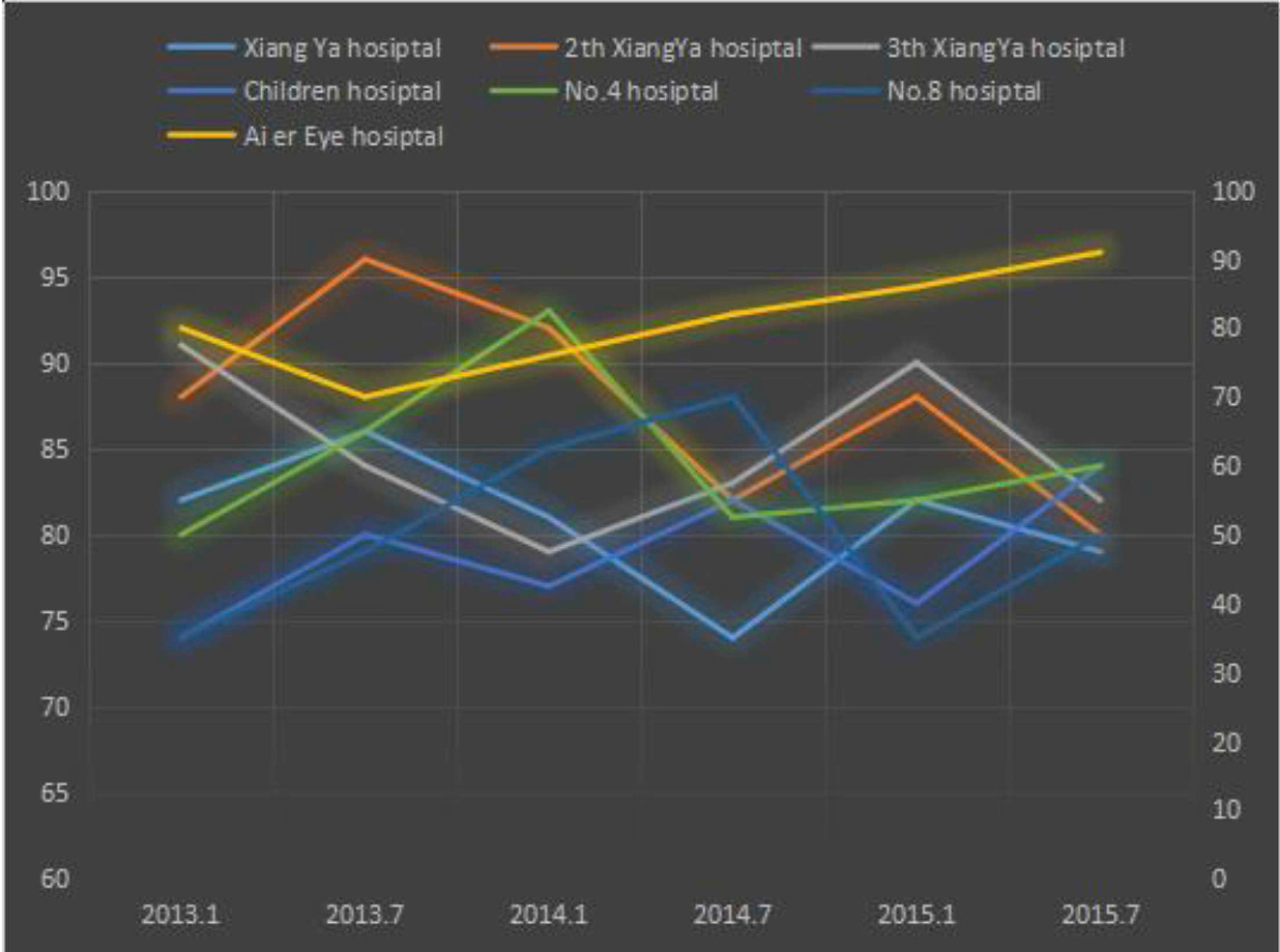 Figure: Fluctuations in hospital evaluation index over time as user feedback offsets official rankings.
Critical Analysis & Conclusion
The value of this work lies in its personalization algorithm. By using "Control Variables" like age and income, the IoT system doesn't just say "this is the best hospital"; it says "this is the best hospital for you."
Challenges & Future Work
- Data Integrity: The model relies on the honesty of user reviews. Future iterations must address potential "malicious reviews" or bot-driven data.
- Connectivity: The authors propose shifting toward D2D (Device-to-Device) real-time data acquisition to minimize the latency in information dissemination.
In summary, this research proves that medical resource distribution isn't just a logistics problem—it's an information symmetry problem. By using IoT to bridge the gap between national standards and patient reality, we can create a sustainable healthcare ecosystem.