
Beyond Subjective Observation: Machine Learning the Logic of Pathological Gait
Computers in Biology and Medicine
This study evaluates seven supervised machine learning algorithms to classify sagittal gait patterns in children with spastic diplegia cerebral palsy (CP). By extracting kinematic features from 200 patients, the Artificial Neural Network (ANN) emerged as the top performer, achieving a SOTA prediction accuracy of 93.5% using a 10-fold cross-validation approach.
TL;DR
Gait analysis for Cerebral Palsy (CP) has long been an art of clinical experience. This study transforms it into a rigorous data science task by comparing seven supervised learning algorithms. The Artificial Neural Network (ANN) leads with 93.5% accuracy, while the Decision Tree provides a transparent "logic gate" that identifies the ankle's motion as the primary differentiator in spastic diplegia.
The "Subjectivity" Gap in Clinical Biomechanics
In treating children with spastic diplegia CP, identifying the specific sagittal gait pattern—be it True Equinus, Jump Gait, Apparent Equinus, or Crouch Gait—is vital for surgical and therapeutic planning. However, even with quantitative motion capture data, the final classification often falls to a clinician's subjective eye. Previous attempts at automation used unsupervised clustering, which frequently generated mathematically sound but clinically useless "artificial groups."
The motivation for this study is clear: Can we use supervised learning to capture the "expert intuition" of seasoned biomechanists and turn it into a reliable, automated diagnostic tool?
Methodology: Mapping Movement to Mathematics
The researchers processed data from 200 children, extracting seven key kinematic features from the gait cycle (e.g., maximal ankle plantar flexion, knee flexion at initial contact).
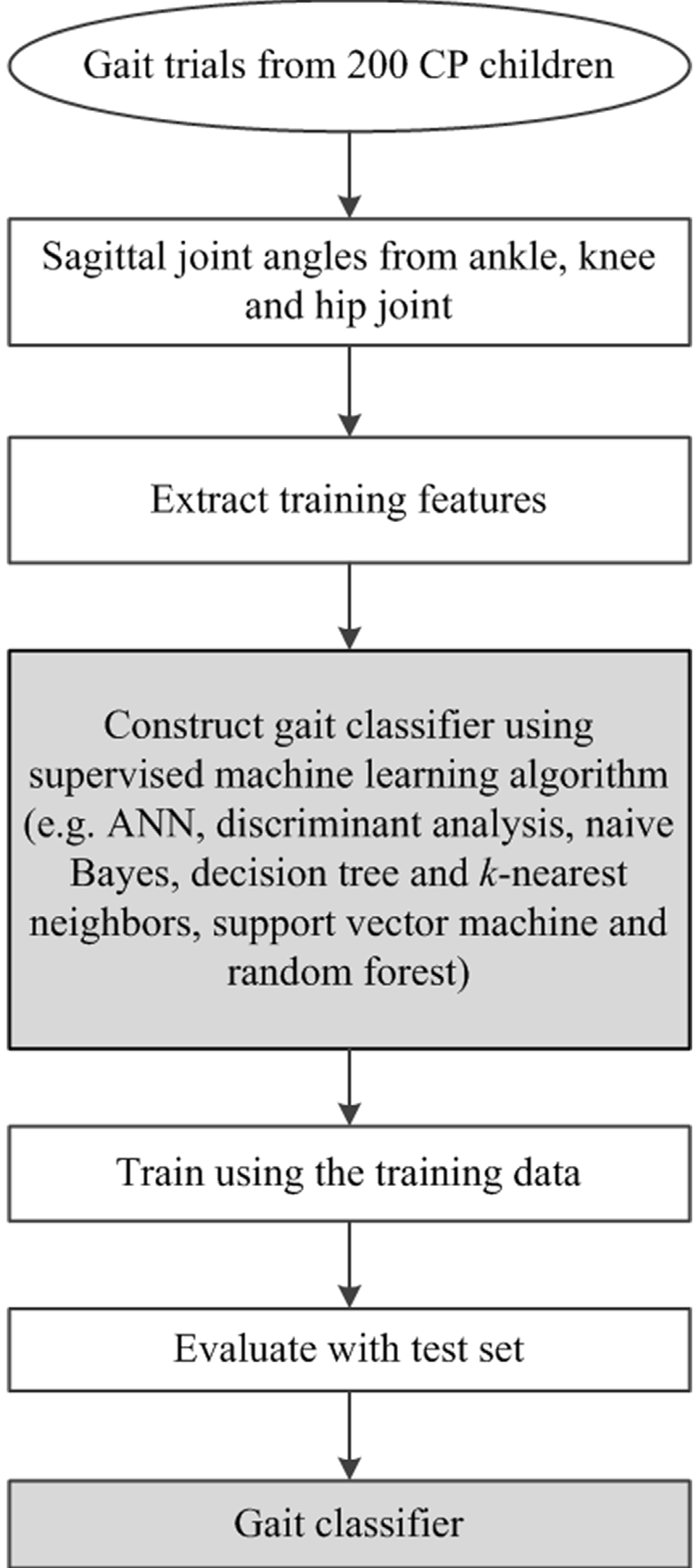
These features served as inputs for seven distinct algorithms:
- ANN (Multi-layer Perceptron): High-capacity non-linear modeling.
- Decision Tree (CART): Transparent, rule-based logic.
- SVM & Random Forest: Robust classifiers for high-dimensional data.
- KNN, Naive Bayes, Discriminant Analysis: Baseline statistical benchmarks.
Results: Performance vs. Interpretability
The results revealed a classic trade-off in AI: the "Black Box" vs. the "Glass Box."
1. The Performance Leader: ANN
The ANN was the clear winner in raw metrics. With an accuracy of 93.5% and an AUC (Area Under Curve) nearly approaching 1.0 for most classes, it proved that the complex, non-linear interactions of joint angles are best captured by neural layers.
2. The Clinical Winner: Decision Tree
While slightly less accurate (84.3%), the Decision Tree provided something an ANN cannot: vivid transparency.
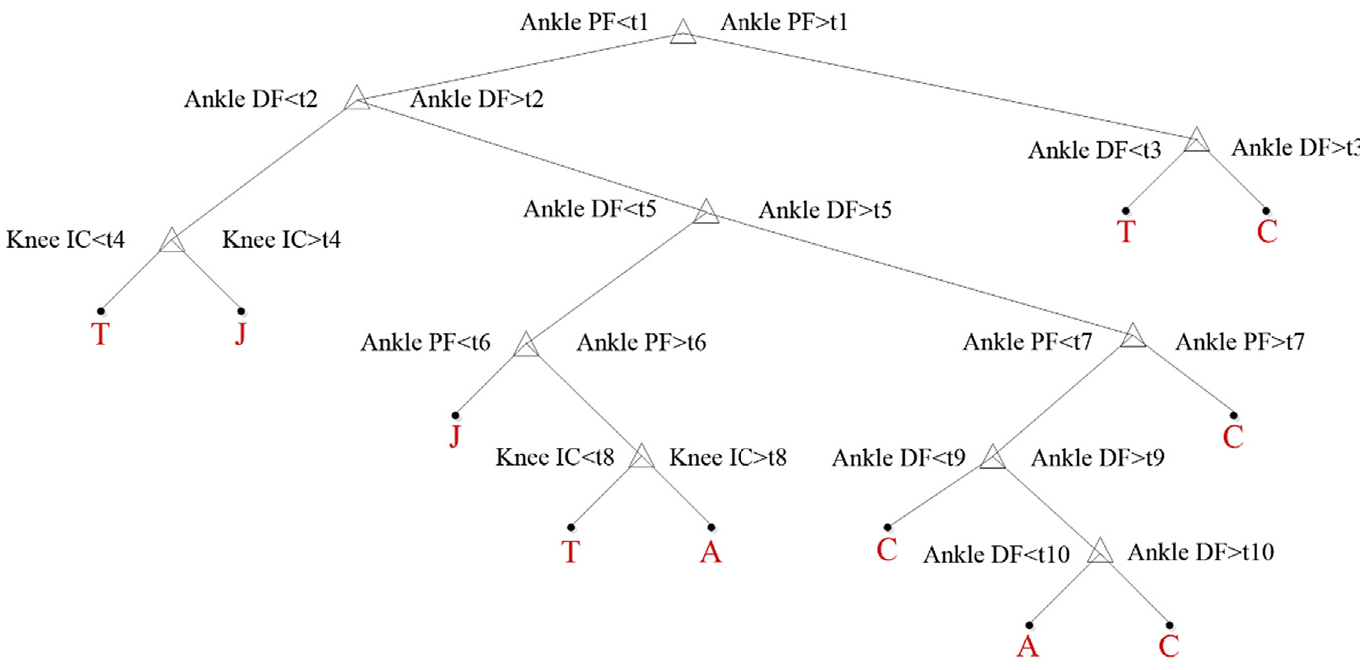
As shown in the logic flow above, the algorithm prioritized Ankle Plantar Flexion (PF) and Dorsiflexion (DF) as the most significant nodes. This confirms the clinical intuition that the "foot-ground relationship" is the primary driver of gait pathology in CP.
Comparison Table
| Algorithm | Predictive Accuracy | Resubstitution Error |
|---|---|---|
| ANN | 93.5% | 5.8% |
| SVM | 85.0% | 5.7% |
| Decision Tree | 84.3% | 5.7% |
| KNN | 77.9% | 0.0% |
Deep Insight: Why ANN Won
The ANN’s superiority stems from its ability to detect latent interactions. Pathological gait isn't defined by one joint in isolation; it’s the relationship between the ankle's equinus and the knee's flexion throughout the stance phase. The MLP (Multi-layer Perceptron) architecture effectively mapped these coupled joint dynamics where simpler models like Naive Bayes failed due to their "feature independence" assumptions.
Future Outlook and Limitations
Despite the high accuracy, the study acknowledges a reality of clinical data: Overlapping Boundaries. Human movement exists on a spectrum, and the "True Equinus" of one child might lean toward "Jump Gait" in another.
The next frontier for this research is the integration of these models into portable, sensor-based systems. By moving gait analysis from the high-end Vicon lab to wearable IMU sensors, this AI-driven diagnostic capability could reach rural or underserved areas, providing high-quality rehabilitation assessment to children who need it most.
Conclusion
This work signals a shift toward Expert Systems in physical therapy. By combining the raw power of ANNs with the interpretability of Decision Trees, we can create tools that not only provide a diagnosis but also explain the biomechanical why behind it.