
Beyond Signatures: Representing Malware Knowledge Through Ontologies and Data Mining
Computers & Security
This paper proposes an ontology-based knowledge representation framework for malware individuals and families. It utilizes the Apriori data mining algorithm to extract common behavioral patterns, achieving a malware family classification accuracy of 96.0%.
TL;DR
Researchers from the Harbin Institute of Technology have developed a system that moves malware detection from "matching black-list strings" to "understanding behavioral intent." By building a formal Ontology and using the Apriori algorithm, they can automatically identify the fingerprint of a malware family based on its actions, achieving a high classification accuracy of 96.0%.
Background: The Semantic Gap in Cybersecurity
The core problem in modern antivirus technology is the Semantic Gap. Traditional signatures are brittle; a single byte change can bypass a detector. While behavioral analysis (looking at API calls) is better, it often produces unstructured logs that humans struggle to parse and machines can't easily correlate. This paper argues that we need a Knowledge Base—a structured way to represent what malware is and what it does.
Methodology: Building the Malware Brain
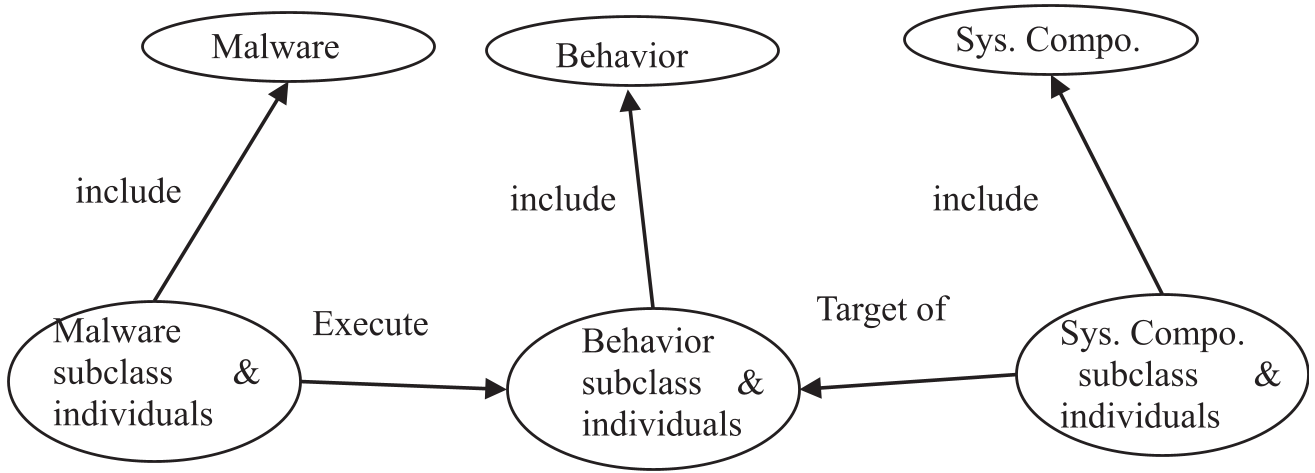
The authors break down the malware universe into three fundamental pillars:
- Concept Classes: Defining the hierarchy of malware (Worms, Trojans, etc.) and system components (Files, Registry Keys, Network Protocols).
- Object Properties (Behaviors): Representing actions as semantic triples. For example,
[Malware_A] -> [Read] -> [Registry_Key_B]. - Knowledge Mining (Apriori): Instead of manually writing rules, the system looks at hundreds of samples from the same family (e.g., Agobot) and identifies frequent sets of behaviors that always appear together.
Moving from Individuals to Families
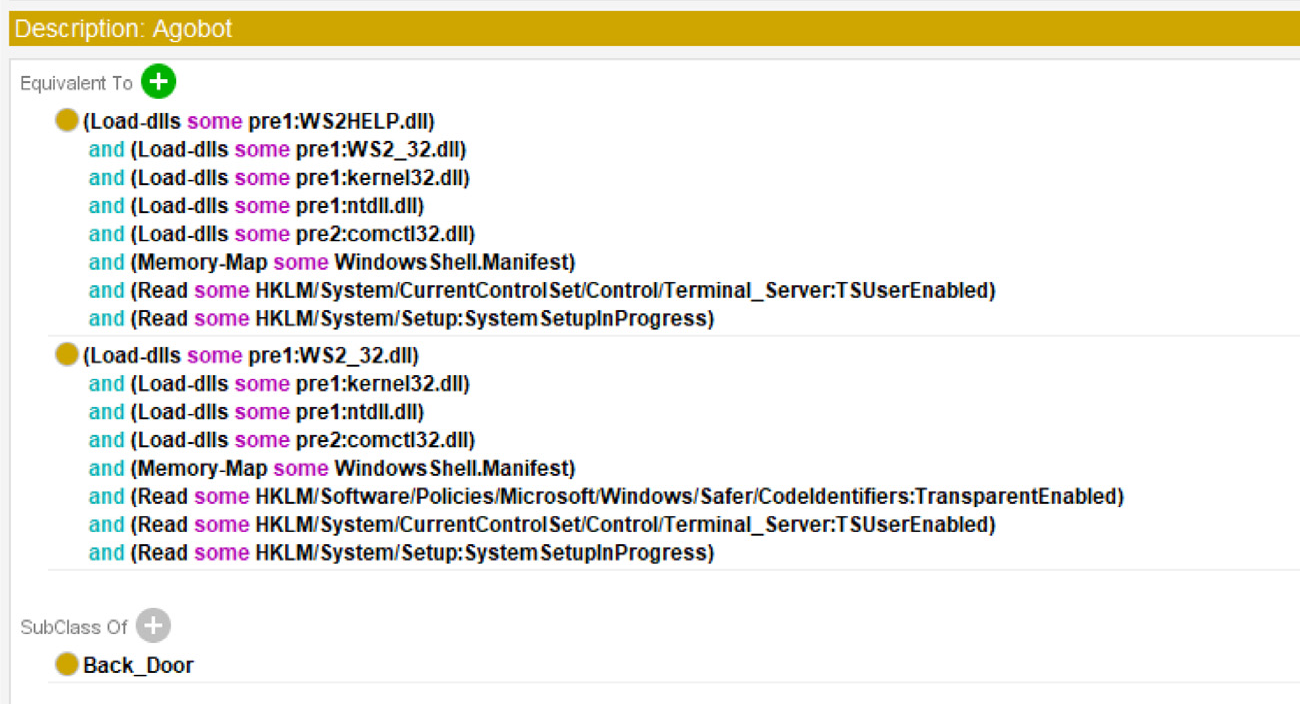
A single malware individual is just a collection of behaviors. A Family, however, is defined by its EquivalentClass. If an unknown sample performs a specific set of actions identified by the Apriori algorithm, the Jena reasoning engine can automatically infer its family membership.
Experimental Validation
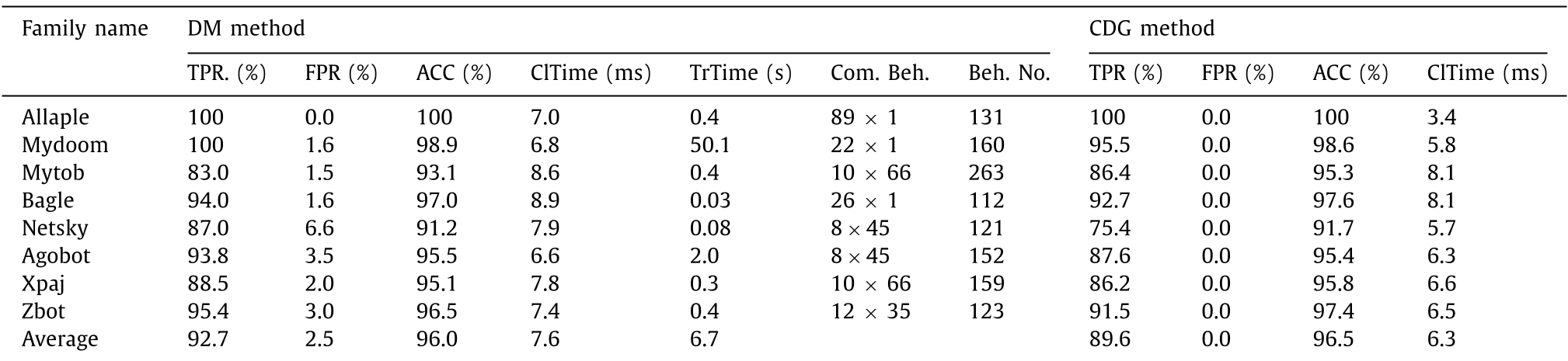
The authors tested their framework against 8 prominent malware families, including Allaple, Mydoom, and Zbot. They compared their Data Mining (DM) approach against the Behavioral Dependency Graph (CDG) method.
| Method | Avg TPR (%) | Avg FPR (%) | Avg Accuracy (%) |
|---|---|---|---|
| This Paper (DM) | 92.7% | 2.5% | 96.0% |
| Graph-based (CDG) | 89.6% | 0.0% | 96.5% |
While the graph-based method has a lower False Positive Rate (FPR), the Ontology method is highly effective at identifying the "intent" of malware and provides a much richer knowledge structure for human analysts to explore.
Critical Insight: Coarse-Grained vs. Fine-Grained
A key takeaway from the study is the trade-off in granularity. The authors used "system behaviors" (coarse-grained) rather than "API sequences" (fine-grained).
- Pro: It makes the knowledge base more readable and the reasoning faster.
- Con: It leads to a slightly higher False Positive Rate (2.5%) because some benign programs might perform similar high-level tasks (like reading a specific registry key) as malicious ones.
Conclusion & Future Outlook
This work transforms malware analysis from a reactive game of "cat and mouse" into a proactive field of Knowledge Engineering. By formalizing malware behavior, security teams can create shared intelligence that machines can reason about autonomously. Future work aims to refine these ontologies to include more complex infection vectors and improve the efficiency of the mining algorithms to handle the massive influx of daily malware variants.
Takeaway for the Industry: Ontologies are not just for the Semantic Web; they are a powerful tool for structuring the chaos of cyber threats into actionable, machine-readable intelligence.