
Computing Beyond Gender-Imposed Limits: Why Social Norms are the Ultimate System Constraint
Computing beyond gender-imposed limits
This paper explores "gender-imposed limits" in computing, focusing on marginalized communities in Bangladesh. It identifies gaps in user research, design, deployment, and usage, proposing a feminist-technical framework to achieve greater equity in Information and Communication Technologies and Development (ICTD).
TL;DR
Technology is never neutral; it is bounded by the social fabric into which it is woven. This paper argues that gender inequality acts as a fundamental "limit" on computing, similar to resource scarcity. By analyzing the tech landscape in Bangladesh, the authors show that without addressing patriarchal power dynamics, even the most well-intended "pro-women" apps can inadvertently cause harm or reinforce marginalization.
Background: The Invisible Boundaries of Innovation
In the world of ICTD (Information and Communication Technologies and Development), we often talk about bandwidth, power, or hardware limits. However, Syed Ishtiaque Ahmed and his colleagues argue that gender is a structural limit that dictates who can design, who can use, and who can even speak about technology. In Bangladesh, despite the "Digital Bangladesh" initiative, women remain largely invisible in the high-stakes world of digital production and repair.
The "Silence" in User Research
One of the paper's most profound insights is the Methodology of Silence. During the development of Protibadi (an anti-harassment platform), researchers found that:
- Many women were uncomfortable voicing their struggles with strangers.
- Potential participants signed up but never showed up, or asked for their data to be deleted post-interview.
- Traditional user research fails because it cannot design for those who are socially coerced into invisibility.
The authors invoke Gayatri Spivak’s question: "Can the subaltern speak?" In computing, if the subaltern (marginalized women) cannot speak through our research instruments, our designs remain fundamentally lopsided.
Architecture of Exclusion: Case Studies in Design and Repair
The paper highlights a stark divide in both formal and informal technical education.
1. The Fear of Making Mistakes
In university labs, female engineering students reported a higher fear of "breaking things." While male students viewed burning an IC (Integrated Circuit) as a rite of passage, female students felt they would be punished or judged as incompetent, a stressor rooted in childhood conditioning where "machines are for boys."
2. The Invisible Marketplace
The authors conducted an ethnography of the Gulistan Underground Market, a hub for mobile repairs.
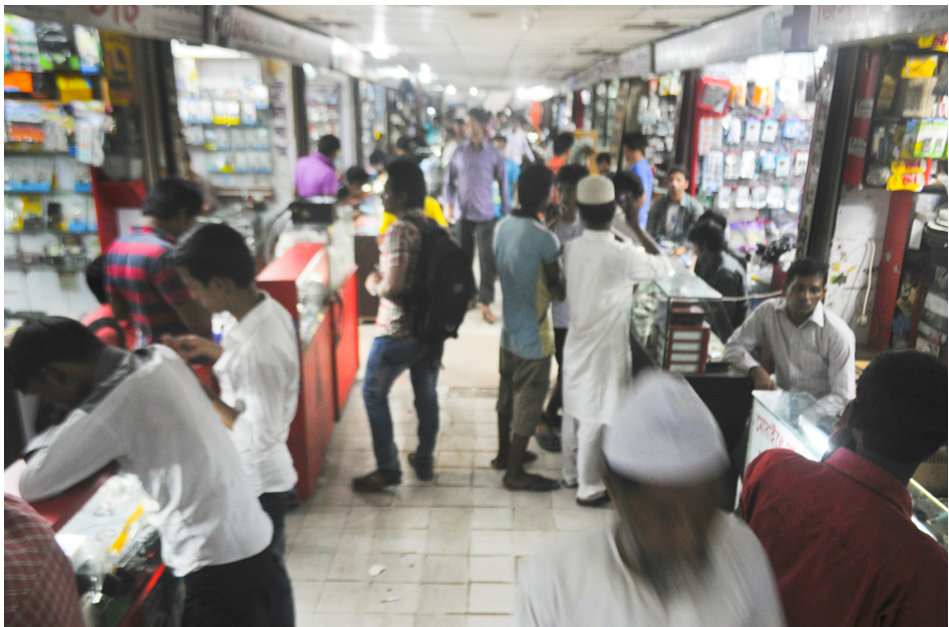 Figure 1: A corridor in Gulistan Underground mobile phone repair market highlights the absolute absence of women in this profession.
In ten different sites, not a single female repairer was found. This absence isn't just about jobs; it’s about the "politics of visibility." Because repair work is hidden "in the back" or underground, it is devalued. Feminist theory suggests that by making these invisible roles visible, we can create a more inclusive and sustainable tech lifecycle.
When Safety Apps Backfire: The Deployment Trap
The study of Protibadi provides a sobering look at how "safety technology" interacts with a conservative society:
- Victim Blaming: Publicly reporting harassment on Facebook led to "backlash" where commenters blamed the victims' clothing or behavior.
- Surveillance: Maps showing harassment hotspots were used by male guardians to further restrict women’s movement, effectively using a safety tool to enforce a "spatial labor division."
 Contextualizing the limits: Images from the field showing the intersection of technology and daily Bangladeshi life.
A Path Forward: Feminist Theoretical Tools
The authors suggest that we must move beyond "Universal Design" and embrace:
- Feminist Reflexivity: Designers must reflect on their own unconscious biases.
- Association: Supporting women-only tech spaces (like "Code it, Girl!") to build technical confidence.
- Valuing Maintenance and Repair: Shifting the focus from "fast innovation" to "slow computing" and repair, which aligns with both feminist values and environmental sustainability.
Final Critical Insight
Sustainability isn't just about using less electricity or recycled plastic. A system is only sustainable if it is equitable. If our computing models continue to exclude or disadvantage half the population based on gender, they are not "innovative"—they are merely reinforcing ancient limits under a modern digital veneer. To compute "beyond limits," we must first dismantle the limits we've imposed on each other.