
Beyond Symmetry: Decoupling In-Coreness and Out-Coreness with MINRES/SVD
Computing continuous core/periphery structures for social relations data with MINRES/SVD
The paper introduces MINRES/SVD, a novel computational framework to model continuous core/periphery structures in asymmetric social networks while handling missing diagonal data. It extends the symmetric MINRES model by incorporating Singular Value Decomposition (SVD) principles, assigning each node distinct "in-coreness" and "out-coreness" scores.
TL;DR
Social and economic networks are rarely two-way streets. While traditional models force a "one-size-fits-all" coreness score on actors, this paper introduces MINRES/SVD, a mathematical framework that allows nodes to have separate in-coreness (popularity/importing) and out-coreness (expansiveness/exporting) scores. By ignoring problematic diagonal data and embracing asymmetry, it provides a far more accurate map of global trade and academic influence.
Background Positioning: Refined Structural Analysis
In the landscape of Social Network Analysis (SNA), the core/periphery model is a staple. It identifies a "core" of highly interconnected elites and a "periphery" of weakly connected outsiders. However, most practitioners use tools (like UCINET's MINRES) that assume if Country A exports to Country B, the relationship is structurally identical to B exporting to A. This paper challenges that inductive bias, arguing that forcing symmetry masks the true mechanics of power and dependency.
The Core Challenge: The Missing Diagonal & Asymmetry
The authors identify two fatal flaws in existing SVD and MINRES approaches:
- The Diagonal Dilemma: In most networks, the diagonal (node to node ) is missing or irrelevant. Standard SVD requires a full matrix, and filling the diagonal with zeros creates "leverage" that distorts the entire model.
- The Symmetry Trap: MINRES assumes , where is a single coreness vector. This is logically insufficient for directed flows like trade or citations.
Methodology: The MINRES/SVD Intuition
The authors propose a "minimum residual" version of SVD. Instead of a single vector , they look for two vectors, and , and a scaling factor :
eq i} (A_{ij} - u_i d v_j)^2$$ This formulation ensures that the **prediction only focuses on the relationships between different nodes**, completely ignoring the diagonal. ### Visualizing Hierarchy 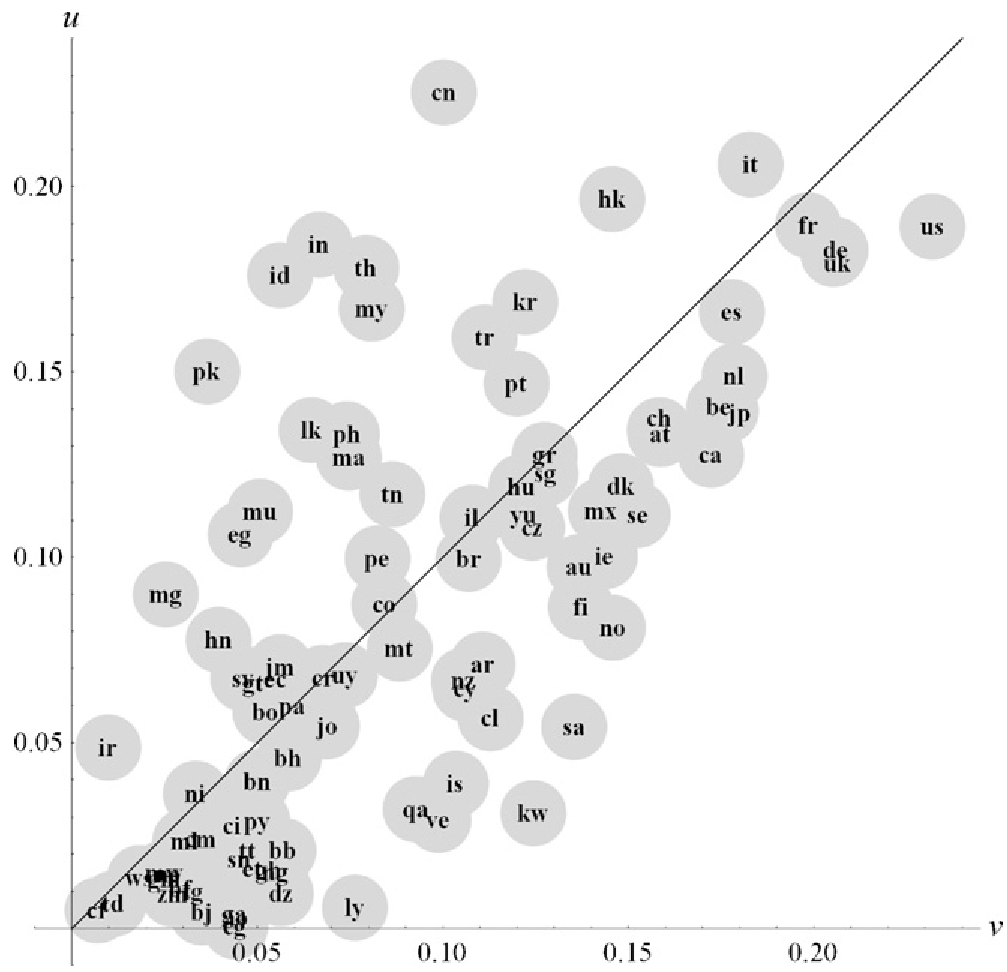 *In the plot above, countries on the 45-degree line have balanced import/export roles. Those above the line (like China in 2000) are export-driven "out-cores," while those below (like the USA) are massive "in-cores" or consumer hubs.* ## Experiments: Global Clothing Trade The authors applied their method to the UN COMMTRADE data for the year 2000, focusing on the garment industry. * **The Findings**: Historically "core" nations (USA, UK, Germany) showed a massive "Import-Coreness" ($v$) but significantly lower "Export-Coreness" ($u$). * **The SOTA Edge**: Traditional symmetric models gave these countries a single high score, missing the fact that their "coreness" is defined by consumption and design, not manufacturing. * **Statistical Rigor**: Using a unique permutation test, they proved that the asymmetric model provides a statistically significant "Proportional Reduction of Error" (PRE) compared to symmetric versions. 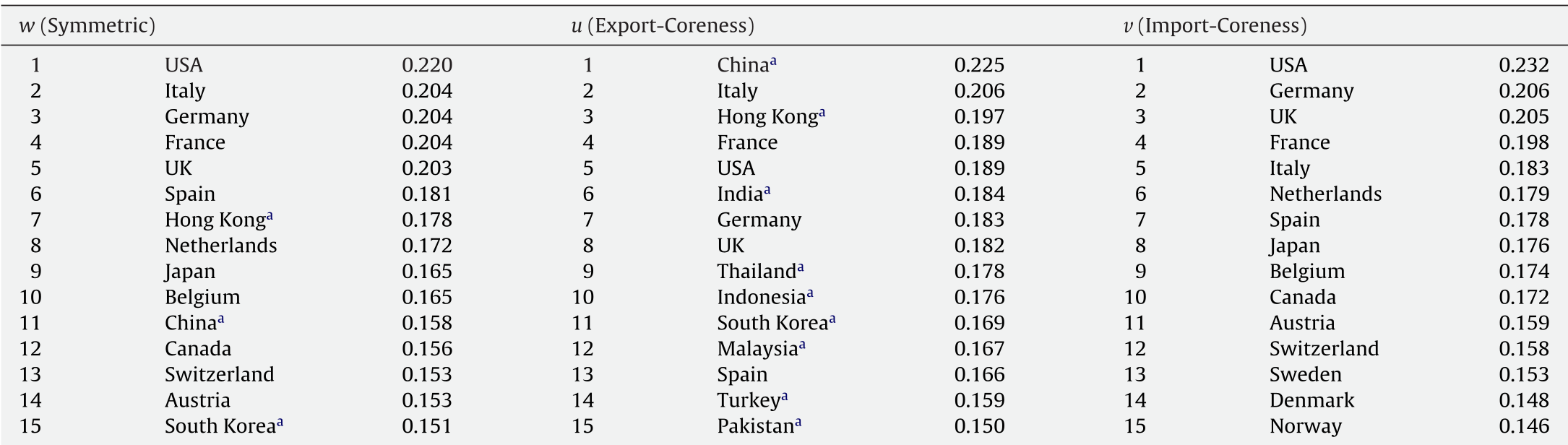 *Table 5 demonstrates the divergence: China ranks #1 in Export-Coreness but drops significantly in Import-Coreness, a nuance lost in symmetric models.* ## Critical Insight: The Imputation Shortcut For researchers dealing with massive datasets where the iterative MINRES/SVD might be slow, the authors provide a "Goldilocks" solution for diagonal imputation: $$A_{kk} = \frac{r_k c_k}{s + s/n - r_k - c_k}$$ This formula estimates what the diagonal *should* be based on row and column marginals, allowing standard, hyper-fast SVD algorithms to be used without the "zero-diagonal" bias. ## Conclusion & Future Outlook The paper successfully bridges the gap between pure linear algebra (SVD) and sociological intuition (Core/Periphery). By acknowledging that "popularity" (being cited/imported from) and "activity" (citing/exporting) are two different structural dimensions, MINRES/SVD offers a more granular lens for World Systems Theory. **Takeaway for Practitioners**: If your data is directed, stop symmetrizing it. The "cost" of using an asymmetric model is low, but the gain in structural insight—as shown in the gap between the US and China's trade roles—is immense.