
Computing Emotion Awareness: Beyond the Surface of Facial EMG
Computing Emotion Awareness Through Facial Electromyography
This paper presents a framework for "Emotional Awareness" in Human-Computer Interaction (HCI) using facial Electromyography (fEMG). By analyzing six statistical parameters—specifically mean, absolute deviation, standard deviation, variance, skewness, and kurtosis—across three muscle groups, the authors demonstrate that physiological signals can classify emotional states into four categories: negative, positive, mixed, and neutral.
TL;DR
Researchers have developed a method to grant computers "emotional awareness" by tapping into the subtle electrical signals of facial muscles. By analyzing 120-second windows of EMG data from the forehead and cheeks, the system can distinguish between positive, negative, mixed, and neutral emotional states. The breakthrough lies in using higher-order statistics like Skewness and Kurtosis, which capture the "shape" of an emotional response rather than just its intensity.
The "Coldhearted" Computer Problem
In current Human-Computer Interaction (HCI), systems are remarkably insensitive. When a user is frustrated by a slow connection or a hidden feature, the computer remains oblivious. To bridge this "empathy gap," affective computing seeks to sense and respond to user emotions.
The authors point out two critical limitations in existing research:
- The Complexity of Mixed Emotions: Purely bipolar models (Positive vs. Negative) fail when a user feels "happy to see a relative but sad about their health."
- Signal Noise and Obtrusiveness: While computer vision is common, it is often unreliable in low light. Physiological signals (like heart rate) offer a direct window into the Autonomic Nervous System (ANS), yet they are often processed too simplistically.
Methodology: The Geometry of a Frown
The study focused on three primary facial muscles:
- Corrugator Supercilii (EMG2): The muscle responsible for frowning (associated with negative valence).
- Zygomaticus Major (EMG3): The "smiling" muscle (associated with positive valence).
- Frontalis (EMG1): The forehead muscle used in surprise or concentration.
Instead of just looking at the average "volume" of these signals, the researchers analyzed the distribution. Specifically, they applied Skewness—which measures the asymmetry of the muscle activity—and Kurtosis—which measures how "spiky" the activity bursts are.
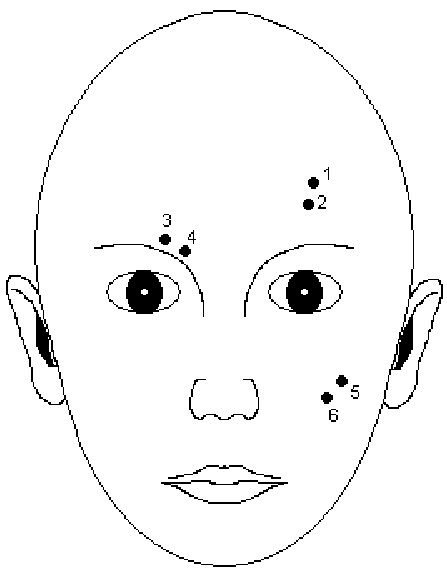 Figure 1: Traditional placement of electrodes for frontalis, corrugator supercilii, and zygomaticus major.
Experimental Insights
Participants watched 16 film fragments designed to elicit specific emotions. The researchers categorization (Neutral, Mixed, Positive, Negative) was then mapped against the EMG data.
Key Findings:
- The Zygomaticus "Powerhouse": The zygomaticus major (smiling muscle) proved to be the most reliable indicator of emotional shifts. Its variance and standard deviation were significantly higher for emotional stimuli compared to neutral bars.
- Skewness as a Secret Weapon: Skewness in the corrugator supercilii was able to discriminate across all four categories. A positive skewness signifies an asymmetric tail in muscle activity, providing a fingerprint for specific emotional intensities.
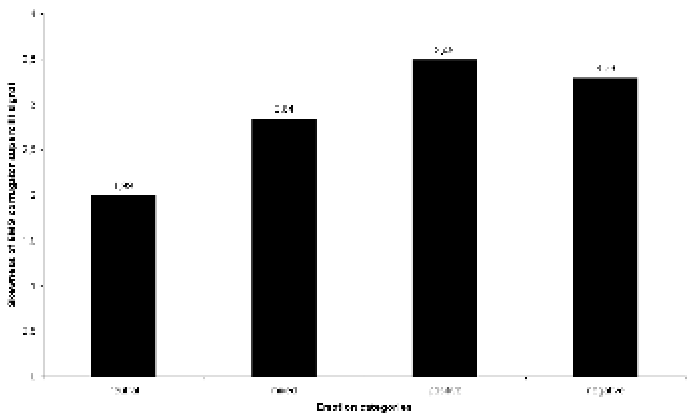 Figure 2: Statistical distributions showing the discriminative power of Zygomaticus and Corrugator parameters (a-d).
Critical Analysis: Why This Matters
The most impressive aspect of this work is its success despite coarse time windows. Analyzing 120 seconds of data is "slow" in the world of signal processing, yet the statistical parameters (like Skewness) remained robust. This suggests that the statistical signature of an emotion is more persistent than the peak intensity itself.
However, the study has its limitations:
- The Arousal vs. Valence Ambiguity: The authors noted that higher variance in the zygomaticus might be driven by "arousal" (intensity) rather than just "valence" (positivity).
- Environmental Noise: While effective in a lab with 42" screens, real-world application requires embedding these into Affective Wearables (like the "expression glasses" mentioned in section 4).
Conclusion
This research moves us one step closer to "Ambient Intelligence"—environments that are aware, natural, and adaptive. By moving beyond "average intensity" and looking at the statistical distribution of our facial muscle movements, scientists are providing computers with the "emotional vocabulary" needed to turn "coldhearted" machines into empathetic partners.
Takeaway for the Future: Expect future wearable tech to monitor not just what you are looking at, but how your micro-expressions are statistically distributed, allowing for a personalized interface that adapts before you even realize you're frustrated.