
Geometric Deformation: A New Frontier in Robust Invariant Set Computation
Computing robust forward invariant sets of multidimensional nonlinear systems via geometric deformation of polytopes
This paper presents a geometric algorithm to compute sequences of polytopic Robust Forward Invariant Sets (RFIS) for multidimensional Lipschitz continuous non-linear systems. The method utilizes a novel "BCD_Test" based on finite test points and surface deformations via homeomorphisms to approximate maximal and minimal invariant sets under bounded additive disturbances.
TL;DR
Determining safe operating regions (Robust Forward Invariant Sets) for non-linear systems is a classic control theory headache. This paper introduces an algorithm that treats a safe boundary like "digital clay," using geometric homeomorphisms and a finite set of lattice test points to deform polytopes into high-precision safety zones for any Lipschitz continuous system.
Background: The Safety Set Dilemma
In control systems, a Robust Forward Invariant Set (RFIS) is the "Holy Grail" of safety: if a system starts inside this set, it stays there forever, regardless of noise or disturbances. However, calculating these sets for non-linear systems usually requires complex optimization (like Sum-of-Squares) that only works for polynomials.
The authors identify a key gap: Algebraic formulations are too rigid. They move the problem into the realm of Computational Topology, asking: Can we simply "stretch" a standard shape until its surface perfectly counteracts the system's push?
The Core Insight: From Infinite to Finite
The mathematical barrier to geometric methods is the Sub-tangentiality condition. To prove a set is invariant, you must show the system's "flow" never points outward at any point on the boundary. Since a boundary has infinite points, this is usually impossible to check.
The authors solve this by proving a Lipschitz-weighted tolerance. By checking a specific lattice of points on a triangle (simplex) and ensuring the "flow" points inward by at least a safety margin proportional to the system's Lipschitz constant and the triangle's size, they guarantee the entire surface is safe.
Methodology: Sculpting the Polytope
The algorithm follows a two-step "Sculpt & Refine" process:
- Vertex Perturbation: It picks a corner (vertex) of the polytope and moves it along a ray.
- Homeomorphism Guard: Using simplicial maps, it ensures the deformation doesn't "break" the shape (no self-intersections), maintaining a valid topological manifold.
- Barycentric Subdivision: When the shape can't be stretched further, the algorithm "splits" the triangles into smaller ones, allowing for finer geometric detail (like increasing the polygon count in a 3D model).
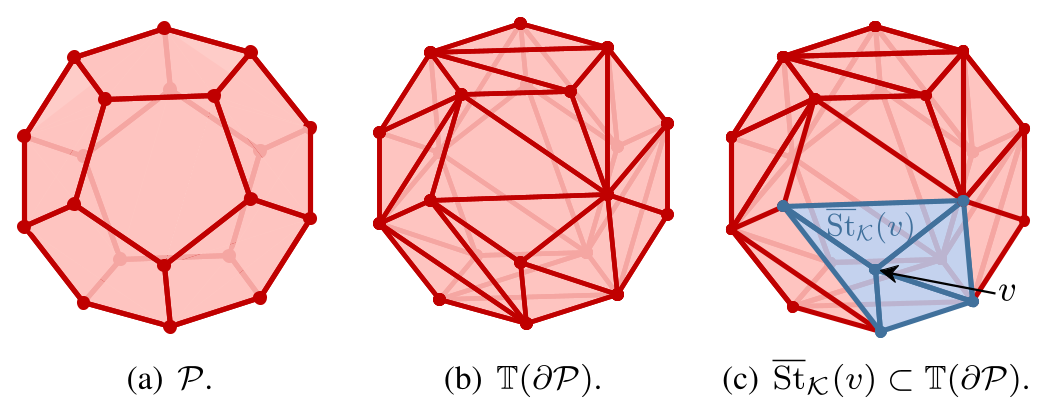 Figure 1: The process of triangulating the boundary and preparing for geometric deformation.
Experimental Proof: Shaking Off Conservatism
The most striking result is found in the Phytoplankton Growth Model. Previous algebraic methods provided a very "loose" safety set (conservative). The proposed algorithm "vacuum-sealed" this set, reducing the volume to a fraction of its original size while remaining robust to noise.
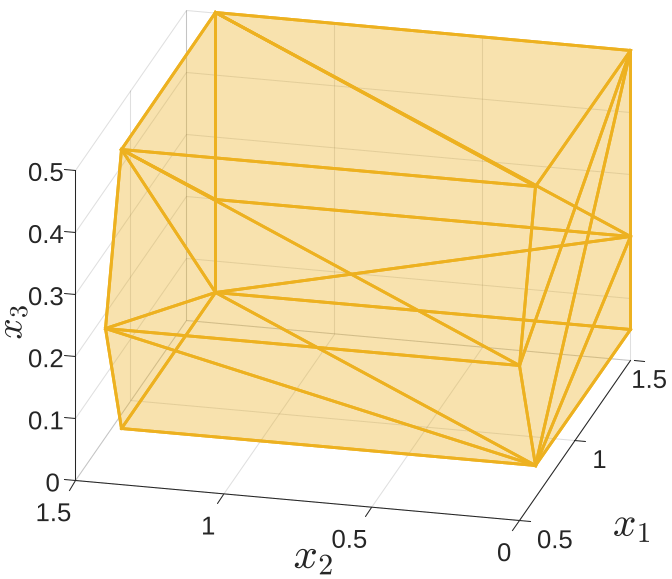 Figure 2: Evolution from a conservative initial set (blue) to a tight, high-precision RFIS (grey) via iterative deformation.
Computational Efficiency
As shown in the table below, the computation time scales with the number of subdivisions, but even complex 3D attractors like the Thomas' Attractor reach convergence within minutes on standard hardware.

Critical Insight & Conclusion
This paper represents a significant shift from symbolic manipulation to geometric computation. By leveraging the Lipschitz continuity of physical systems, the authors bypass the need for polynomial approximations entirely.
Limitations: The method currently relies on a known Lipschitz constant, which can be difficult to estimate accurately for "black-box" systems. Furthermore, while the algorithm works for N-dimensions, the number of simplices in a triangulation grows rapidly, potentially hitting a "computational wall" in high-dimensional state spaces (e.g., > 10D).
Future Outlook: Integrating this geometric "sculpting" with machine learning—where a neural network predicts the optimal vertex moves—could lead to real-time safety set generation for autonomous robots and drones.